

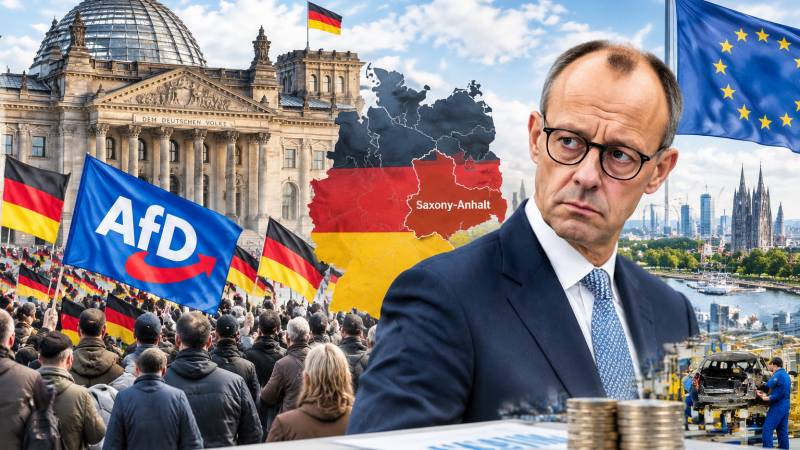
For decades, Germany appeared to possess something that many European democracies had gradually lost: a political center strong enough to absorb almost any shock. Governments changed, coalitions shifted, chancellors came and went, and arguments over taxation, migration, Europe and social policy could become fierce. Yet underneath these disputes stood a remarkably durable consensus about the Federal Republic itself. Political competition took place largely within its boundaries. That assumption was shaken on 6 September 2026, when the Alternative for Germany (Deutsche) won almost 44 per cent of the vote in Saxony-Anhalt and captured 39 of the state parliament’s 83 seats. Chancellor Friedrich Merz’s Christian Democrats were left at roughly 17 per cent. A state of barely 2.1 million people had produced a political earthquake with implications extending far beyond Magdeburg.
The result looks even more consequential when placed on a timeline. The AfD is not an ancient feature of German politics. It was founded only in 2013, initially as a Eurosceptic movement focused largely on opposition to eurozone bailouts. In the federal election of that year, it secured 4.7 per cent of the vote, narrowly missing the threshold for entering parliament. By the 24 September 2017 federal election, however, the party had changed both its political language and its constituency. The refugee crisis had placed migration and national identity at the center of German politics, and the AfD entered the Bundestag with 12.6 per cent of the second vote and 94 seats. What had begun as a rebellion against European monetary policy had become a broader revolt against the political establishment.
The transformation accelerated. On 1 September 2024, the AfD won 32.8 per cent of the party-list vote in Thuringia, finishing first in a state election for the first time. Other parties combined to keep it away from government, but an important psychological barrier had already fallen: the AfD had demonstrated that it could become the largest political force in an entire German state. Then came the 23 February 2025 federal election. The AfD secured 20.8 per cent, exactly double its 2021 share of 10.4 per cent, and emerged as the second-strongest party nationally. Turnout was an unusually high 82.5 per cent, making it difficult to dismiss the result as a protest generated by political apathy.
Friedrich Merz became chancellor on 6 May 2025, heading a coalition between the CDU/CSU and the Social Democrats. Even his arrival in office contained a warning about Germany’s new political fragility: he unexpectedly failed to secure enough votes in the first Bundestag ballot and was elected only in a second round later that day. Merz had nevertheless come to power with a clear political proposition. Germany needed economic reform, stronger defence, stricter migration policy and more assertive leadership in Europe. A rejuvenated center-right, he believed, could also recover conservative voters who had drifted towards the AfD. Sixteen months later, Saxony-Anhalt delivered the opposite verdict. Instead of shrinking, the AfD had recorded its greatest state-election victory.
For the first time in decades, the question facing Germany is no longer merely who will govern within the postwar consensus. It is whether that consensus itself can survive a political generation increasingly willing to vote outside it.
That is what makes the September result so damaging to Merz. It challenges not merely one election strategy but the theory on which his chancellorship partly rests. He has responded by refusing to abandon his economic program. Germany, in his view, cannot postpone reform simply because reform is unpopular. The argument has considerable economic logic. Europe’s largest economy has spent several years confronting weak growth, expensive energy, ageing infrastructure, labour shortages, excessive bureaucracy and intense competition from China. The automobile industry, once a symbol of almost effortless German industrial dominance, is undergoing painful restructuring. Energy-intensive industries have struggled after the collapse of the old model built partly on inexpensive Russian gas. Even as the RWI institute recently raised its 2026 growth forecast to 1.3 per cent, it warned that the structural problems of competitiveness, investment and energy costs remained unresolved. Industrial production unexpectedly fell by 1.1 per cent in July. Germany may be recovering, but it has not recovered the economic certainty on which its politics once rested.
Merz therefore confronts a political paradox. Some reforms may indeed be economically necessary, but the people expected to accept them increasingly feel insecure. Pensions illustrate the dilemma. Germany is ageing rapidly. Fewer workers will have to support an expanding retired population, making some combination of higher contributions, later retirement, greater immigration, higher productivity or reduced benefits increasingly difficult to avoid. Yet macroeconomic necessity is experienced very differently at household level. A finance ministry may describe pension reform as sustainability; a worker approaching retirement may hear only that something previously promised is becoming less secure. Merz has acknowledged that reforms must be communicated not merely rationally but emotionally. The difficulty is that the AfD has already become highly effective at supplying the emotional interpretation: ordinary Germans, it argues, are being asked to sacrifice while a distant establishment remains insulated from the consequences. The original Saxony-Anhalt analysis captures precisely this collision between Berlin’s economic reasoning and the voter’s sense of personal insecurity.
Nowhere is that disconnection more politically potent than in the east. More than three decades after reunification, eastern Germany cannot be described simply as an economic failure. Unemployment has fallen enormously from the catastrophic levels of the 1990s; infrastructure has improved; investment has arrived; and regions once devastated by industrial collapse have developed new sectors. But statistics do not erase memory. Saxony-Anhalt has lost roughly a quarter of its population since reunification. Many communities remember factories closing, younger residents leaving, western managers assuming control of institutions and careers losing their social value almost overnight. Household wealth in eastern Germany remains substantially below western levels. The question for many eastern voters is therefore no longer whether life has improved since 1990. It is whether they have ever become fully equal participants in the political and economic settlement created after reunification.
This is why reducing the AfD phenomenon to immigration alone explains too little. Migration is unquestionably central to the party’s appeal and program, but it is connected to a larger language of abandonment. The AfD has managed to combine several anxieties that would otherwise appear unrelated: immigration, energy prices, industrial decline, pensions, support for Ukraine, distrust of Brussels, anger at political elites and resentment over cultural change. Its political achievement has been to weave them into one story. According to that story, Germany was safer, more prosperous and more culturally coherent before establishment decisions exposed ordinary citizens to risks, they neither requested nor controlled. Whether that diagnosis withstands economic or historical scrutiny is almost secondary to its political effectiveness. A coherent explanation of decline can be more persuasive than a technically sophisticated program for managing complexity.
There are contradictions within that explanation. Eastern Germany has some of the country’s most serious labour shortages and demographic problems, yet it gives exceptionally strong support to a party committed to sharply restricting immigration. Businesses require workers, particularly as the population ages, but large numbers of voters resist the mechanism through which part of that labour gap might be filled. The AfD criticizes economic policies that have weakened industry while proposing its own disruptive changes to Germany’s European and international relationships. It promises social security while supporting policies that would profoundly alter Germany’s economic model. Opposition allows these contradictions to coexist because they do not yet have to survive the discipline of administration. This is precisely why the possibility of an AfD government in Saxony-Anhalt matters so much: governing would force choices that campaigning does not.
Russia adds another layer to the eastern divide. Merz has placed Germany firmly behind Ukraine, expanded defence commitments and treated Moscow as a strategic threat to European security. The AfD argues for a radically different approach: reduced support for Ukraine, restored ties with Russia and a less confrontational relationship with Moscow. In parts of eastern Germany, that message draws upon a historical experience unfamiliar to many western voters. Memories of life in the former German Democratic Republic, decades of Soviet presence, frustration over the economic effects of sanctions and nostalgia for the era of relatively cheap Russian energy all influence perceptions. Reuters has documented how these different historical experiences have reopened a Russia divide in Saxony-Anhalt. The disagreement is therefore about more than Vladimir Putin or the current war. It reflects two different memories of Germany’s twentieth-century relationship with the east.
The scale of the AfD victory now confronts Germany with its most difficult institutional question. Since the party’s emergence, the mainstream parties have maintained the Brandmauer, or firewall: no coalition or systematic cooperation with the AfD. The principle carries exceptional historical weight in Germany because the Federal Republic constructed much of its postwar political identity around preventing extremist politics from becoming normalized. The AfD organisation in Saxony-Anhalt has itself been classified by the state’s domestic intelligence authorities as a proven right-wing extremist organisation. Merz has again ruled out cooperation. Yet maintaining a firewall becomes politically more complicated when the party outside it receives more than two-fifths of all votes. The barrier may keep the AfD out of executive office. It cannot, by itself, explain to 44 per cent of voters why they should return to the mainstream.
The arithmetic in Magdeburg is therefore more than a mathematical curiosity. The AfD has 39 of 83 seats, three short of the 42 required for a majority. Most established parties continue to reject cooperation, but the five-seat Bündnis Sahra Wagenknecht, or BSW, has indicated greater willingness to engage. The two parties differ sharply in ideology but overlap on criticism of migration policy, support for Ukraine and relations with Russia. If some form of cooperation emerged, Germany could face an AfD-led state government for the first time. If it does not, the other parties must construct a governing arrangement capable of excluding by coalition arithmetic a party that has just won a landslide. Neither outcome is politically comfortable.
An AfD state government would matter because Germany is federal in more than name. The Länder possess substantial authority over policing, schools, culture and administration and participate in federal legislation through the Bundesrat. In Saxony-Anhalt, the party has proposed tougher deportation rules, significant changes to education and cultural policy and a more nationalist approach to questions of identity. State power would therefore give the AfD something it has never possessed: the ability to demonstrate what its politics looks like when translated from rallies and social media into budgets, civil-service decisions, schools and police administration. That could transform German politics in either direction. If an AfD administration appeared competent and economically successful, the party could argue that the Brandmauer had been built around a false assumption that it was incapable of governing. If the administration descended into legal confrontation, economic damage or factionalism, incumbency could expose weaknesses that opposition has concealed. Germany may soon discover that the most important test of the AfD is no longer whether it can win, but whether it can govern.
The first indication of whether Saxony-Anhalt is contagious will come almost immediately. 13 September 2026 brings municipal elections in Lower Saxony. More consequentially, on 20 September, voters go to the polls for the Berlin House of Representatives and the state parliament of Mecklenburg-Western Pomerania. The latter will be watched especially closely because it is another eastern state where the AfD is strong. If the party produces another major breakthrough only two weeks after Saxony-Anhalt, the argument that September 6 was an exceptional regional revolt will become much harder to sustain. If its advance is contained, the centre may gain evidence that local personalities and specifically Saxony-Anhalt conditions magnified the result. Germany’s official electoral calendar then moves to Schleswig-Holstein and Saarland in April 2027, North Rhine-Westphalia later that month, and eventually towards the next federal election scheduled for spring 2029.
The political clock is therefore already running against Merz. He has roughly two and a half years before the scheduled federal contest to demonstrate that reform can produce something voters can feel rather than merely something economists can model. Berlin has opened the fiscal taps through a vast infrastructure program and expanded defence expenditure. The economic outlook has recently improved, but infrastructure spending takes time to become visible and structural reforms frequently impose pain before producing benefits. A bridge rebuilt in three years does not necessarily reassure a household worried about this winter’s energy bill. A defence factory may eventually create employment but does not immediately answer anxiety over pensions. Merz must make an argument that is economically credible and politically tangible at the same time. The AfD needs only to argue that the discomfort proves he has failed.
The result is a contest over time as much as ideology. If growth strengthens through 2027 and 2028, industrial investment returns, migration appears more controlled and public services visibly improve, the center-right may regain voters who currently use the AfD as both protest and alternative. But if reforms become associated with insecurity, if Germany’s industrial restructuring produces further closures, or if the costs of geopolitical confrontation remain high, the AfD enters 2029 with an extraordinarily favorable narrative. Reuters currently cites national polling at about 28 per cent, placing it ahead of its competitors. A party that received 4.7 per cent in 2013, 12.6 per cent in 2017 and 20.8 per cent in 2025 can no longer be treated as a temporary insurgency waiting to collapse.
The AfD has managed to combine several anxieties that would otherwise appear unrelated: immigration, energy prices, industrial decline, pensions, support for Ukraine, distrust of Brussels, anger at political elites and resentment over cultural change.
There is also a European dimension that makes Germany different from other cases of populist advance. France’s National Rally has become a central contender for national power. Italy is governed by a right-wing coalition under Giorgia Meloni. Populist and nationalist movements are established across the continent. Yet Germany carries a particular historical burden, and its economic weight gives its domestic instability continental significance. French officials reacted to the Saxony-Anhalt result with open alarm. A Germany whose political center is preoccupied with containing the AfD is a Germany with less room to lead on Ukraine, European defence, fiscal reform, energy policy and integration. The political consequences of Magdeburg therefore travel quickly to Paris, Warsaw and Brussels.
It would still be wrong to conclude that Germany has suddenly become a far-right country. The constitutional order remains strong. Most parties remain committed to the democratic settlement of the Federal Republic. The AfD’s strength varies substantially between regions, and winning votes is not the same as acquiring executive power. But the opposite reassurance has become equally untenable. Saxony-Anhalt cannot simply be dismissed as an eastern eccentricity. The progression of dates tells its own story: 2013, foundation and 4.7 per cent; 2017, entry into the Bundestag at 12.6 per cent; 2024, first place in Thuringia; February 2025, 20.8 per cent nationally; May 2025, Merz becomes chancellor promising renewal; September 2026, nearly 44 per cent in Saxony-Anhalt; 20 September 2026, two more state elections; 2029, the next federal test. Political movements do not rise indefinitely simply because a graph points upward. But this is no longer a graph that Germany can explain away.
Merz’s deeper challenge is consequently not to imitate the AfD, nor simply to defeat it electorally. It is to rebuild confidence in the political settlement from which the AfD draws its rejection. Moving further right on migration has not so far stopped the party’s advance. Moral warnings about extremism have not persuaded enough of its voters to return. Economic statistics alone cannot resolve feelings of status loss. And the Brandmauer, however defensible as an institutional principle, is a containment mechanism rather than a strategy for political persuasion. Germany must simultaneously reform an ageing economy, protect citizens from the insecurity created by that reform, manage migration in a way the public considers credible, maintain support for European security and persuade eastern voters that reunification is not a project in which they remain permanent junior partners.
That is why the election of 6 September 2026 may eventually matter for reasons larger than the identity of Saxony-Anhalt’s next premier. It has exposed the fragility of an assumption on which postwar Germany depended: that the political center would reproduce itself because most voters ultimately regarded it as the safest home. The center has not collapsed, but it is no longer self-sustaining. It will have to earn again the legitimacy it once inherited.
The coming weeks will show whether the shock travels beyond Saxony-Anhalt. The coming years will answer the harder question. Merz believes Germany must change in order to preserve the future. The AfD argues that Germany must overturn much of the existing political order in order to recover something it has lost. Between those propositions lies a struggle not simply over immigration, pensions, Russia or economic reform, but over what the Federal Republic is becoming. For the first time in decades, the question facing Germany is no longer merely who will govern within the postwar consensus. It is whether that consensus itself can survive a political generation increasingly willing to vote outside it.