

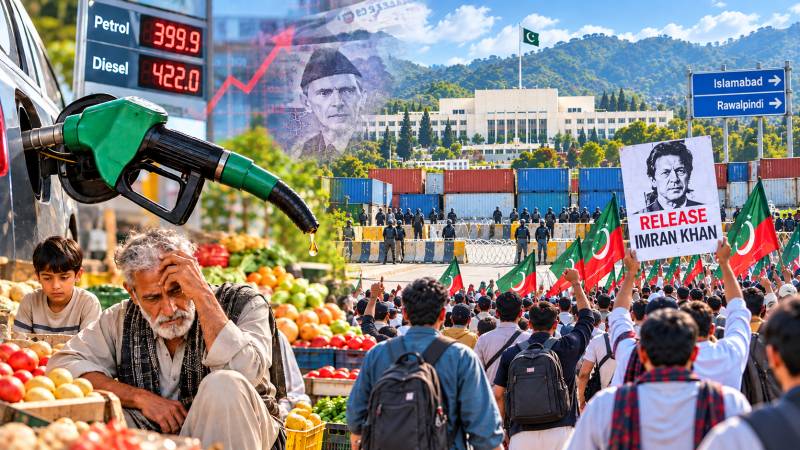
Expressing over confidence despite back to back call for march to Islamabad, the government proceeded with daily increase in the prices of petrol and diesel. The price of petrol has reached almost Rs. 400 and diesel is Rs. 422 per liter. The protest march of Jamaat-e-Islami against petroleum levy and price escalation of petroleum products failed to exert any pressure on the government. Likewise, those wielding power are over reacting to PTI’s protest march on Islamabad for the release of founding Chairman Imran Khan and surge in prices of essential commodities but is not reluctant to use excessive force by ordering large-scale arrests and deployment of hundreds of containers in Rawalpindi and Islamabad to prevent PTI long march and protest.
If power elites are devoid of strategic prudence and care less for the well-being of 250 million people of Pakistan it means those who are living in their comfort zones lack the wisdom to redeem the consequences of their over confidence in dealing with colossal economic challenges. The protests and demonstrations of Jamaat-i-Islami against escalation of petroleum products and subsequent price hike also didn’t impact on the government. It is futile to expect PML(N), PPP and MQM to raise their voice against how criminal handling of escalation of petroleum prices is being done. Since February this year there has been 150% increase in the price of petroleum products whereas in Bangladesh and India that hike is 20-40% respectively.
As of September 22, 2026, price of crude oil has fallen below 100 dollars a barrel but the government is in no mood to reduce the prices of oil and diesel. Nowhere in the world, prices of oil and diesel are reviewed on daily basis but that is being done in Pakistan because authorities neither feel accountable nor concerned about the implications of periodic hike in the prices of petroleum products. They are more interested in extracting more and more money from people in order to sustain their lavish life style and pay interest on foreign and domestic loans. They quote IMF that it has asked for increase in petroleum, gas and electricity prices while IMF is not asking the government to reduce government expenditures. Now according to the reports, the government is trying to get a bailout package of 10 billion dollars from the U.S but will Washington oblige and on what terms particularly when American President Donald Trump has marginalized its interest in the top power wielders of Pakistan.
There is always light at the end of the tunnel: 250 million people of Pakistan cannot be dictated by force, and the assertion of youth under capable leadership can potentially reshape the country.
Everyone knows that when there is rise in the price of oil, diesel, electricity and gas the cost of essential products including transport also increase. Not only the prices of daily use like vegetables, fruits, meat, milk, flour and cooking oil have reached beyond their capacity but the lower class has been pushed before the wall and the middle class is also reaching poverty level. Is there any realization on the part of those who matter that their negligence and indifference in preventing surge of prices of essential commodities will not only augment anger, antagonism and frustration among the people but will also compel Gen Z which comprise 65% of Pakistan’s population to take to streets. It is argued by concerned circles that if the elites fail to deal with escalation in economic predicament of lower and middle classes then the islands of prosperity of those who possess enormous wealth will cease to exist. Those having their overseas wealth and properties will try to escape from predictable turmoil but most of them will not be able to reach their safe destinations.
Armed with 26th and 27th amendments which provide them enough confidence to crush any popular uprising, military establishment and their junior civilian partners believe that when judiciary has been tamed, media neutralized, civil society weakened, coalition partners lack wisdom and capability to salvage democracy, voices of dissent which are getting an impetus because of surge in economic challenges will be crushed. But, for how long those who wield power can use force or show of force depends on the emergence of leadership in civil society, lawyers, media and the youths of Pakistan to take the risk of launching a fierce movement against the status quo. Wrong priorities of power elites by focusing on external issues like Iran-U.S conflict while undermining domestic challenges will lead to a dangerous situation. If Jamaat has compromised by delaying its long march will other opposition parties particularly PTI relegate and postpone their movement?
If strategic prudence to deal with prevailing economic crisis along with political schism, bad governance and absence of rule of law is not being expressed by those wielding power it means the vast majority of people will be mobilized under charismatic leadership which will not be crushed by those who have crossed all limit and are over confidence. One needs to examine the ramifications of lack of strategic prudence to deal with prevailing crises from three angles. First, when the situation is ripe for a political movement but there is no mobilization of popular forces in that case a single spark can act as a catalyst and change the situation. Will the military use force in Punjab if there is a popular agitation led by PTI and other opposition parties? Will the military kill its own people if it confronts worse than May 9, 2023 situation?
One needs to revert to April 1977 when military was called in Karachi and Lahore to enforce law and order against protests and demonstrations against alleged rigging in March 1977 general elections. Force was used in Karachi but the army refused to fire its own people in Lahore which led to the resignation of couple of army officers. But, one needs to understand that unlike 1977 in 2026 those holding power in the last few years have used colossal force in Punjab against PTI workers, supporters and leaders. It is yet to be seen that in 2026 how much the military can take the risk of firing its own people in Punjab. Baluchistan, KPK and Sindh don’t matter and the three provinces have suffered a lot at the hands of Punjab dominated military and civilian bureaucracy. Second, it seems that strategic prudence which was lacking in ruling power elites in the past is gradually giving way to a degree of wisdom and reasoning. Voices of reason particularly in Punjab dominated military establishment to prevent bloodshed emanating from a civil war like situation is a perceived reality. Will change and transformation in the wielders of power lead to a positive change by allowing dissent and pursuing an even handed approach by giving space to opposition parties, particularly PTI which has substantial vote bank needs to be seen.
By sealing Islamabad and Rawalpindi from rest of the country will not help manage crisis which is of a critical nature. It is not only economic cost of sealing the capital which matters but the image of the country will also go down the drain. If there is some brainstorming going on in circles representing military establishment to avoid a civil war like situation it would mean prevalence of sanity and strategic prudence. Finally, the coalition government because of its mismanagement of economic, political and governance issues has thoroughly exposed its position. If the survival of country matters and those who have made the lives of people miserable by raising the prices of oil, diesel, gas and electricity on regular basis are marginalized because of popular assertion, the result will be change in status quo.
Currently it looks gloomy and grim to perceive the taming of judiciary, media and civil society but there is always light at the end of the tunnel. One can expect positive change in Pakistan in 2026 because 250 million people of Pakistan cannot be dictated by force and the assertion of youth under a charismatic and capable leadership will certainly change the country for the better by establishing rule of law, good governance, adherence to merit and accountability.