

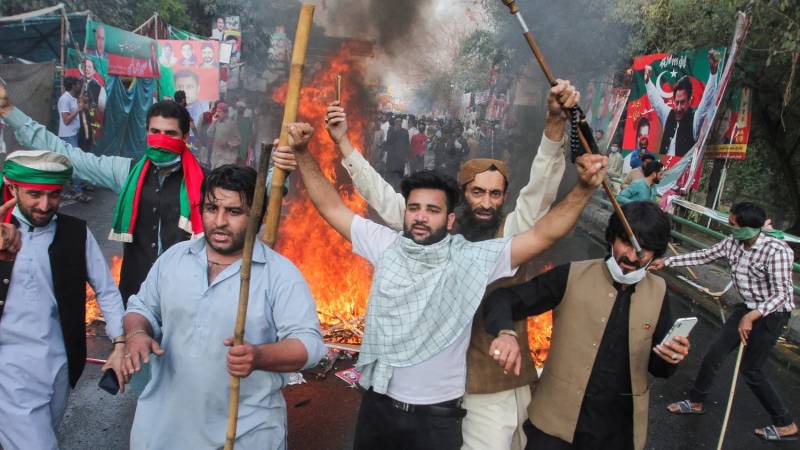
Political ego, confrontation and an unrelenting obsession with power have brought Pakistan back to square one. The imposition of emergency or governor’s rule in Khyber Pakhtunkhwa, with provincial authority transferred to the governor, raises serious questions about the future of democratic governance. Such an extraordinary development should have been avoided at all costs. Curtailing an elected provincial government is no ordinary political manoeuvre; it strikes at the very foundations of people’s rule. Yet the tragedy is that PTI’s own confrontational politics have helped create the circumstances in which such a drastic step has become possible.
Imran Khan, the party’s founder and undisputed decision-maker, has remained steadfast in his confrontational approach, showing little willingness to move towards meaningful dialogue and negotiations. True to its familiar strategy of street agitation, PTI mobilised its cadres for a disruptive march towards Islamabad. But what greater national cause justified this upheaval? Was it the people’s welfare, the country’s economic recovery or any pressing national emergency? No. The overriding demand was the release of one incarcerated leader.
Pakistan faces formidable challenges, from economic hardships and unemployment to poverty and the erosion of public confidence in democratic institutions. Did PTI have no other issues worthy of its immediate attention? Why should the political future of an entire province, and the peace of the capital, revolve around the fate of a single individual? The party’s central weakness is its one-man structure, in which crucial decisions appear to depend overwhelmingly on Imran Khan’s wishes. When one man’s decision becomes final and unquestionable, political judgement gives way to personal loyalty, and collective responsibility is sacrificed at the altar of individual ambitions.
The consequences of this confrontation have been painfully visible. Islamabad remained paralysed for days, its roads barricaded with shipping containers and its residents subjected to immense hardship. Businesses, schools and offices were disrupted, while daily wage earners, labourers, small shopkeepers and street vendors bore the heaviest burden. A capital that should symbolise order and governance was transformed into a scene of uncertainty and distress. Ordinary citizens, who neither made these political decisions nor stood to benefit from them, were forced to pay the price.
The ultimate test of leadership is not the ability to bring a province or a capital to a standstill, but the wisdom to lead towards peace, stability and a better future for its people.
The economic cost was equally troubling. Every day of shutdown meant lost earnings, interrupted commercial activity and further damage to an already fragile economy. At a time when millions are struggling to meet their basic needs, political leaders have a moral obligation to protect livelihoods rather than jeopardise them through prolonged agitation.
Both the ruling coalition and PTI have contributed to an atmosphere of political hostility, each appearing determined to stand its ground. The government has sought to prevent a breach of security in the capital, while PTI has pressed relentlessly for its leader’s release. But the emergence of hard-line voices demanding a do-or-die confrontation has only deepened the crisis. Political brinkmanship has brought neither reconciliation nor relief; instead, it has pushed the country towards another dangerous impasse.
Imran Khan, like other political leaders, rose to power within Pakistan’s complex political system, with the backing of powerful quarters widely believed to have facilitated his ascent. The relationship eventually deteriorated, particularly after the May 9, 2023, violence, and he was removed from power in April 2022 following a parliamentary vote of no confidence. His political journey has been marked by dramatic reversals, unfulfilled promises and divisive rhetoric. During his tenure, the gap between lofty pledges and practical delivery disappointed many, while his persistent attacks on political opponents deepened an already polarised political culture. Whatever the merits of his grievances, holding the nation hostage to the demand for his release cannot be justified.
Politics is the art of the possible, not the pursuit of confrontation at any cost. PTI has democratic avenues available to it: parliamentary debate, peaceful protest, negotiations with the government and recourse to the courts. These are legitimate instruments of political struggle. Roadblocks, shutdowns and coercive street mobilisation, however, inflict suffering on ordinary people and weaken the very democratic principles a political party claims to defend.
The people of Pakistan deserve better. They cannot remain hostages to the egos, rivalries and ambitions of political leaders. PTI must abandon its politics of perpetual confrontation and place national interests above personal demands. Equally, the federal government must exercise restraint, uphold constitutional safeguards and avoid measures that could further undermine representative government. The restoration and protection of democratic institutions must remain the overriding objective.
Political leaders should come to their senses. Pakistan is already burdened by economic distress, political instability and the daily struggles of its vulnerable citizens. The country needs reconciliation, responsible leadership and constructive engagement—not another reckless display of political power.
We have returned to square one, but for how long must this cycle continue? No one knows. Let us hope that reason prevails, that political differences are resolved through dialogue rather than confrontation, and that Khyber Pakhtunkhwa soon returns to stable, constitutional and genuinely representative government. The ultimate test of leadership is not the ability to bring a province or a capital to a standstill, but the wisdom to lead towards peace, stability and better future for its people