

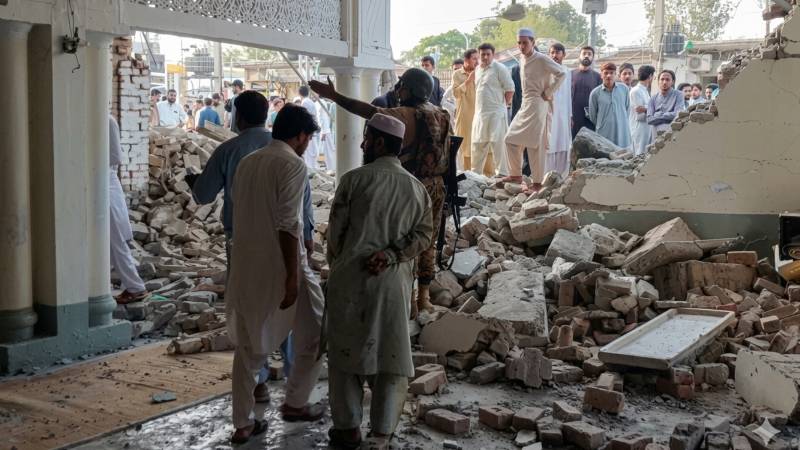
On Friday, September 18, a vehicle packed with explosives was driven into the gate of the Old Police Lines in Kohat as worshippers gathered for prayers at its mosque. Armed attackers then stormed the compound. At least 21 people were killed, including 15 police officials, and more than 80 were injured. Dawn reported. Al Jazeera later put the toll at 27. Among the dead were a senior traffic police officer and a children’s doctor. Ittehadul Mujahideen, the alliance led by Hafiz Gul Bahadur, claimed responsibility.
After every attack like this, we follow the same routine. We count the dead and repeat our resolve. Those things matter, but Kohat calls for a harder question: If seven armed men can reach buildings that house Counter Terrorism Department and Special Branch officers, who is responsible for making sure the next attempt fails?
Police said at least seven attackers breached the compound and moved towards the buildings of the Counter Terrorism Department and Special Branch. Six were killed, and a clearance operation followed. This was a planned assault carried out in stages, not a single bomb left by the roadside. It came a day after a roadside blast in Hangu killed six soldiers, and after troops killed 10 suspected militants in raids that same week.
No inquiry has yet established an intelligence failure, and it would be unfair to announce one in advance. But questions about surveillance, perimeter security and emergency response are legitimate, and the families of the dead deserve answers. Each successful attack also weakens public trust in the police, who are the first line of defence in the settled districts.
It is tempting to file every attack in Khyber Pakhtunkhwa under the TTP. That habit is out of date. In April 2025, Hafiz Gul Bahadur’s group joined Lashkar-e-Islam and a newer outfit, Harkat Inqilab-e-Islami Pakistan, to form Ittehadul Mujahideen Pakistan as PICSS recorded. It warned that the alliance’s footprint was then limited to two tribal districts but could grow, and that parallel command structures could complicate intelligence coordination. That warning reads differently today.
The European Union Agency for Asylum describes Hafiz Gul Bahadur as a former North Waziristan Taliban leader whose network survived counterterrorism operations with its capabilities intact. A Jamestown Foundation analysis published in August says the alliance now coordinates operations, shares intelligence and uses drones and organised propaganda. The group is also banned. Islamabad proscribed it in July 2024 and Dawn reported that it was believed to operate from Afghanistan. Yet a banned organisation has now hit a police compound in a settled district.
Geography adds to the worry. Kohat sits on the road to North Waziristan, Bannu and Dera Ismail Khan, and Al Jazeera’s correspondent noted that deadly attacks have hit all of them in recent months. This part of the argument needs care. Nobody can say the chief minister’s travel caused the attack in Kohat, and I do not suggest it. Militants choose their own moment. But political priorities can be examined, so let us examine them.
Chief Minister Sohail Afridi spent September 14 and 15 in Lahore. Dawn reported that he accused Punjab police of abusing his party’s workers and spoke of a street movement planned for September 27. The Punjab government responded by pointing to strikes by doctors and university staff in KP and telling him to go home and look after his province. That response is partisan and should be read as such. Still, the picture is hard to ignore: a provincial leader campaigning outside his province while his police face a militant campaign inside it.
The state needs a regional plan that combines governance, diplomacy and force, not another round of reactive clearance operations.
In fairness, Mr Afridi condemned the Kohat attack the same day, asked for a detailed report and reminded the country of what his province has sacrificed. Statements after an attack are expected. The real test is what exists before one: a standing security mechanism chaired at the top, clear priorities for district officers, and a counterterrorism plan the public can actually see.
None of this lets the federal government off the hook. National counterterrorism policy, intelligence agencies, military operations, border security and relations with Kabul rest largely with Islamabad. The Hangu bombing and the operations in Hangu and North Waziristan show that the threat crosses institutions as well as districts. Pakistan accuses the Afghan Taliban of sheltering militants, which Kabul denies. Whatever the truth of that dispute, a group banned two years ago still managed to plan a complex assault.
Peshawar cannot simply blame Islamabad, and Islamabad cannot simply blame Peshawar. The deeper danger is fragmentation. Federal ministries, the military, intelligence agencies, provincial departments, police, the CTD and district administrations each hold a piece of the job, and after a tragedy, each can point to another.
The provincial government has real powers and should use them. It can create a permanent security coordination cell under the chief minister, linking the Home Department, police, CTD, district administrations and federal agencies, and meeting on ordinary days, not only after funerals. It can review the protection of police and CTD compounds, from gates and walls to cameras and emergency plans. It can map threats district by district, beginning with Kohat, Hangu, Bannu, Lakki Marwat and Dera Ismail Khan.
The chief minister can be seen in those districts, at police lines and in security briefings, on days when there are no cameras. And after every major attack, the government can publish a plain account of what failed, what was fixed and who is answerable.
Kohat is a warning that the militant threat is changing faster than the political response to it. New alliances, banned groups that keep operating, drones and coordinated assaults mean that geography no longer tells us where danger lies. Military operations alone cannot answer that. Governance has to arrive early and answer for its results. The question after Kohat is not only who built the bomb. It is whether the institutions responsible for stopping the next one are working together before it goes off.