

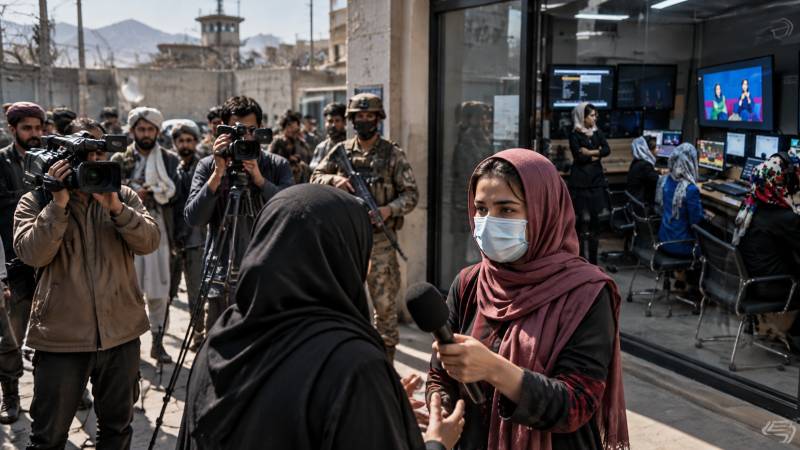
More than 200 attacks on journalists have been documented in Afghanistan since the Taliban takeover in August 2021, with beatings, arrests and threats continuing into 2025, according to data from the Afghanistan Journalists Center, AJC. The AJC’s Annual Media Violations Reports for 2024 and 2025 show the violations have not declined. The Committee to Protect Journalists, CPJ database records a similar trend. Despite the numbers, no independent mechanism exists to investigate the cases, press freedom groups say. We file without a byline now
In Nangarhar province last month, a radio reporter was stopped at a Taliban checkpoint while returning home. He requested anonymity due to security concerns. “They asked for my name and my phone,” he said. “When they saw my last story on civilian casualties, they beat me and warned me to stop reporting. This was the second time this year.” He said he now works without a press card, insurance, or any institutional support. If my name is on the story, they know where to find me. So, I file without a byline now. We are self-censoring because there is no other option. If we report the truth, we are punished.
The International Federation of Journalists, IFJ, in its South Asia Press Freedom Report 2024-2025, said reporters outside Kabul remain the most vulnerable. “They are first on the scene of violence and last to receive any protection,” the report noted. Between 2023 and 2025, the Taliban’s Ministry of Information and Culture issued directives banning music, requiring female presenters to cover their faces, and prohibiting content deemed un-Islamic. The ministry also ordered Afghan channels to stop rebroadcasting BBC Pashto, Dari and Uzbek services, Voice of America and Deutsche Welle. A joint report by UNAMA and OHCHR covering August 2021 to September 2024 documented a pattern of intimidation against media workers. Reporters Without Borders ranked Afghanistan 178 out of 180 countries in its 2024 and 2025 World Press Freedom Index. According to AJC monitoring and archives from Khaama Press, TOLOnews and Afghanistan International, more than 150 TV and radio stations have closed since 2021.
Legal experts say the problem is not just the rules but the absence of law. “There is no law that guarantees a journalist’s safety and no due process when a station is shut,” said a Kabul-based media lawyer who asked not to be named. “The directives are deliberately broad so local commanders can interpret them. A protest story can be called propaganda. There is no appeal.” In Kandahar, three FM stations were closed and six staff arrested. In Takhar, two journalists were shot dead during a live program. No prosecutions have followed, according to AJC. The impact has been sharpest for women. Beheshta, 22, who started as a TV presenter at 16, said she was told not to return to work one morning in 2022. “They erased us,” she said. “One day you are reading the news. The next day, you become the news that no one is allowed to tell. I trained for years. Now I can’t even enter a newsroom. It feels like my identity was taken away.”
If my name is on the story, they know where to find me. So I file without a byline now. We are self-censoring because there is no other option. If we report the truth, we are punished.
In Herat, a newspaper reporter attacked outside his office in 2023 said the trauma continues. “I can’t sleep. I jump at loud noises,” he said. “There is no counselor, no support system here. I think about quitting every day but journalism is all I know. We carry this alone.” Dr. Aisha, a psychologist working with Afghan journalists in exile, said she is seeing repeated cases of Post Traumatic Stress DIsorder, PTSD. “The pattern is the same: anxiety, depression, trauma,” she said. “There is no support system inside Afghanistan. They are dealing with it alone.” Saba, a former Kabul TV editor now working from home, said threats have forced me to remain indoor. “They call and ask who I spoke to today. They tell me to stop writing,” she said. “I believe my phone is monitored. Men have come to my door. I haven’t gone to the office in months. They’ve left us two choices: leave Afghanistan or quit journalism and stay locked inside.” The killing of Malala Maiwand, 26, of Enikass TV in Jalalabad in 2020 remains a turning point for many. Her brother Hamad recalled reaching the scene. “The driver was dead behind the wheel. Malala was still alive but covered in blood. I picked her up and she died in my arms,” he said. “Weeks earlier she told me she felt she was a target. Her father told her not to work.”
Nargis Harkhash, a journalist, said the murder changed her. “I felt numb, worried and terrified,” she said. “I went on to cover more killings of colleagues. After Malala, I thought the next target could be me.” Farahnaz Forotan, a Kabul presenter, said the climate of fear has moved into homes. “For the first time, I didn’t feel safe in my own home,” she said. “A death like this spreads more fear and things just get worse.” Veteran journalist Mina Baqtaş said most provincial bureaus are now empty. “In a time that was supposed to bring peace, freedom of speech is dying,” she said. Leila, a former radio reporter who managed to leave for Europe, said her family remains in Kabul. “I call them every night,” she said. “I got out. They didn’t.”
Taliban officials deny targeting journalists. Government spokesman Zabihullah Mujahid has said the Islamic Emirate supports media operating within Sharia and Afghan culture. The Ministry of Interior says cases are under investigation. A representative of a Kabul-based media group said that. “The government and the Taliban keep blaming each other,” he said. “But on the ground, nothing has changed. No one has actually done anything to keep journalists alive.” Journalists and rights groups say three steps are urgent: clear media laws with protections, safety mechanisms for district correspondents, and mental health support. “If no one filmed it, did it even happen?” asked a Kabul reporter. “Without accountability, 200 attacks will become 300. And more newsrooms will go dark.”