

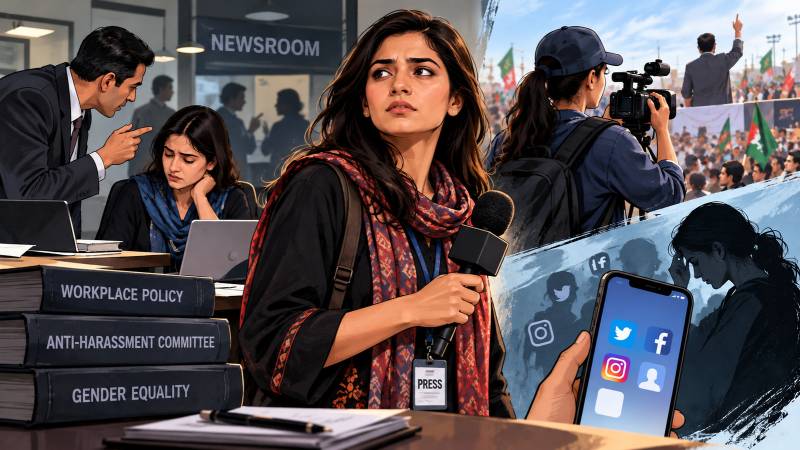
“I have been associated with the field of journalism for the past eight years. Identifying public issues and reporting important events in a timely manner have been my professional responsibilities. However, while fulfilling these responsibilities, I have continuously faced mental stress.” Suhaira Tariq
She says that she was associated with a regional private news channel. There was no formal and functional anti-harassment committee in the organization where a female employee could confidently lodge a complaint. An assignment editor from her office repeatedly made comments and compliments about her dress and makeup in front of other journalists. Although these remarks were apparently made in a complimentary manner, the situation made her uncomfortable and embarrassed. In addition, she also received personal messages.
When Suhaira Tariq informed senior management about the matter, she faced indifference instead of the response she had expected. She was told to ignore the behavior. The fact that her complaint was ignored had an impact on her professional life. As a result, she started going to the office in a very simple manner so that she could avoid any comments or unnecessary attention. Whenever there was an important conference or event, she did not feel mentally prepared because of concerns about her appearance. Consequently, her performance was affected on some occasions. It was a strange situation: something that was related to inappropriate behavior at the workplace was affecting her professional identity.
Similarly, while working in field reporting, Suhaira experienced situations in which she felt that the abilities of women journalists were questioned more frequently than those of male journalists. She says that there was a political rally of former Prime Minister Imran Khan in Khanewal. The office sent a team to cover the rally, and she was also included in the team. However, some male reporters who had not been selected for the coverage began questioning the decision. These reporters objected to why a newly appointed female reporter had been sent and whether she had enough experience in political reporting to cover an important political rally.
Suhaira says that, because she is a woman, she has faced multiple challenges, including having her abilities viewed with suspicion based on gender and facing harassment both in the office and in the field during reporting. Suhaira, is not the only women facing such issue. Recently, a journalist Mahnoor Qureshi working for Pakistan TV reported that she was subjected to online harassment following her coverage of the Azad Jammu and Kashmir Legislative Assembly elections in Muzaffarabad (Azad Jammu and Kashmir). According to the journalist, she received abusive and hostile comments on her social media accounts after reporting on the election process and related developments.
In a public statement shared on social media, Qureshi stated that despite the criticism, pressure, and challenges she had faced, she would continue reporting on issues of public importance and raising her voice for the truth. The online harassment appeared to be linked to her election reporting and professional journalistic activities.
The reality of the problems faced by women journalists is reinforced by a report by the PFUJ, according to which five incidents of violence against women and transgender journalists occurred between 2022 and 2023. Women journalists faced violence and harassment at political gatherings. Meanwhile, according to a report by Media Matters for Democracy, 82 percent of the women surveyed faced gender discrimination. According to a female reporter, an incident also occurred in which she was slapped by her own colleague. The photographer involved said that he could not tolerate working with a woman who did not cover her head with a dupatta. The matter was resolved after the journalist was merely reprimanded.
According to IRADA 700 women are working as journalist in Pakistan. If we talk about creating a conducive environment for women in news outlets, according to a report by the Women Journalists Association Pakistan, only two of the 15 media outlets surveyed had established anti-harassment committees. Meanwhile, in each outlet, only one out of every ten journalists is a woman. This makes it clear that, because of the small number of women journalists, their concerns are often ignored, and their problems are increasing day by day.
When complaints of inappropriate behaviour are ignored by media organisations, the consequences can extend beyond personal discomfort, affecting a journalist’s confidence, professional identity and ability to perform her work effectively.
A senior journalist Ghazala Faseeh from Nawa-i-waqt says that the issue of gender-based harassment has always existed. When she started her career in journalism, she also faced this problem, and even today, women who are new to the field experience similar challenges. Generally, women prefer to ignore such behavior otherwise, a cycle of victim-blaming can also begin in our society. Women who face harassment may be denied appreciation according to their performance for failing to fulfill inappropriate demands. They may also be denied promotions and, in some cases, even face termination of their jobs. On the other hand, strict implementation of laws in progressive organizations can help prevent such incidents.
More than two decades ago, when Ghazala Faseeh began reporting, she was assigned soft beats as a “lady reporter.” She found a way to perform well in these beats by taking on assignments that were difficult for male reporters to access as a woman. For example, she covered stories related to women’s prisons and spoke to families of victims in cases involving kidnapping, sexual violence and similar incidents. When nuclear scientist Dr. Abdul Qadeer Khan was placed under restrictions and it became impossible for the media to contact him, she managed to establish contact with his sister in Karachi. Through this source, she obtained exclusive news stories for Nawa-i-waqt. She suggests that women in every organization should also ensure gender solidarity with one another when facing such challenges in their professional networking.
At the government level, acknowledging the services of women journalists, Principal Information Officer (PIO) Raeesa Adil says that, in collaboration with the Pakistan Information Service Academy, various training courses and programs on freelancing, digital media, climate reporting, and modern journalistic skills will soon be launched to enhance the capacity of journalists, particularly women journalists.
Regarding the problems faced by women journalists, Supreme Court lawyer Rao Akram Khurram suggested that under Section 20 of the Prevention of Electronic Crimes Act (PECA), action can be taken against those who damage a person’s dignity and reputation, make false allegations, or attempt online character assassination. Similarly, Section 21 may apply to offences involving the dignity of women, private images, or sexual harassment. If harassment occurs at the workplace or within a media organization, a person may approach the organization’s inquiry committee, the Ombudsperson, or the court under the Protection Against Harassment of Women at the Workplace Act 2010.
Suhaira Tariq believes that if female journalists are assigned any beat based on their interests or abilities, just as male journalists are, they can easily perform the work. She also says that male colleagues support them in the field to protect them from harassment. However, to completely prevent such incidents in offices or the field, organizations should have their own support systems or anti-harassment committees that can hold those responsible for such incidents accountable.
In this regard, a guide issued by the Global Investigative Journalism Network for women journalists suggests that harassment can cause some journalists to develop imposter syndrome and begin doubting their own abilities. This can be addressed with the help of counseling from colleagues. It also advises journalists to ensure their safety while working on field reporting or sensitive topics and to obtain appropriate security support from their organization.
The Pakistan Press Foundation believes that there should be no room for discrimination or harassment in any aspect of the work of women journalists. In all its activities aimed at building the capacity and developing the professional skills of journalists, PPF ensures that women journalists actively participate so that they can have access to the same resources, opportunities and support as their male counterparts.
Women journalists are undoubtedly playing an admirable role in bringing the political and social changes taking place across the country to the public. This is why they face such challenges, but despite all of this, they are proving their abilities in the field of journalism as well. There is a need for government and non-governmental organizations to continue playing an active role so that the problems faced by women journalists can be addressed to the greatest extent possible and they can perform their work effectively and safely.