

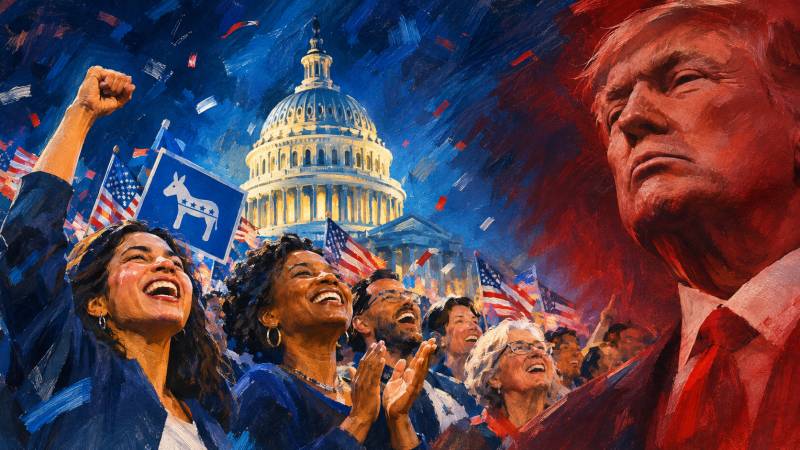
Two years ago, Donald Trump appeared to have it all. He had won back the White House, carried the popular vote, and secured both houses of Congress. The courts were friendly, the Republican Party had been remade in his image, and a new class of tech billionaires had lined up behind him. Pundits spoke of a realignment that would last a generation. On Tuesday, American voters returned a very different verdict, handing the Democrats control of both the House of Representatives and the Senate.
The scale of the reversal is striking. Democrats won Senate seats in states long written off. In Texas, James Talarico defeated Ken Paxton to become the first Democrat to win statewide office there in 32 years. Kansas is sending a Democrat to the Senate for the first time since 1932. Susan Collins lost Maine after nearly three decades, and Roy Cooper took North Carolina. In South Carolina, counties that voted for Trump in 2024 swung left by an average of about 21 points, and in Florida, Democrats won House seats in districts redrawn to keep them out. Some races are still being counted, but the direction is clear.
The cracks ran through Trump's own coalition. The early returns suggest he may have lost ground in rural America, where Democrats ran ahead of their 2024 numbers in states such as Kansas and South Carolina, and among Latino voters, who swung towards him in 2024 but had soured on him by this autumn. Six in ten disapproved of his presidency, and more than seven in ten of his handling of the economy. A Democrat winning statewide in Texas is hard to explain without them.
Is this the end of Trumpism? It is too early to say. A movement that has dominated American politics for a decade, feeding on real grievances about jobs, migration, and a political class that ignored much of the country, does not vanish in a single election. Trump remains President until January 2029, and the forces he mobilised will look for a new vehicle. But this is, at the very least, a serious jolt to the politics of division, exclusion, and deportation that defined his second term. Voters were asked to endorse that project, and a clear majority declined.
What turned the tide was not distaste for Trump's style but the economy, and above all, the war with Iran. When the United States went to war in late February, the President promised a swift and decisive campaign. Instead, the conflict dragged on, fighting resumed in the summer, and petrol prices climbed with every disruption in the Gulf.
On polling day, 75 per cent of voters told the NBC News exit poll that the economy was in rough shape. Nearly nine in ten were worried about fuel and grocery prices, and 62 per cent said Trump had been wrong to start the war. A President elected on the promise of lower prices and no new foreign wars delivered higher prices and a new foreign war. It may prove the costliest miscalculation of his political career.
Immigration, the issue that carried Trump back to power, also turned against him. The promise of "mass deportations" became, in practice, masked agents and raids on workplaces and neighbourhoods. In Minneapolis, two American citizens were killed in confrontations with federal officers, and tens of thousands took to the streets. Voters who wanted a secure border had not signed up for this, and many Republicans in competitive seats spent the campaign trying to distance themselves from it.
The result is also a setback for the tech billionaires who bet heavily on Trumpism. Crypto, artificial intelligence, and betting firms poured record sums into the campaign, hoping for a friendly, deregulated Washington. Their money could not change the mood of voters paying more at the pump and the supermarket.
For the Democrats, victory is also a story of renewal. For years, the party was dismissed as old, cautious, and out of touch, led by figures who had dominated Washington since the last century. This year, primary voters ousted several long-serving incumbents and chose a younger generation of candidates who could speak to working families in places the party had long neglected. Talarico in Texas, Annie Andrews in South Carolina, and others won not by retreating to safe ground but by contesting the deep pockets of Republican America and talking about prices, health care, and dignity.
Nowhere was the change sharper than in Michigan, where Abdul El-Sayed, a physician and the son of Egyptian immigrants, defeated Mike Rogers to become the first Muslim elected to the United States Senate. He faced some of the crudest attacks of the season. The President called him a "Communist loser who hates Jews and Israel," and his opponent insinuated that he believed America "deserved 9/11," a smear with no basis beyond his faith.
In the primary, he had already beaten a rival backed by some $30 million from AIPAC and its affiliates, while openly criticising Israel's conduct in Gaza and American support for it. His victory is a rebuke to the Islamophobia that has become routine in Republican politics. It also reflects a deeper shift in opinion. This year, for the first time, Gallup found Americans about as likely to sympathise with Palestinians as with Israelis, and roughly two-thirds of Democrats now side with the Palestinians. Unconditional support for Israel's wars, once a fixed point of American politics, can no longer be taken for granted.
The consequences will be felt well beyond America's shores. Europe, which has spent two years bracing against a President hostile to NATO, sceptical of Ukraine, and careless with allies, now faces a Congress more willing to check him on the alliance, on Russia, and on threats to territories such as Greenland. Europe's far-right parties, which drew energy from Trump's success, may find that momentum harder to sustain. In Latin America, where Washington has wielded tariffs and pressure against governments it dislikes, Brazil among them, a Democratic Congress offers a counterweight, just days after Lula's re-election showed that the region's voters can resist the same politics.
What does it mean for Pakistan? In the short term, not much. American foreign policy is made largely in the White House, and Trump will run it until the next presidential election. Islamabad has invested heavily in this administration, from the warm reception given to the Army Chief in Washington to last year's trade arrangements, and the relationship will continue on the President's terms. A Democratic Congress, which holds the purse strings, may ask harder questions about human rights, democracy, and the war in the region. But any real change will come in 2028. Pakistan's policymakers would do well to remember that rapport with one President is not a foreign policy, and to start cultivating the Americans who may be running Washington next.
The midterms have reminded the world of something it had begun to forget: American democracy can still correct itself. Whether the correction lasts is now up to the Democrats.