

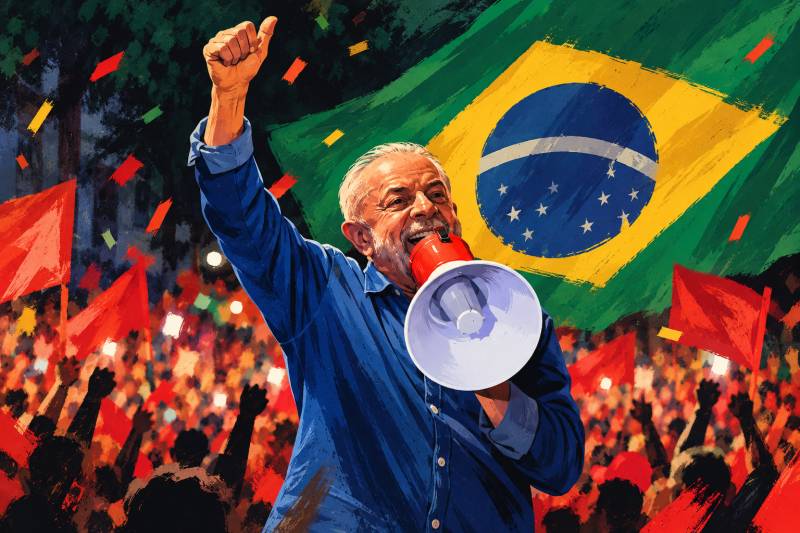
Luiz Inácio Lula da Silva has done it again. On Sunday, Brazilians returned him to the presidency for a fourth time, with 51.8 per cent of the vote against Flávio Bolsonaro, the son of the former president who is now serving a 27-year sentence for plotting a coup. The margin, nearly 4.4 million votes, was narrow, and the country remains deeply divided. But at a time when the far right is winning or threatening to win across much of the world, the largest country in South America, and a founding member of BRICS, has chosen a different path. This is a significant victory for progressive politics, and it deserves to be understood properly, especially in Pakistan.
The question worth asking is why Brazil has resisted the global tide when so many others have not. The answer lies less in Lula's undoubted charisma than in what his government actually did. Redistribution has been at the heart of his agenda from his first term, when Bolsa Família transferred cash to millions of poor families on the condition that their children attended school and received vaccinations. In his third term, he expanded it, raised the minimum wage, and pushed through Congress a tax reform, in force since January, under which some 10 million Brazilians earning up to 5,000 reais a month no longer pay income tax and 5 million more pay less, while the very rich face a new minimum rate. The results have been visible in ordinary lives. Poverty fell substantially, real wages rose, food insecurity declined, and unemployment dropped from above 9 per cent in 2022 to around 5.4 per cent this year. In 2025, Brazil left the United Nations' Hunger Map, a milestone first reached in 2014 under the Workers' Party, only to be lost in the years that followed. The International Monetary Fund now projects that Brazil will become the world's eighth-largest economy in 2027.
His victory is not a triumph of rhetoric but of organisation, policy and performance.
Social development went hand in hand with climate action. Under Bolsonaro, the Amazon was treated as an obstacle to be cleared. Under Lula, deforestation has fallen every year since 2022. This month, official data showed it at its lowest level since records began in 1988, down 42 per cent in a single year.
Equally important has been the protection of minorities and Indigenous peoples. Lula created Brazil's first Ministry of Indigenous Peoples, appointed Sônia Guajajara to lead it, and drove most illegal miners out of Yanomami lands, where a humanitarian catastrophe had unfolded under the previous government. He also defended institutions at a moment of real danger. When the Bolsonaro camp tried to overturn the 2022 election, the courts held, the coup plotters were tried, and the republic survived.
The result is also a defeat for Trumpism, in its own hemisphere. In 2025, Washington imposed punitive tariffs on Brazil and tied them openly to the prosecution of Jair Bolsonaro, an attempt to bend a sovereign country's courts to the interests of an ally. Lula refused to bargain over Brazil's democracy, and his standing at home rose as a result. Flávio Bolsonaro ran on the familiar script of crime, fear and alignment with Washington, pledging to join a US-led security pact against "narco-terrorism." After the vote, President Trump, a long-time friend of the Bolsonaro family, called it "another rigged election." Brazil's institutions, and much of the Bolsonaro camp itself, accepted the result. The playbook of grievance, foreign pressure and stolen-election claims was tried on a large and confident democracy, and it failed.
Lesson: The far right can be beaten, but not by moral lectures alone.
Lula's re-election matters well beyond Brazil, because few leaders today speak for the Global South with his authority. At a time when the United States has withdrawn from the Paris climate agreement and turned tariffs into a tool of political pressure, Lula has argued that hunger, inequality and a heating planet can only be tackled together, and through cooperation rather than coercion. During Brazil's G20 presidency in 2024, he launched a Global Alliance Against Hunger and Poverty and secured, for the first time, a commitment from G20 leaders to work towards taxing the world's billionaires. Brazil held the BRICS presidency last year, and at the climate summit it hosted in Belém it launched the Tropical Forest Forever Facility, a fund to reward countries for keeping their forests standing. Its message has been consistent: the countries that did least to cause the climate crisis are suffering most from it, and they deserve a fairer share of finance and a louder voice in the institutions that govern the world economy. For Pakistan, battered by floods and dependent on lenders who set the terms, that voice is no abstraction. A confident Brazil at the table makes the case for all of us.
What are the lessons for others? The first is that the far right can be beaten, but not by moral lectures alone. Voters who feel abandoned by globalisation need tangible improvements in their lives: jobs, food on the table, a fairer tax system and functioning public services. The second is that progressive politics must be built on coalitions. Lula governed with a broad front that included centrists and former rivals, and he never mistook his base for the whole country.
Popular politicians can be imprisoned, disqualified and vilified, but not easily erased.
In Pakistan, Lula's politics has been confused with populism. Populism thrives on grievance and personality. It promises everything, blames everyone else, and builds nothing that outlasts its leader. Lula's career is the opposite. He emerged from the metalworkers' unions of São Paulo, helped found the Workers' Party in 1980, and spent decades building a structure of party branches, trade unions, landless workers' movements and church-based groups that reaches into Brazil's poorest neighbourhoods. When he campaigns, he campaigns on a record: Bolsa Família, the minimum wage, the hunger figures, the forest. His victory is not a triumph of rhetoric but of organisation, policy and performance.
There is one more lesson, and for Pakistan perhaps the most poignant. In 2018, Lula was jailed on corruption charges and barred from contesting that year's election. He spent 580 days in a prison cell in Curitiba. In 2021, Brazil's Supreme Court annulled his convictions. The following year he won the presidency again, and now he has been re-elected. Popular politicians can be imprisoned, disqualified and vilified, but they cannot easily be erased from the affections of those they served. Pakistan's own history, from Benazir Bhutto to Nawaz Sharif, and now Imran Khan, in prison since 2023, tells the same story. Jail rarely ends a political career; it often prolongs it.
But the deeper point is that Lula returned not merely because he was wronged, but because he had something to return to: a party, a movement, and a body of work that people remembered. That is the part of the Brazilian story that Pakistan's politicians would do well to study.