

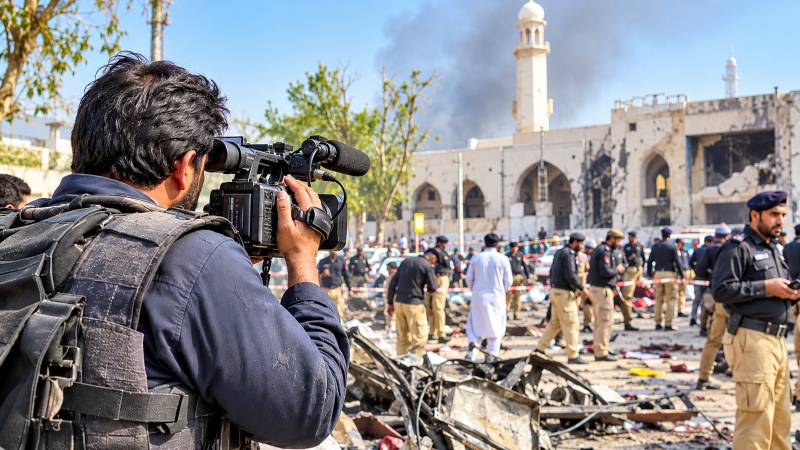
Journalism is often described as the fourth pillar of the state, holding power to account, exposing injustice and corruption, and keeping the public informed. In Balochistan, however, those tasked with bringing the truth to light often pay a heavy personal price. Journalists and media workers across the province endure a combination of security threats, professional pressure, low wages, delayed salaries and difficult working conditions, leaving many vulnerable to severe mental and physical health problems, including depression, diabetes, hypertension and heart disease. These challenges are compounded by more than two decades of violence and instability, during which numerous journalists have been killed or injured in bomb blasts and targeted attacks. Behind the headlines they report lies a largely overlooked crisis: the toll that years of danger, economic insecurity and psychological trauma are taking on the people who keep the public informed.
Shehab umar, a journalist associated with electronic media in Quetta, has been covering such incidents in Quetta and various areas of Balochistan for the past 16 years. After completing his Master's in Media and Journalism from the University of Balochistan, he practically stepped into the field of journalism in 2010 and became associated with a major news channel of the country. He stated that when he newly came to this field, the conditions in Balochistan were bad (anyway, conditions are still not fine), so every day bomb blasts, suicide attacks, or target killing incidents were reported somewhere within Quetta city. It was the early days in journalism; there was an opportunity to learn and gain experience practically in the office and the field. Especially during 2013 to 2018, many major incidents of sabotage took place in Quetta and the interior of the province, and he did live reporting of these incidents on the ground.
Especially the day of August 8, 2013, he remembers even today, when in the morning a target killing incident of a police officer took place and he had to reach the spot for the coverage of this incident. He reached the spot with the live system and did the coverage, after which instructions were received from the office to reach the Police Lines and cover the funeral prayer. He reached the Police Lines with the coverage team. Preparations for the funeral prayer were taking place in the courtyard of the Police Lines mosque, the arrival of police officers was ongoing, and the funeral prayer was to take place shortly. During the same time, a loud sound came; a suicide blast took place at the main gate of the mosque where police officers were present, while other people including media teams were present in the courtyard. Immediately after the blast, chaos spread, and people present in the courtyard were seen trying to hide here and there to save their lives.
After a few moments, when the situation became clear, the scene itself had changed; the place of the blast had become a killing ground, and there were scenes of destruction everywhere and the smell of gunpowder in the air. He stated that he has not forgotten a single scene witnessed with his own eyes at that time. After covering this incident all day, when he reached home, his heart and mind seemed to have stayed right there; those scenes and blood-soaked dead bodies lying on the ground were in front of his eyes. He stated that he could not sleep peacefully that night; it was a strange state, and apprehensions and thoughts were revolving in his heart and mind. And when this incident was fresh, in those days whenever any sound came around—of any firecracker or a balloon bursting or any thing falling on the floor—it felt like a major sound, and he would immediately turn his attention to that side thinking, "May Allah keep us safe,
Exactly two years after this incident, on the morning of August 8, 2015, the target killing incident of Bar Association President Bilal Anwar Kasi took place, and when his dead body was shifted to the Civil Hospital, he also reached the hospital as a reporter to cover this incident and saw that a large number of lawyers were also present. He says that he was going towards those lawyers when a powerful suicide blast took place at a distance of approximately 100 meters, as if the earth shook and there were cries and screams on all sides, a doomsday-like scene. He stated that seeing living humans dying in front of his eyes in a moment made his heart very sad, and for several days it felt like he was still passing through that same trauma.
After covering the August 8, 2013, suicide blast at Quetta’s Police Lines, the scenes of destruction, blood-soaked bodies and the sound of the explosion remained etched in my mind. Even ordinary sounds, such as a firecracker bursting or something falling on the floor, would make me think that another tragedy had occurred.
Senior journalists of Balochistan express concern over the increasing mental health issues among journalists and emphasize their solution. Former President of the Pakistan Federal Union of Journalists (PFUJ) and renowned and senior journalist of Balochistan, Shahzada Zulfikar, stated regarding the various mental and economic issues faced by journalists in Balochistan that a journalist's entire work is of stress, and these are of various types and natures. On one hand, they see dead bodies, see blood, and report on such incidents—such as a husband killing a wife and children and then committing suicide, etc.—so that journalist is also a human being after all; he sees his own children in those children, sees his family. Although in several other countries where there are conflict zones, after reporting such situations they are given leave for some time so that they can come out of this stress and spend time with their family in a good and peaceful environment, or they are treated, guided psychologically, and told measures for the betterment of mental health.
Unfortunately, here neither the facility of guidance regarding the mental health of journalists is available nor is that environment available to them through which they can bring themselves towards a normal routine. He stated that the conditions for journalists in Balochistan are such that if a blast happens anywhere, their duty hours increase further. The tragedy is also that the same journalist has to go to the hospital the next day and report on the individuals injured in that same incident, meaning he has to pass through that same stress again. According to him, whenever there is a condolence reference for any journalist, the death of many of them is this stress itself—mental tension, stress, mental pressure from some party, or stress from an organization; a journalist is working in stress as to how to print or broadcast their news. Shahzada Zulfikar stated that he believes that journalists who are suffering from mental health issues in one way or another should be treated. For this, besides government-level steps, journalistic organizations themselves also need to pay attention to this direction so that, understanding the sensitivity of this important matter, they introduce refresher courses for journalists, and it is very essential especially for those journalists who are performing their professional journalistic work in conflict zones.
When mental health issues are talked about, to come out of this issue an important psychologist plays a role. Regarding this, psychologist Assistant Professor Dr. Mujeebullah Dotani stated that besides general physical health, better mental health is also a fundamental right of every human being, because a healthy brain alone makes one capable of learning and moving forward in daily life. But nowadays, due to various reasons and problems, a human's mental health is getting affected day by day. He stated that in Balochistan, journalists are performing their professional services while living in difficult conditions. Due to the daily bad law and order situation—especially bomb blasts, firing, and other threats most journalists are suffering from mental stress. Besides this, the journalists of the province also face economic problems, low income, and unemployment. In these conditions, mental pressure among journalists is increasing to an alarming extent.
While fulfilling their professional responsibilities, journalists in Balochistan not only face terrifying security threats, bomb blasts, and targeted killings, but they are also victims of economic destitution and severe mental pressure. It is a tragedy that while they perform the duty of awakening society on one hand, on the other hand, they are silently falling prey to depression, trauma, and other fatal diseases. The need of the hour is for government institutions and journalistic organizations to take immediate notice of this grave situation, and to ensure psychological support, medical treatment facilities, and a proper working environment for media workers so that they can perform their duties without any mental fear.