

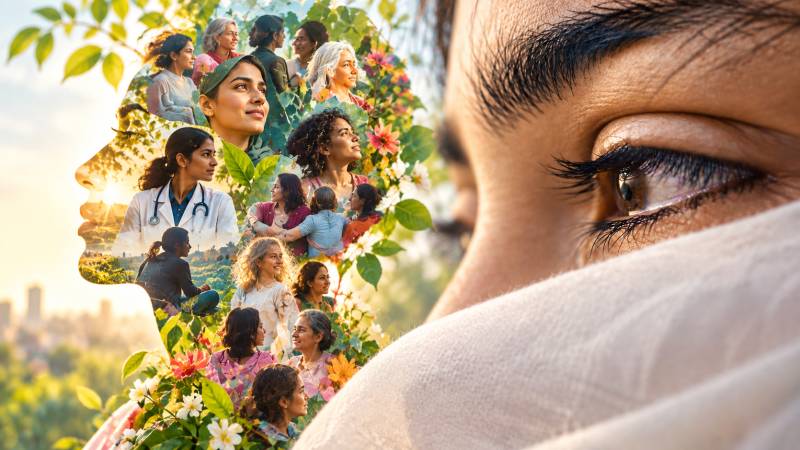
10 October 2026 — World Mental Health Day
This year's stated theme is "Lived Experiences Heard: Real Voices, Real Change." Oh, this theme rather than reassuring me makes me restless. I keep returning to an array of questions: Do they care? Are they staying to listen? And what happens afterward? Do they exit? It is easier to admire Sylvia Plath than to live with what we call her madness. Easier still when the madness is safely contained in poems, books or even a digital space. I wish all UN and aid agencies would go further: if lived experience does not shape decisions, listening is merely theatre.If we are serious about mental health, we must become candid. Perhaps indecent. Start with the numbers because numbers are where "listening" stops.
Pakistan has just 0.19 psychiatrists per 100,000 people one of the lowest psychiatrist densities anywhere, and what services exist sit mostly in cities, out of reach for the rest of the country. An unaccountable system does not only fail on capacity. It fails on belief, too. That failure has a shape, and I want to trace it.Its first nationally representative psychiatric morbidity survey found substantial levels of lifetime and current morbidity among adults.But the crisis is not only about numbers or clinics. A quieter scandal sits beside it: quality and accountability.A mental health system needs more than credentials.It needs enforceable standards, meaningful licensing and registration,complaintsmechanisms,confidentiality, professionalaccountability and consequences for malpractice. Vulnerable people should not have to discover the limits of a practitioner's competence by becoming their next case.
I have watched proximity substitute for merit: postgraduate seats shaped by domicile and connections, with no licensing examination at the other end to test competence. What "merit" means is another argument. But a profession that cannot police its own boundaries cannot credibly claim quality control. Something in us needs to be impolite enough to say: Displaced emphasis on mental health, delivered in sophisticated English, is not the same as care. In Urdu and our other languages, the easiest translation for anyone struggling is one word: Pagal. I know this embarrassment. Doctors are human beings before they are doctors, too. They too can be hurt, harassed, and betrayed. They too can live through violence, grief, trauma and humiliation. A medical degree does not inoculate anyone against being wounded.
I name men here not because women are incapable of the same toxicity — they are not but because men are handed the presumption of composure faster, and credited with wisdom before they have earned it, simply for being men. A woman must prove her steadiness. A man is assumed to already have it. And yet, over the years, I have heard variations of the same sentence ironically, from a few intelligent men, some even admirers of Plath's Ariel, I happened to meet: “As a doctor, you know better about the healing process.” I know that healing is neither linear nor guaranteed. It simply means I have learned the difference between a wound that needs time, a person who disrupts through a detailed disclosure, and a person who keeps reopening the wound.
If lived experience does not shape decisions, listening is merely theatre. Mental health requires more than sympathetic language; it requires resources, accountability, enforceable standards and institutions willing to act.
I wish those men understood that disclosure can be defiance. Knowing the anatomy of trauma does not make a person immune to it. Professional knowledge may tell you what is happening; it does not always tell you how to survive it. Doctors can be both clinicians and survivors.Stop telling professionals they "should know better" and ask whether they, too, have somewhere safe to take their pain. The disclosures about abuse often produce the same responses: 'Don't be so jazbaati.'
Survivors are not diplomats.They do not owe us polished disclosures, measured language or emotional comfort. 'Why didn't you report it then?' And sometimes, the question that reveals everything: 'How can someone as blunt and bold as you possibly have been abused?' The assumption that vulnerability must look helpless. That an outspoken person — especially a woman — cannot also be wounded. And if the survivor is past fifty, past sixty, doctor or not, there is another taunt waiting, dressed as concern: Why now? Why at this age? As if trauma has a shelf life. As if pain that is not reported within some invisible window forfeits its right to be believed. But memory does not expire, and neither does harm. Delay is not evidence against a wound; it is often evidence of how deep the wound went, how long it took to find language for what happened, how long the world took to become safe enough to hear it.
Trauma literature has said this for decades, delayed disclosure is the norm, not the exception, and has nothing to do with whether harm occurred. I did not need a textbook to know it. I needed only to live it, and later, as a doctor, to read what I had already survived being described in someone else's careful clinical language. The question is never really 'why now.' It is always 'why did it take this long for you to feel safe enough to say it. Psychiatrists in Pakistan are regulated through the Pakistan Medical and Dental Council, while regulation of other mental health practitioners has stayed fragmented. The Allied Health Professionals Council Act, 2022 put a statutory framework on paper. But a law is not the same as accountability, and a register is not the same as belief.
If this is what happens to a doctor with degrees, standing and public visibility — a system that cannot enforce its own standards, and colleagues who cannot extend belief, what happens to the woman who has none of it? The girl whose abuser is also her financial provider. The girl whose abuser is also her real or step father,brother or father in law. The woman whose family calls silence "honour". And I repeat, then there is the survivor who finally speaks, only to be asked: "Why didn't you tell us earlier?" I focus on women and girls not because abuse spares others, but because "honour" and blame fall on them disproportionately.
The glossary of mental health is good but words can also become ceremony. A survivor is invited to speak. We listen for a day. We applaud their courage. Then everyone returns to business as usual. I refuse that format. When a woman speaks about what happened to her, I want us to ask different questions: Who believes her? Who protects and who investigates her? What institution or profession failed her? Mental illness and suffering are real. People require clinical care, not prayers for success, peace and happiness, romanticisation or dismissal. But anger is not automatically pathology. Dissent is not dysfunction.
A patient or client especially a woman who makes a room uncomfortable is not automatically a patient who needs to be "fixed." Perhaps the room needs changing. Perhaps the perpetrator needs to be named. Perhaps the profession needs to look at itself. Sometimes the most healing sentence is simple: 'I believe this happened to you. I am here.' Not conditional on being calm or easy to understand. It can also mean this: not severing ties, not pausing a friendship or a conversation, treating someone as the same person they were before the disclosure not fragile, not altered, not suddenly in need of careful handling.
Many survivors did not initially need a policy paper or diagnosis but someone to believe them without also making them smaller. The consequences of mental distress while politely protecting its causes profit from our silence. Audre Lorde, the Black American poet, essayist and activist who called herself a "warrior poet," writing as a cancer survivor in The Cancer Journals — said it before I ever needed to: "My silences had not protected me. Your silence will not protect you." This World Mental Health Day, let us move beyond listening as an official cathartic act. Ask the problematical questions. Follow the power trail and the paper trail of whoever is licensed to hold it. I do not want to make trauma respectable. Let me finish with an advocacy plea: Let truth be speakable and breathable, eligible to be hugged. Mental health needs resources, services and empathy. But it also needs truth and accountability. And truth is indecent.