

Mental health is no longer a peripheral concern; it is a defining public health challenge of our time and, increasingly, a reflection of gaps in governance. In Pakistan, an estimated 32.4 million people require mental health support, while only around 5% of the population has access to mental health services. The mismatch between need and access is stark.
Although mental health is discussed more openly today than in previous years, particularly in urban settings, this growing visibility has not been matched by equivalent progress in service delivery, workforce development, or system-level investment. Many people continue to lack access to timely and affordable care, with young people and those living in rural communities facing significant barriers. The absence of a centralized mental health data system further compounds the problem, making it difficult to accurately assess the scale of need, identify gaps in services and track progress over time.
Public conversations about mental health often center on stigma, and for good reason. Fear of judgment, discrimination and social exclusion continue to strongly shape whether and how people seek support. However, stigma alone does not explain the scale of unmet need in Pakistan. Focusing exclusively on attitudes risks obscuring deeper structural problems that have left mental health services fragmented, under-resourced and inaccessible for large segments of the population.
These challenges are rooted, in part, in the country's policy and governance landscape. Pakistan's mental health framework underwent a major legal shift in 2001 with the introduction of the Mental Health Ordinance, which replaced the colonial-era Lunacy Act of 1912 and established procedures for voluntary and involuntary care. Although the Ordinance was a significant step forward, implementation lagged. The Federal Mental Health Authority it established lapsed without meaningful progress, and by 2010 the provincial Boards of Visitors meant to inspect facilities had still not been constituted. The Ordinance itself eventually lapsed because parliament never enacted it.
The policy environment became more complex following the 18th Constitutional Amendment in 2010, which devolved responsibility for health to provincial governments. Devolution created opportunities for greater local ownership and responsiveness, but it also introduced coordination challenges. The result has been uneven progress across provinces, varying levels of prioritization and a lack of coherent national direction.
But a policy, however well designed, does not itself create a functioning mental health system. Turning these commitments into reality will require sustained political will, adequate financing and accountability for implementation.
The human resource gap is equally concerning. According to the Government of Pakistan, the country has approximately 0.19 psychiatrists per 100,000 people, while high-income countries have an average of 7 per 100,000. The concentration of specialized services in urban centers and tertiary hospitals further limits access to care for many communities. Mental health care also remains insufficiently integrated into primary care, despite repeated policy recommendations and calls from experts for greater integration. These shortcomings reflect broader weaknesses in how mental health care is organized, governed and financed.
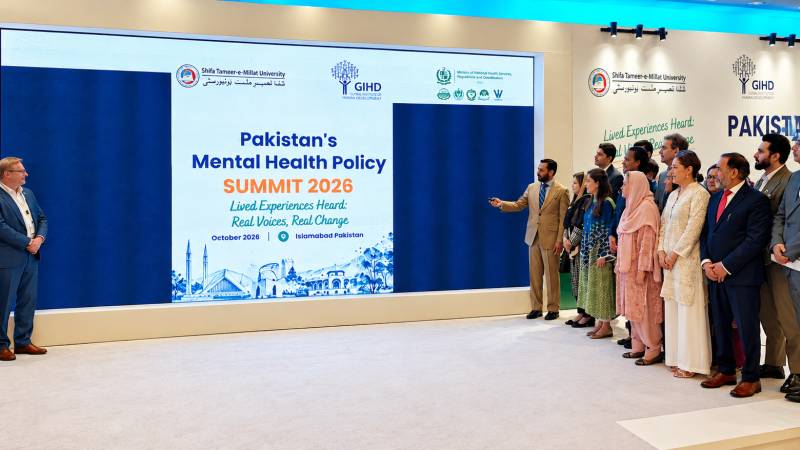
Nevertheless, there is now a critical opportunity to address these longstanding gaps. On October 1, 2026, the Government of Pakistan launched the National Mental Health Policy 2026-2035 at the Pakistan Global Mental Health Summit in Islamabad. Developed with national and provincial stakeholders in partnership with the World Health Organization (WHO) and the United Nations Children’s Fund (UNICEF), the policy aims to provide a shared national direction while allowing provinces and regions to adapt implementation to local needs.
Importantly, the policy does not view mental health solely through the lens of specialist treatment. It emphasizes primary and community-based care, prevention and early identification, workforce development, support for children and young people, and responses to emergencies and climate-related crises. It also recognizes the importance of involving people with lived experience, young people and families in shaping mental health services. But a policy, however well designed, does not itself create a functioning mental health system. Turning these commitments into reality will require sustained political will, adequate financing and accountability for implementation. This is where Pakistan's real test begins.
The government has outlined plans to translate the policy into action through provincial implementation plans with clear priorities, responsibilities, timelines and measurable results. The Minister of State for Health announced that a costed, time-bound implementation and monitoring plan will be developed in consultation with the provinces within the next 12 months. The challenge now is to make sure these plans deliver tangible improvements in access to care, supported by a national data system that can track whether they do.
In practice, this means ensuring that mental health support reaches people at different stages of life and in different circumstances. Children and young people need opportunities to receive support before distress escalates into a crisis. Schools, primary care and community-based services are well placed to support prevention, early identification and referral. The policy must also account for the realities people face outside the health system. Floods, displacement, loss and prolonged uncertainty can have lasting psychological and social consequences. Mental health therefore needs to be a core part of Pakistan’s climate-related emergency preparedness.
The National Mental Health Policy is a crucial step. But its success should not be measured by the policy itself or the number of commitments announced. It should be measured by what changes for the people of Pakistan. Can someone living outside a major city access care? Can a young person get help before their distress reaches a crisis point? Can families find services without facing financial barriers? Can people with lived experience see their knowledge reflected in the way services are designed?
Pakistan has made an important shift from recognizing that mental health matters to putting forward a national policy. The task now is to ensure that policy does not remain on paper. The real measure of Pakistan’s mental health moment will be whether it translates into accessible, affordable and equitable care for people across the country, regardless of where they live.