

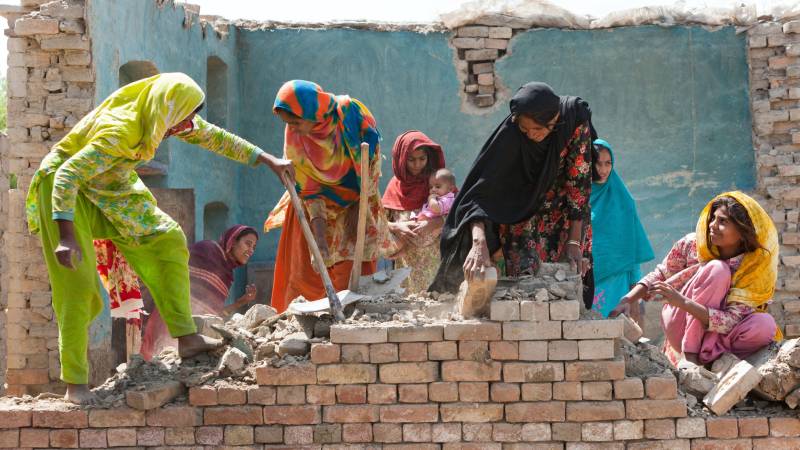
The state of Pakistan is spending billions to put roofs over the heads of flood survivors. But is the country doing enough to ensure that women in these areas can build the next one themselves? In Ravio Bheel village, near Mirpur Khas, a woman lives in a mud house that she built herself. Even in the scorching heat, its walls remain cool to the touch. She prepares food on one of the 250 chulahs built here, elevated to the height reached by the 2022 floods and decorated with birds painted by her and her son. A reconstruction programme may be instrumental in rebuilding a house, but is it capable of building real resilience?
The effects of climate change are not distributed equally, with women and girls often bearing a disproportionate level of the impact. Pakistan consistently ranks among the world’s most climate vulnerable countries; the 2022 floods alone left millions displaced and submerged roughly a third of the country. These disasters exacerbate existing gender inequalities and pose a unique threat to women’s livelihood. A 2025 UN spotlight brief found that the heightened social and economic stress caused by climate disasters increases violence against women and girls. For women working in the agricultural sector, climate disruption means more time and energy spent securing food, water, and income. For girls, this can mean leaving school to take on those responsibilities, exposing the weakness of an already fragile education system. This combination of low literacy, limited skills, and limited income perpetuates a cycle that leaves women highly vulnerable to the next climate disaster.
This vulnerability is particularly important when considering how Pakistan approaches reconstruction. Countries like Pakistan bear the consequences of emissions driven disproportionately by the global north, then recovery often leaves them reliant on international financing and aid. Sindh’s flagship reconstruction program, Sindh People’s Housing for Flood Affectees (SPHF), has built around 850,000 houses, and transferred land titles to women. But this model is still primarily centered on rebuilding physical structures, using carbon heavy materials to build pakka (cement, brick) houses, that depend on markets, financing and skilled labour from outside the community. When the next flood comes, nothing durable is left in the community’s own hands. A house can provide security. But a house alone cannot guarantee that a community will be able to rebuild after the next disaster.
Pakistan's own climate policies acknowledge that women are essential to climate adaptation. The National Climate Change Policy names gender-sensitive adaptation as a goal, and the Climate Change Gender Action Plan exists specifically to increase women’s participation in climate decision making. However, their participation remains largely symbolic and constrained. If women are treated only as beneficiaries rather than as active participants in rebuilding, policy will continue to reproduce the same vulnerabilities it claims to address. Disaster relief has the potential to extend beyond just building structures, to build lives. It can build the capacity to withstand future disasters. Resilience should outlast aid.
Women cannot be written into climate policy as an afterthought, or as dependents to a charity program. They need to be part of its design, its funding, and its execution.
Architect Yasmeen Lari’s Heritage Foundation works from this premise. Its model of Barefoot Social Architecture does not treat the final product as just a house, but as a skill being transferred, especially to women. The knowledge required to build it is essential to the intervention.Built using accessible local materials such as bamboo, lime, and mud, Lari’s communities construct their own homes, at a fraction of the price of pakka (cement/brick) houses, and other infrastructure while learning skills that can be passed on and uplift the local economy.
A woman trained in one village goes on to train another. That second woman can train another. The value compounds: instead of resilience being re-delivered after every flood, it becomes something that already exists within the community. One woman, Champa, illustrated this process. She and her husband became barefoot entrepreneurs, helping build 30,000 chulahs and training others to construct them. Not only does this utilise existing skill, but the knowledge to build them will not disappear when an outside organisation leaves.
Lari’s Barefoot Social Architecture (BASA) has impacted the lives of over x people across Pakistan by helping disaster-hit communities build their own safe, eco-friendly homes. The significance of this is not only that the houses are cheaper or greener. It is that the people rebuilding their communities are not reduced to recipients of aid. They acquire skills, earn income, and become capable of passing those skills on. Every painted wall, every raised chulah, and every woman teaching another woman represents a form of agency. An ownership not just over the homes, but over the lives they were able to build.
And this model is not too small to scale, given that such policy is already being run at state scale elsewhere. In Nepal, a compressed-earth-block program built over 3,500 homes and 2,200 jobs after the 2015 earthquake, with women a third of all trained masons, and the government went further, hiring 149 women directly onto the National Reconstruction Authority's payroll. In West Africa, the Nubian Vault technique has produced more than 7,000 homes across six countries as a self-sustaining trained-mason market, with no ongoing donor funding required. And in Pakistan, Lari's model has already scaled past 50,000 homes without state backing. The problem does not lie in the solution itself, but in the lack of funding behind it. These examples suggest that community-based construction and skills transfer do not have to remain isolated NGO projects; they can be incorporated into reconstruction systems at a much larger scale.
Pakistan’s disaster financing frameworks should do the same. Housing and reconstruction budgets should directly fund community-built, women-led approaches alongside conventional construction. That means investing not only in the structures themselves, but also in the systems that allow the knowledge to persist—systems that are currently overlooked: formal training, so that skills do not disappear when a grant cycle ends, and local material production, so that the economic benefits are funded alongside the shelter itself.
Pakistan has just approved its first new National Housing Policy in 25 years, and it names climate resilience as a pillar. The next step should be to define resilience more broadly than simply by the number of houses rebuilt. Women cannot be written into climate policy as an afterthought or treated as dependents of a charity programme. They need to be part of its design, its funding and its execution. A house can be rebuilt after a flood. A skill can rebuild a community.