

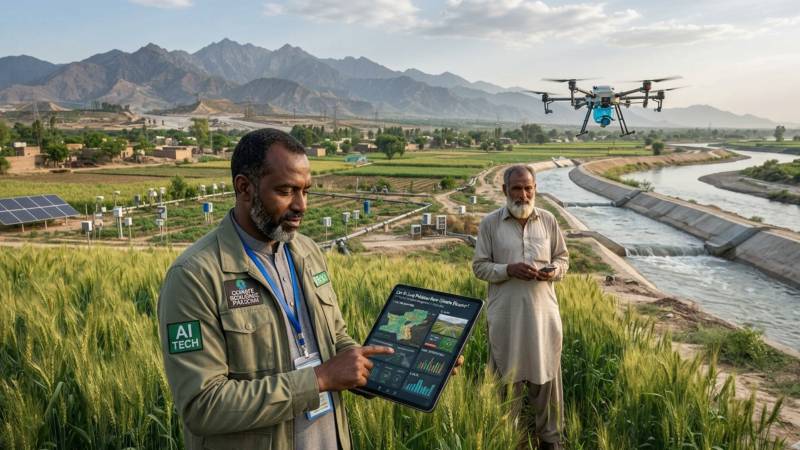
Of the many issues that are going to define the next generation, two prominent discussions are likely to be artificial intelligence and climate change. In Pakistan, however, both topics have already progressed from boardroom discussions and policy papers to government planning. With regard to the former, Pakistan is gearing up for an AI-enabled future. This is evident from the government’s approval of the National Artificial Intelligence Policy 2025 and its decision to place artificial intelligence at the forefront of national priorities, including the development of National AI Hubs. On the other side is a very different future.
Just a few hundred kilometres from Pakistan, the Himalayas have delivered yet another warning signal. On August 26, a deadly flash flood struck the Nepal-China border after a glacier collapsed, triggering an ice-and-rock landslide and a massive debris flow. Hundreds were killed, and almost a thousand people were reported missing as search operations continued. The catastrophe wiped out entire villages, roads, bridges and electricity infrastructure, while the formation of new lakes has raised concerns about future flooding. Scientists are studying the possible influence of abnormal heat and a rapidly changing environment in the Himalayas.
For those who watched the videos from Nepal, it may have seemed like just another Himalayan catastrophe. For Pakistan, however, it should be much closer to home. The same is true of the mountain ranges that feed the rivers which sustain agricultural production, energy generation and millions of livelihoods in Pakistan. Changes in glaciers and glacial lakes across the region do not remain confined to Nepal, China or India. Ultimately, they become an issue for the Indus Basin. This is where the two great debates of our generation collide. Pakistan is investing in artificial intelligence at precisely the moment when climate change is making its physical environment increasingly unpredictable.
Consider a situation in which a farmer in Sindh sees the skies suddenly become overcast. Elsewhere, a family living near a river receives a warning alert on its phone. A glacier in a mountainous region becomes unstable. In Lahore, temperatures are rising while electricity demand increases with every fan and air conditioner being switched on. Now imagine a system capable of linking all these developments together. Such a system could analyse satellite imagery, track river levels, monitor rainfall patterns and temperature changes, and identify vulnerable populations.
Herein lies the potential application of artificial intelligence to Pakistan’s climate-change debate. The government of Pakistan is not entirely new to this idea. Technical early-warning systems already exist within the National Disaster Management Authority, alongside an increasing focus on proactive disaster management. The National Disaster Response Plan 2026 identifies floods, glacial lake outburst floods, heat waves, cyclones and droughts as some of the country’s emerging risks, while emphasising early-warning technologies and community preparedness. The question now is whether AI can improve the speed and accuracy of these systems.
Technology alone does not make a country resilient; resilience begins with accurate data, functioning monitoring systems and institutions capable of acting on warnings.
Pakistan has long been known for responding to disasters after they occur. First it rains, then the rescue begins. Buildings collapse, then compensation discussions start. Fields are destroyed, then relief programmes are launched. Roads are washed away, bridges collapse and communities are displaced, and only then does the country begin assessing the damage.
But this is precisely where AI has the potential to transform Pakistan’s disaster-response strategy. How can the government forecast which areas will be affected by flooding before it occurs? How can it anticipate which districts will face the greatest risk from extreme temperatures? How can farmers receive information about changing rainfall patterns before planting their crops?
Pakistan does not need to do this alone. India has already begun combining AI with traditional flood-prediction models. Its government says that AI, alongside physics-based modelling, is being used to enhance river-basin management in the Ganga and Brahmaputra regions, while remote sensing and land-data systems are being used to predict floodplain inundation. Indian authorities are also exploring the use of AI and machine learning for flash-flood prediction and glacial-lake monitoring. The lesson is not that India has discovered a miraculous technology that can eliminate floods. The point is that AI can be integrated into existing systems to make them faster, more accurate and more responsive.
China has pushed the envelope further in weather forecasting. Artificial-intelligence-based weather prediction models such as Fengwu, Pangu and Fuxi have been developed to analyse vast amounts of historical weather data and generate forecasts much faster than conventional weather models. Fengwu, for instance, has demonstrated strong capabilities in forecasting extreme weather events and successfully predicted the landfall of Typhoon Doksuri several days in advance. These AI models are being used alongside conventional meteorological models.
This offers an important lesson for Pakistan: the country does not necessarily need an entirely new disaster-management system. It needs a smarter one. Satellite imagery could be combined with rainfall records, river levels, glacier data, population density and infrastructure maps to help AI identify where rainfall is occurring and where it is likely to become hazardous. Such technology could enable administrators to identify villages at risk of flooding, inaccessible roads and areas requiring evacuation. Farmers could make more informed decisions about which crops to plant and when, while officials could continuously monitor vulnerable glacial lakes in Gilgit-Baltistan.
However, technology alone does not create resilience. Pakistan must first have accurate and reliable information about its climate. That requires functional weather stations, effective river monitoring and consistent data collection. A computer programme cannot forecast what has never been measured. The other critical component is ensuring that predictions translate into action. Warnings must reach district authorities, rescue teams, farmers and communities in languages they can understand, accompanied by clear instructions about evacuation routes, cooling centres and emergency procedures.
The recent catastrophe in Nepal should therefore be viewed not merely as a tragedy across the border, but as a warning for Pakistan. The country already possesses several technologies capable of forecasting climate-related risks. What it needs now is the institutional capacity and political will to act on those warnings. AI cannot prevent floods, cool down a heat wave or stop glaciers from melting. But it can give Pakistan what disaster management has always needed most: time. Sometimes, a few hours of warning can be the difference between responding to a tragedy and preventing one.