

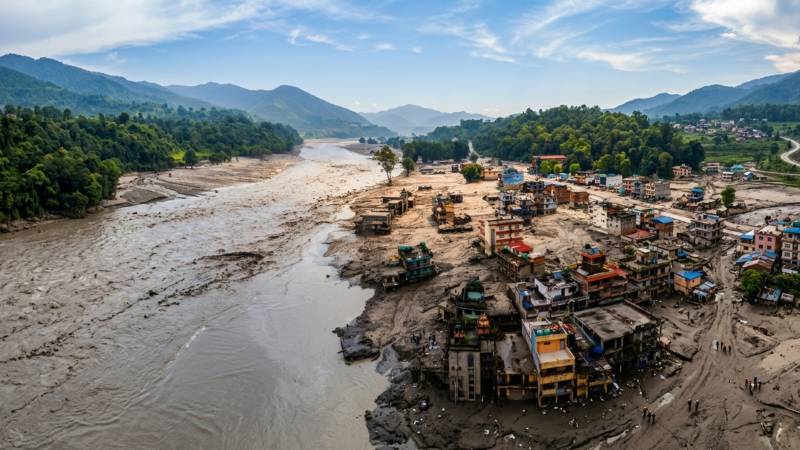
The catastrophic flash flood that hit Nepal's Rasuwa district on 26 August is not merely a national tragedy. It is a warning to the whole of South Asia; a region whose climate, water, and food security are inseparably linked through the Hindu Kush, Himalaya mountain system and its transboundary rivers. Preliminary assessments suggest an ice-rock avalanche and landslide dammed the Lhende River near the Nepal–China border, forming a temporary debris-dammed lake; its sudden release sent a violent slurry of water, mud, rock, and sediment down the Bhote Koshi and Trishuli river systems. Hundreds are reported dead, nearly a thousand missing, and tens of thousands affected, with roads, bridges, settlements, and border facilities destroyed.
A shared mountain system under pressure
South Asia holds roughly one-quarter of humanity on less than 5% of the world's land, and more than 750 million South Asians have been affected by at least one climate-related disaster in the past two decades. The Himalayan cryosphere feeds 12 major river systems, sustaining about 240 million mountain residents and some 1.65 billion people downstream. What happens on Nepal's slopes therefore reaches irrigation, drinking water, food production, hydropower, and coastal cities across the region.
The exposure is measurable. An ICIMOD inventory counted 3,252 glaciers and 2,323 glacial lakes in Nepal; a more recent assessment mapped 2,070 glacial lakes in the Nepalese parts of the Koshi, Gandaki, and Karnali basins, with 21 classified as potentially dangerous. Across High Mountain Asia, around 15 million people are exposed to potential glacial lake outburst floods, making this the most exposed mountain region on Earth.
A record already written in loss
Rasuwa is not a once-in-a-century anomaly. In February 2021, about 27 million cubic metres of rock and ice collapsed from Ronti Peak in Chamoli, India, generating a debris flow that killed or left missing more than 200 people and severely damaged two hydropower projects. In October 2023, a collapsing moraine at South Lhonak Lake in Sikkim sent a tsunami-like wave over the dam; the resulting glacial lake outburst flood tore down the Teesta valley, overwhelming hydropower infrastructure. The 2010 Pakistan floods affected more than 20 million people and killed nearly 2,000. In 2022, floods affected 33 million people, killed more than 1,700, and caused over US$30 billion in damages and economic losses. Since 1970, the scale, intensity, and duration of floods in Bangladesh and Nepal have all increased.
Climate information must cross borders faster than floodwater: shared glacier and glacial lake monitoring, satellite and river data, common warning protocols, and rapid communication among disaster-management agencies
A more dangerous future
Glacier mass loss across the Hindu Kush Himalaya accelerated by about 65% between the first and second decades of this century. Even if warming is held to 1.5–2°C, the region's glaciers are projected to lose 30–50% of their 2015 volume by 2100; under 3°C, 55–75%; under 4°C, 70–80%. Peer-reviewed projections confirm the direction: every Himalayan sub-region stands to lose at least 35% of its present-day ice by 2100. About 200 glacial lakes across the region are already considered dangerous. This means not simply "less water" but more violent swings, expanded lakes and higher early-season flows raise flood risk, while shrinking ice reserves make water supply more seasonal and uncertain. Add roughly 40 million projected internal climate migrants in South Asia by 2050 and climate-related losses averaging about US$160 billion per year by 2030, and the bill keeps climbing.
As Nepal reels, a strong El Niño is developing over the Pacific: the World Meteorological Organization reported in July 2026 that it would intensify during August–October. El Niño shifts the odds toward rainfall failure, prolonged dry spells, and abnormal heat. India's monsoon was already about 13% below average by late August; Pakistan entered 2026 with January–March rainfall 12% below normal (Punjab -37%), including a February that was 77% below average making it seventh driest on record. During the 2015–16 El Niño, some rain-fed areas of Sindh and Balochistan saw winter precipitation deficits exceeding 80%.
Yet the same season can drown one district while drying another. More than 145 mm fell in a single August event across Islamabad and Rawalpindi, flooding Nullah Lai and submerging streets because drainage is inadequate, floodways are encroached, and impervious surfaces leave water nowhere to go. That is the emerging climate paradox: meteorological drought and destructive flooding in the same region, sometimes within weeks.
Those who emitted least are losing most
Nepal's first Nationally Determined Contribution estimated its share of global greenhouse-gas emissions at just 0.027%. Yet the country is bearing a vastly disproportionate share of climate destruction. The Fund for Responding to Loss and Damage was created for exactly this, but only about US$250 million was allocated for its initial 2025–26 window, against the more than US$30 billion Pakistan's 2022 floods cost alone. This is not charity; it is climate responsibility.
Four levels of one survival strategy
The lessons are regional, national, local, and global. Climate information must cross borders faster than floodwater: shared glacier and glacial-lake monitoring, satellite and river data, common warning protocols, and rapid communication among disaster-management agencies. National infrastructure planning must treat cascading hazards; glacier collapse, glacial lake outburst floods, avalanches, landslides, earthquakes, debris flows, and extreme rainfall, as one system, especially for roads, bridges, hydropower, and settlements in mountain valleys. And adaptation must be locally led: warnings in languages people understand, marked evacuation routes and safe shelters, trained response teams, regular drills, district-specific agricultural advice, cleared drains, and protected floodways. Finance must reach municipalities, villages, farmers, and women's groups and not stall in national offices and international consultancies.
The Himalayas have delivered one warning; El Niño is delivering the next. Global climate responsibility, South Asian cooperation, national preparedness, and locally led adaptation are not separate agendas. They are four levels of the same survival strategy.