

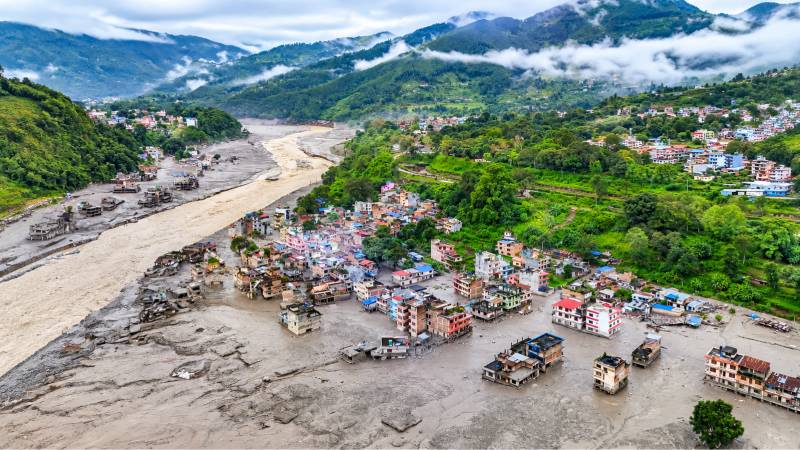
Devastating. The scenes on television reminded me of the film 2012, where the end of the world was characterised by floods reaching the top of the Himalayas. As a nine-year-old kid, when the movie came out in 2008, the visuals seemed imaginary and far from reality. Fast-forward to 2026, a flood emerged from the mountains, sweeping away all infrastructure and life it came across. Suddenly, the film looked realistic, and the threat of climate-induced disasters became a reality the world needs to prepare for.
Contrary to an earlier belief, scientists now largely agree that the devastating flood, ravaging lands along the Nepal-China border, was triggered by a massive glacier collapse and landslide. But why did this happen? Looking at the historical data, Nepal has been at the brunt of climate disasters, with frequency and scale intensifying because of climate change. For a country that produces an extremely small fraction of global carbon emissions - approximately only 0.1 per cent of the world’s carbon emissions - Nepal, being a nation vulnerable to the impacts of climate change, bore the consequences of other nations’ unchecked carbon footprint.
In Nepal, a large portion of a glacier collapsed at high altitude, finding its way to the river below as it descended nearly 7000 feet. According to an analysis from CNN, the glacier was approximately 2000 feet wide, which may explain why the event was extraordinary. As the glacier made its way down the slope, it also caused a landslide, forming a deadly combination of rock and ice which made its way to the Lhenda Khola River, eventually leading to 1200 deaths and 4000 missing from 26th of August.
The authorities were caught off guard as there was no rainfall, which is often linked to floods. The sudden burst of the glacier is attributed to the rising temperatures in the region, as global warming shrinks glaciers. According to recent research by the International Centre for Integrated Mountain Development (ICIMOD), Glaciers across the Hindu Kush Himalaya (HKH) are melting at an accelerating rate, with ice loss rates doubling since the year 2000, which poses a great risk for millions of people who live downstream and are dependent on the glaciers for their freshwater supply. The report also provided a comprehensive analysis, revealing that between 1990 and 2020, Hindu Kush Himalaya (HKH) glaciers lost about 12% of their total area and 9% of their estimated ice reserves.
The destruction in Nepal would raise the alarm bells here in Pakistan, and for the right reasons. While both countries’ contributions to carbon emissions remain extremely low, they are most vulnerable to climate change. Pakistan is no stranger to climate-induced disasters, as the country has seen a stark rise in flood occurrences, unpredictable rainfall, and droughts. One of the biggest threats comes from the “Third Pole”, the region of the Hindu Kush Himalaya mountain range, where more than 13000 glaciers are present.
Glaciers will keep retreating; what remains within our control is how quickly we prepare the communities living in their shadow.
Contributing nearly 60% of the country’s water, the glacial melt from the Third Pole is sustaining the population and ensuring food security. Yet, the rise in temperature poses a direct threat, with nearly 10,000 glaciers shrinking. This has led to the creation of 3044 glacial lakes, with 33 declared highly unstable.
The increased meltwater may sustain river flows for a while, but it also risks more landslides and glacial lake outburst floods, raising questions over food and water security in Pakistan. The economic impact of these disasters is already visible, as the 2022 floods dealt a blow of 9.8% to the country’s gross domestic product (GDP), a massive toll for a developing country.
If the necessary steps are not taken to counter the climate threat, there are three overarching consequences, with a few transcending national borders. Firstly, water security becomes a challenge not only for Pakistan, but also for Nepal and India. Secondly, food and energy security also becomes uncertain. Thirdly, these floods and increased flow of water lead to forced internal displacements, with the communities in Gilgit-Baltistan and Khyber Pakhtunkhwa already moving twice in the last decade, contributing to rural-urban migration.
Nevertheless, Pakistan has been implementing measures that can help reduce the impact, with the Glacial Lake Outburst Flood risk-reduction project (GLOF-II), led by the Green Climate Fund and the United Nations Development Programme (UNDP), Recharge Pakistan and the Living Indus Initiative serving as a step towards resilience and disaster risk management.
Looking forward, South Asian countries must come together and work towards common governance of glacial zones, as the impact of glaciers is not limited to national borders. Adaptation and resilience-building need to be extended at a greater scale to the people in the mountains, as glaciers will keep retreating with each passing day. Nevertheless, the speed with which they disappear and how well the communities are prepared to face them remains mostly within the fold of policy framing and development approach. Rest assured, proactive planning is always better than reactive strategy.