

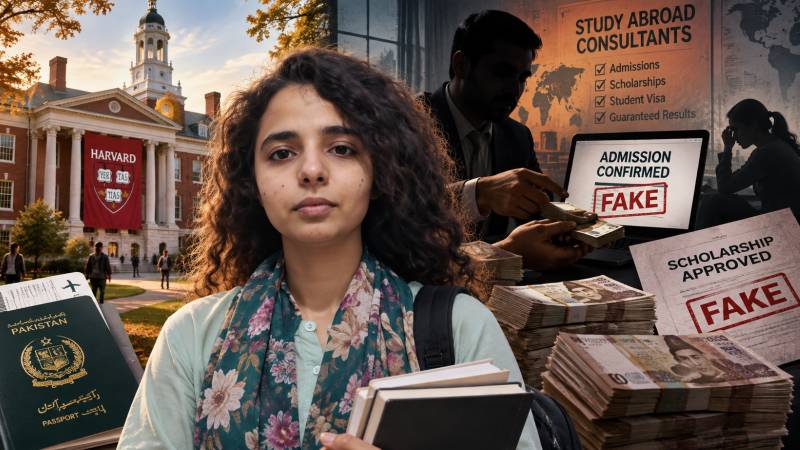
A young Pakistani woman who excelled academically, earned a gold medal and dreamed of studying at Harvard University is now dead. Her dreams of a world-class education were allegedly exploited by individuals who promised her admission and a scholarship in exchange for money. According to the Federal Investigation Agency (FIA), Rs 9.3 million was obtained from her through a scheme involving fraudulent university documents.
Laiba Aijaz, a student of the International Islamic University Islamabad (IIUI), reportedly died by suicide after discovering that the admission and scholarship she believed she had secured were fake. It is a heartbreaking tragedy. But it is also an indictment of a system that allows unscrupulous individuals to exploit the educational ambitions of young Pakistanis with seemingly little fear of being caught or punished. And unless something changes, Laiba will not be the last student whose dreams are shattered by this flourishing industry of deception.
Pakistan has a serious problem with educational and visa consultants who promise everything from admission to prestigious foreign universities to scholarships, student visas and even guaranteed immigration. While many consultants provide legitimate services, the industry also attracts individuals who prey on desperation, ambition and ignorance of foreign admissions procedures. The absence of effective oversight means that almost anyone can present themselves as an educational consultant, advertise their services on social media and begin collecting money from unsuspecting students and their families.
Where are the regulators? Where are the licensing requirements? Who verifies the credentials of these consultants? And who protects students when promises of admission and scholarships turn out to be elaborate frauds? These are questions that the government must answer.
According to the FIR registered by the FIA on October 10, two individuals, Muhammad Nauman and Fatima Sarwar, also identified as Aiza, allegedly obtained Rs 9.3 million from Laiba by promising to arrange a US visa and university scholarship. The FIR states that Rs 2.9 million was transferred through a bank account, while the remaining amount was paid in cash. Investigators allege that fraudulent scholarship letters, university admission offers and fee payment receipts were provided. The allegations must, of course, be established through the legal process. The FIR also records Laiba’s subsequent death, although it does not establish its cause.
Prime Minister Shehbaz Sharif has reportedly ordered immediate action against those involved. That is welcome, but action against the accused in one case is not enough. What Pakistan needs is a comprehensive crackdown on fraudulent educational consultants and, more importantly, a regulatory system that prevents such scams from occurring in the first place. Consider the sheer scale of the problem.
It is a heartbreaking tragedy. But it is also an indictment of a system that allows unscrupulous individuals to exploit the educational ambitions of young Pakistanis with seemingly little fear of being caught or punished.
Facebook is full of groups where Pakistanis seek information about student visas, university admissions, scholarships and immigration opportunities in the United States, Britain, Canada and Europe. Many of these groups are populated by individuals advertising themselves as educational consultants, visa specialists and immigration experts.
Some promise admission to prestigious universities. Others claim they can arrange scholarships or secure visas through special connections. Still others advertise supposedly guaranteed results. For a student unfamiliar with the intricacies of foreign university admissions, such promises can sound entirely credible. And that is precisely what makes this industry so dangerous.
Not every Pakistani student grows up attending an elite private school in Karachi, Lahore or Islamabad, where professional college counsellors explain how to apply to American universities. Not every family understands the difference between legitimate admissions assistance and someone falsely claiming to possess influence over university decisions. A student can be academically brilliant and still lack familiarity with the admissions procedures of an institution thousands of miles away.
Indeed, being a position holder or gold medalist at a Pakistani university is a considerable achievement, regardless of the shortcomings of our education system. Admissions officers at leading Western universities recognise academic excellence across different educational systems. Such students should not have to rely on expensive consultants to secure admission.
The world’s leading universities have established admissions procedures, and several prestigious American institutions, including Harvard, Yale, Princeton and MIT, provide substantial need-based financial assistance to admitted students. Some are need-blind for international applicants, meaning their financial circumstances do not influence admissions decisions. At these institutions, an academically outstanding Pakistani student from a modest background can potentially receive enough financial assistance to make studying there possible. This is something far too few Pakistani students understand.
Instead, many grow up believing that admission to a prestigious Western university requires either enormous wealth or the services of a well-connected consultant. That misconception creates an ideal environment for fraud. There have been suggestions that Laiba, being a gold medalist, should have known better. But academic excellence does not automatically confer knowledge of foreign university systems. Such arguments also overlook the enormous disparities in access to information between students from privileged backgrounds and those who have achieved academic success without comparable resources.
The responsibility for fraud lies with those who commit it, not with students who place their trust in people claiming professional expertise. The government must now move beyond expressions of sorrow and promises of punishment.
First, Pakistan needs mandatory registration and licensing of educational and visa consultants. No individual or company should be permitted to advertise overseas admissions or visa services without verifiable registration, a physical business address and clearly identified owners.
Second, the government should establish a publicly accessible online database of licensed consultants, allowing students and parents to verify credentials before making payments.
Third, there must be strict rules governing fees, written contracts and refund policies. Consultants should be prohibited from guaranteeing admissions, scholarships or visas, because these decisions rest with universities and immigration authorities.
Fourth, the FIA should establish a dedicated mechanism for investigating educational and visa fraud, with an accessible complaint portal and specialised investigators. Complaints involving substantial financial losses should be handled promptly rather than allowing alleged fraudsters to continue operating.
Fifth, authorities should work with social media platforms to identify fraudulent advertisements and repeat offenders. Online groups and pages offering supposedly guaranteed admissions or scholarships deserve particular scrutiny.
Finally, universities and colleges across Pakistan must provide students with reliable information about foreign admissions, scholarships and financial assistance. This should not be a privilege available only to those attending expensive private schools.
The Higher Education Commission could play a central role by establishing a national information portal containing verified links to foreign universities, scholarship programmes and official admissions procedures. None of these measures is particularly complicated. What is required is political will, institutional coordination and recognition that educational fraud is not a minor consumer dispute. It can destroy families financially and inflict devastating emotional harm.
Laiba Aijaz’s death should force Pakistan to confront a deeply troubling reality: young people who work extraordinarily hard to build better futures can find themselves exposed to sophisticated scams precisely because they dare to dream beyond their circumstances. A gold medalist should be celebrating her achievements and planning the next stage of her education, not becoming the subject of an FIA investigation after an alleged multimillion-rupee fraud.
The government has an opportunity to ensure that this tragedy produces meaningful change. Arresting those accused is only the beginning. Preventing the next fraud must be the real objective. Because the measure of a government’s response to such a tragedy is not how quickly it expresses outrage, but whether it creates a system in which the next promising young Pakistani is protected from the same fate.