

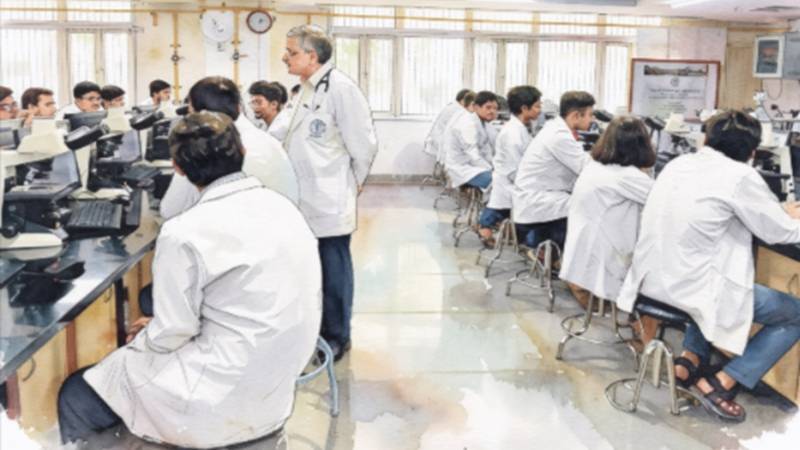
For decades, medical education in Punjab had a brutal but honest gatekeeping system. The first professional examination, held after the first two years of medical college education, stretched over weeks. A student had to appear before two experienced professors with decades of teaching experience for each of the three “basic science” subjects and pass every subject in theory, then defend that knowledge in viva exams. They also needed to pass a practical exam for each subject organised on a separate day. It was unstructured, subjective, and sometimes unfair. But it forced individual accountability and imposed a minimum pass standard. You could not hide behind an aggregate score. You had to prove – face to face – that you knew each of the examined subjects up to a pass level as judged by highly experienced subject specialists.
That system was far from perfect. But it was a system developed by the earliest teaching doctors and had served its purpose reasonably well for nearly two centuries in the Global North and for over half a century in Pakistan. Since it was a system evolved in the West at a time when they too faced a shortage of resources, both material and manpower, it suited our resource-limited settings. It asked for no more than experienced subject specialists who could make themselves available for weeks on end to individually examine hundreds of students. It demanded that a future doctor be able to make themselves understood both through writing and speaking, and to be able to speak, reason, and explain under pressure.
We have now replaced an imperfect system with something far more dangerous: a cheap imitation of Western assessment models that we do not have the capacity or the will to implement effectively.
Integration, Modernisation or Dilution?
The new system is presented as “integration” (of basic knowledge of the workings of the human body with clinical knowledge) and “modernisation.” It is meant to align us with international standards. In practice, it has reduced assessment to recall-based multiple-choice questions, removed meaningful viva voce exams, and lowered the pass mark to a level which, when applied to the poorly designed and administered exams, runs the grave risk of certifying medical students with less than even a minimal grasp of human body structure and function and its relationship to disease.
The current block examination system entails six block exams (three per year) for the first two years of MBBS. Each block exam consists of a theory exam and a “structured” practical exam conducted over 3-4 hours for batches of around 20 students each.
The theory exam comprises 140 single-best-type MCQs compiled from questions submitted separately by the faculty of the tested subjects (no “integration”), which, in addition to the three subjects traditionally taught in the first two years (anatomy, biochemistry, and physiology), now also include pharmacology, pathology, community medicine, and “behavioural sciences”. A student passes with a 50% overall score. There is no requirement to pass the core subjects of anatomy, physiology, and biochemistry separately, even at 50%. A student can fail the three core basic sciences and still pass, provided community medicine or pharmacology pulls the total high enough.
We have now replaced an imperfect system with something far more dangerous: a cheap imitation of Western assessment models that we do not have the capacity or the will to implement effectively
Consider an example. A student scores 18 out of 50 in anatomy, 14 out of 35 in physiology, and 8 out of 20 in biochemistry on the written exam. That is a failure in every major foundation subject. But if they score well enough in other subjects, their total reaches 70 out of 140. Under the current rule, that student passes. They are certified as ready for the next block. They are one step closer to a medical degree.
So, we need to ask ourselves: what basic criteria of competence has such a student achieved to merit a pass in that block?
Flawed Nature of MCQ Assessments
It is not just the marks distribution and pass marks either. The quality of the MCQs themselves is part of the problem. Most of these test nothing more than simple recall or recognition and so reward past-paper drilling, not deep learning. An MCQ exam which can certify adequate mastery of the tested material should include questions with well-formulated clinical scenarios that pose questions requiring the student to understand the scenarios and not just recall or recognise names or numbers, questions that require multi-step reasoning, and all questions with plausible distractors. Formulating such MCQs requires in-depth and wide knowledge of both basic sciences and clinical medicine, at least some basic training in the assessment of medical knowledge, and mastery of precise, unambiguous language needed for multiple-choice questions.
Our system, with very few exceptions, is not equipped to fulfil any of these requirements for a long list of reasons that are beyond the scope of the present discussion. We do not have the expertise to develop multiple-choice questions of the standard required to assess and certify medical students. And so, we rely on recycling MCQs from low-quality question pools widely available in the market, or on AI-generated MCQs that are scarcely, if at all, reviewed, and have thus adopted the format of the US system without adopting its rigour: a cheap and dangerous imitation.
The US examinations that we claim to imitate do not pass students at 50%. They do not allow subject-wise failure. Their questions are heavily clinical and integrated and are formulated by a dedicated team of examiners with training and experience both in their respective disciplines and in medical education and assessment. The questions are routinely revised and reviewed against the outcomes of the exams, new questions are added, and questions that fail to meet pre-set criteria are retired. Assessment is thus a tool to judge the students, the standards of teaching, and the tools of assessment themselves.
The MCQ exam we have come up with requires no more than a passing familiarity with the terms on the syllabus, a good head for guessing, and some past paper drilling applied strategically so that the minor subjects – where you can score by revising minimum material superficially and going through a few old question papers – are prioritised over any extensive or deep learning.
Illusion of the Practical Exam
Now let us consider the new “practical exam”. On paper, it looks modern and rigorous: first-year and second-year MBBS students rotate through 16 stations for each “block exam”. There are 11 objective structured practical exam (OSPE) stations for anatomy, biochemistry, physiology, pathology, and pharmacology. There are two objective structured clinical exam (OSCE) stations for professionalism, ethics, research, and leadership skills (PERLS) and core foundation required competencies (CFRC) and three objective structured viva exam (OSVE) “viva” stations: one each for physiology, anatomy and biochemistry.
It sounds like a real assessment. It sounds structured, objective, and comprehensive. But when you examine the actual weighting, the quality of questions asked, and the pass rules, the illusion collapses. The practical exam is designed in such a way that a student can fail all three viva stations and still pass the practical comfortably.
Out of a total of 146 marks for the entire practical exam for each block, less than one-third are allotted to the three viva stations. At a 50% aggregate needed to pass the practical exam for each block, a student can score 25% in the aggregate viva exam—thus failing all three vivas individually and the viva in aggregate—and still pass the practical exam for the block if they can score 60% in all the other stations in aggregate. In other words, a student who cannot answer more than one or two viva questions satisfactorily in anatomy, physiology, or biochemistry can still be certified as having passed the practical exam. The viva is not a gate. It is decorative.
But it gets worse: the “viva” station is not a real viva. The old viva was subjective and often harsh. But it forced a student to speak, defend and think aloud. An examiner could probe further. A student who gave a memorised first line could be pushed until their ignorance showed. Equally, a student could be asked questions widely from across the subject to assess their overall grasp of the material instead of marks being granted or deducted based on a few questions of narrow scope and limited depth.
The new OSVE station is not that. It is a six-minute station where the examiner asks five or six fixed questions from a card and must follow a pre-set, often tabulated key to award and deduct marks. There is little time for follow-up. The questions are frequently recall-level, reused from past papers, or so narrow in scope that they can be memorised. The role of the examiner is merely to tick a checklist on the provided key and then add up the number of checkmarks to assign a total score, acting as no more than the software that marks the MCQ exam.
A student can prepare for the OSVE by memorising previous station questions, learning one-word answers or “definitions,” recognising a diagram or specimen name, or repeating lists of “causes” without understanding. That is not a viva but more a verbal MCQ. The examiner knows this. The students know this. The administration knows this.
Gamifying the System
The practical stations (OSPE and OSCE), which are where most students make the effort of scoring around 70% so they can pass the practical overall, do not assess practical competence either but are another version of the written MCQ exam and the MCQ-like viva. It uses the props of a practical exam (all kinds of machines and equipment, and even human subjects) while testing very little, if any, real skill. Many OSPE stations comprise spot identification, labelling diagrams, answering a recall-based written question on a bench, or reciting a definition, a formula, or a principle of a chemical test. The allotment of marks to individual questions is haphazard and follows no principle. The same poorly worded question might carry 2 marks on day one of the exam and 4 marks on day three.
The practical exam includes at least 4 or 5 stations in each block exam for non-core subjects (32 to 40 marks) in each block of the first two professional MBBS exams. These stations are supposed to examine students' knowledge beyond anatomy and physiology and hence include pathology (disease), pharmacology (drugs), clinical skills (CFRC) and professional development (PERLS). But these stations are given a marks weightage that outweighs the scope and depth of the syllabus taught, and they end up being even more predictable and repetitive than the basic sciences stations. The result is that we have scores of published guides now available that address these 4 or 5 stations, and these slim volumes ensure that students score near-perfect marks in these with a minimum of effort, without developing any of the wide-ranging skills envisioned by the examiners. The fact that the first- and second-year students take no interest in these subjects during the term beyond marking attendance is a subject for another day’s discussion.
Students quickly learn that studying anatomy, physiology, or biochemistry in depth earns them almost nothing, while collecting easy marks from the predictable “practical” stations is enough to scrape through. The result is that a student can pass the practical exam with very little real knowledge of the basic medical sciences, and certainly no integrated understanding of how the body works in health and disease.
There is nothing wrong with structured stations in principle. But they only work if the stations are well designed, the questions require reasoning, the viva stations are deep enough to test understanding, and the pass standard requires competence in each domain. None of that is true here.
The result is that a student can pass the “practical” exam while failing every viva, never being required to explain anything, never demonstrating any ability to think or reason through a problem, academic or clinical, and never showing that they understand why an answer is right. They only need to score enough in the non-viva stations, which are themselves often repetitive recall-based or pattern-recognition tasks.
So, the students study for recognition, not understanding. They memorise past papers. They cram facts. The exam does not require them to think or reason or understand, and so they have no incentive to. It tells students that oral reasoning does not matter. It tells them that they do not need to practise explaining medicine in words. It tells them that a doctor’s ability to communicate, defend, and think aloud is irrelevant. And then we send them into clinical training and wonder why they cannot present a case.
Dilution of Standards
The case of the evolution of the 50% passing score is even more damning. It did not start at 50%. It started higher. It was 65%. Then students struggled to clear even that low bar. So the response was not to improve teaching, not to provide remediation, not to fix the questions. The response was to lower the pass mark to 60%. Then to 50%. That is pass-rate management. A legitimate pass mark is based on what a minimally competent student must know. It is not based on how many failures the administration is willing to tolerate. When a system lowers the pass mark because students are failing, it is no longer measuring competence. It is measuring institutional convenience.
We need to be honest about what is happening. It is the adoption of foreign labels without the foreign resources. It is a system designed to satisfy external paperwork while quietly dismantling the internal gatekeeping that once protected patients.
And the cost will not be visible next month or next year. It will be visible in ten years, in clinics and wards, when a doctor who passed at a 50% MCQ and “structured” practical exam cannot explain why their patient is deteriorating. It will be visible when a graduate who never faced a viva cannot present a case to a senior consultant. It will be visible when the health system realises that it has produced a generation of doctors who are good at recognising answers on paper but weak at reasoning with human lives.
Time to Reset?
This is not an attack on students. They are victims of a system that has taught them to survive rather than to learn. Nor is it an attack on all faculty. Many are doing their best under impossible conditions. The problem is a medical education system that has stopped asking the hardest question: are we producing doctors who actually know medicine? If the answer is no, then no amount of international alignment, integrated block labelling, or MCQ modernisation will fix it.
We need subject-wise minimum pass marks both in theory and in viva. We need a gating practical and viva that must be passed separately in at least the core subjects (majors) for each professional exam. We need better questions, not just more questions. We need faculty who are subject specialists, or at least faculty who are trained and rewarded to teach their assigned subjects. And we need a pass mark that is set by evidence, not by embarrassment.
If we cannot implement the new modernised “integrated” system in its true substance and spirit for lack of resources or will, then is it not better for us to reform the system we already had in a way that trains our doctors to work in this country with all its resource and infrastructure limitations? We should serve our patients instead of running factories to mint graduates who on paper meet the criteria to appear in foreign licensing exams, but who are barely equipped to treat patients independently for years if not decades after graduation—a luxury our poorly structured and funded healthcare system cannot afford.