

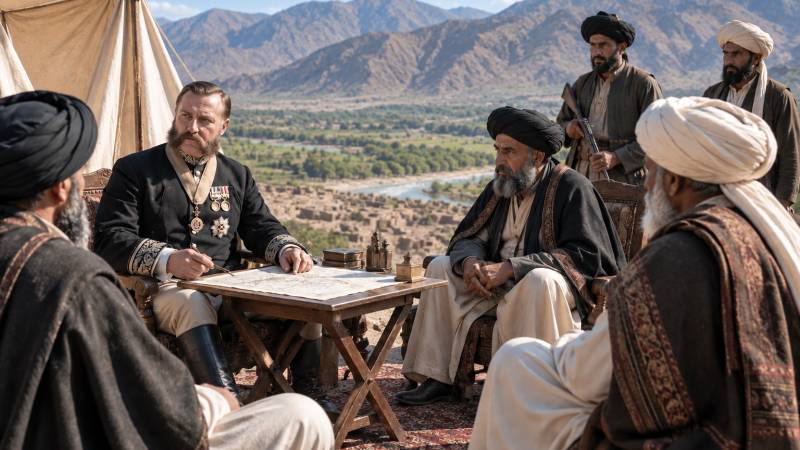
The system of indirect rule developed by Sir Robert Groves Sandeman was one of the most consequential developments in the colonial political history of Balochistan and the adjoining tribal areas of Dera Ghazi Khan and Rajanpur. Although Sandeman’s principal efforts took place in Balochistan, important foundations of his political method were laid during his tenure as Deputy Commissioner of Dera Ghazi Khan, beginning in 1866. His experience of dealing with the Baloch tribes of Dera Ghazi Khan and Rajanpur subsequently influenced the system that he developed and formalised in Balochistan during the 1870s.
The system assumed a more mature form through the political settlements of 1875–76, particularly the Mastung Settlement of 1876, and was institutionalised when Sandeman became Agent to the Governor-General in Balochistan in 1877. It is therefore more precise to associate the formal emergence of the Sandeman System with 1876–77 rather than simply with 1870.
At the heart of the system was a carefully constructed political bargain. The British sought frontier security, political stability, and tribal cooperation; in return, the Sardars received official recognition, financial allowances, privileges, and enhanced authority within their tribes. Traditional institutions such as jirgas and Sardar councils were retained but placed under British supervision. Thus, the system incorporated tribal Sardars into the colonial administrative structure.
The Sardars consequently became intermediaries between the colonial administration and the tribes. This arrangement enabled the British to exercise political control without assuming the considerable administrative and financial costs of governing every tribe directly. One important instrument was the Levies system, through which local tribesmen were recruited into security forces supported financially by the colonial government, while Sardars exercised substantial influence over recruitment and administration. Traditional tribal authority was thereby transformed into a more institutionalised form of political power, increasingly dependent upon the colonial state.
The Mastung Settlement of 1876 provides important documentary evidence of the emerging political arrangement. Among the Sardars specifically recognised were Mulla Muhammad Raisani, who was succeeded by his son Asad Khan Raisani; Taj Muhammad Zarakzai, who was succeeded by Mir Ghoar Khan Zarakzai; and Noor Din Mengal, who was succeeded by Shakar Khan Mengal.
Other tribal leaders, including those of the Bugti, Marri, and Khetran tribes, subsequently developed close relationships with the British administration. The historical record describes Ghazeen Khan Marri receiving Sandeman at Kahan, together with Murtaza Khan Bugti, Babel Khan Khetran, and other notables. The cooperation of tribal Sardars, however, was neither uniform nor permanently loyal to colonial authority. Sections of the Marri tribe strongly resisted interference in their traditional autonomy, and the British responded with military expeditions, punitive campaigns, and efforts to impose administrative control. Such conflicts demonstrate that the Sandeman System was a negotiated and contested arrangement rather than a universally accepted political system.
Sandeman’s tenure as Deputy Commissioner of Dera Ghazi Khan from 1866 was crucial to the development of his political method of indirect rule. He cultivated personal relationships with leading Sardars of the region. During his tour of the tribal hill areas in 1867, he was accompanied by prominent chiefs, including Sardar Haider Khan Gurchani, Sardar Jamal Khan Leghari, Sardar Nur Muhammad Khan Buzdar, Sardar Imam Bakhsh Khan Mazari, Sardar Miran Khan Dreshak, Sardar Sikandar Khan Khosa, and Sardar Mazar Khan Tibbi Lund, together with approximately 300 tribesmen.
This episode illustrates the nature of the relationship Sandeman was constructing with tribal leadership. Rather than relying exclusively upon direct administrative control, he sought to work through existing structures of tribal authority and to make their leaders partners in the maintenance of colonial order. The subsequent colonial administration incorporated major Baloch tribes, including the Mazari, Gurchani, Dreshak, Leghari, Khosa, Lund, Buzdar, Qaisrani, and others, into the broader Tumandari framework. The Nutkani were not incorporated into the Tumandari network in precisely the same manner, although their cooperation was also rewarded. The degree of cooperation, however, varied considerably among tribes and individual leaders.
The colonial administration rewarded cooperative Tumandars through financial allowances, official positions, and honours. Sardar Imam Bakhsh Khan Mazari, for instance, is reported in historical literature to have received an annual allowance of Rs. 10,000. Such payments demonstrated the material importance attached to chiefly cooperation. Some Tumandars were also incorporated into the formal administrative structure. Fazal Ali Khan Qaisrani, Sikandar Khan Khosa, and Jamal Khan Leghari, for example, were appointed Zaildars, thereby combining traditional tribal authority with formal colonial office. Colonial honours further reinforced this relationship. Din Muhammad Khan, acting Tumandar of the Leghari tribe, was reportedly granted the title of Khan Bahadur for his services to the colonial administration, while many others from different tribes were similarly honoured with the title of Khan Bahadur. Such honours were more than ceremonial; they integrated the traditional elite into the prestige and patronage structure of the colonial state.
The Sandeman System was not simply a method of administering territory but a method of restructuring political authority.
The cooperation between Tumandars and the British administration can also be observed during the colonial authorities’ campaign against Sardar Koura Khan Qaisrani. The colonial administration called upon cooperating Sardars to provide tribesmen. Historical records reveal that approximately 1,000 Buzdars, 700 Legharis, 400 Lunds, 50 Khosas, and 50 Gurchanis participated in the campaign. The participating tribes were subsequently rewarded. The episode reveals an important feature of indirect rule: the British could mobilise local authority and manpower rather than relying exclusively on their own forces. The Tumandar thus became an essential intermediary between the colonial administration and the population under his influence.
The history of the Nutkani tribe demonstrates an interesting example of cooperation predating the formal establishment of Sandeman’s policy. Colonial records identify Massu Khan Nutkani as an influential chief who reportedly cooperated with the British administration during the 1860s, before the establishment of Sandeman’s system. His involvement in irrigation development is particularly significant. The British encouraged influential chiefs and landholders to participate in canal construction and provided favourable arrangements, including grants of waste land. This suggests that the Sandeman System did not emerge in an institutional vacuum. Rather, it developed from earlier colonial experiments in incorporating influential tribal leaders into systems of administration, security, and economic development.
It is important, however, to recognise that tribal society remained politically diverse. Some Sardars cooperated with the British, while others resisted, negotiated, or altered their positions according to circumstances. Local accounts reveal that Sardar Aslam Khan Malghani, who is remembered as having resisted British authority and subsequently gone into exile in Kabul, requires further verification through primary colonial records. Nevertheless, such accounts remind us that tribal leadership did not automatically imply colonial loyalty.
The departure of the British in 1947 did not entirely eliminate the political structure established during colonial rule in Balochistan and the adjoining tribal regions. Relationships between state institutions and traditional Sardars continued in various forms, sometimes resembling earlier patterns and sometimes adapting to the requirements of a post-colonial state. The subsequent political history of Balochistan, however, cannot be attributed to the Sandeman System alone. Post-colonial state-building, economic inequality, questions of provincial autonomy, resource distribution, political representation, nationalism, and successive military and civilian policies have all shaped the region’s political trajectory. Nevertheless, colonial inheritance remains an important part of this historical context.
The enduring significance of the Sandeman System lies in the fact that it was not simply a method of administering territory but a method of restructuring political authority. The effects of such restructuring could extend well beyond the colonial period. Its legacy is therefore particularly relevant when examining contemporary relations among tribal authority, state power, and political patronage in Balochistan and the adjoining regions.
One illustrative example of the persistence of colonial institutional memory can be found in Fort Munro. During Sandeman’s tenure in Dera Ghazi Khan, he developed Fort Munro in 1869 and had a residence constructed there. The building was given the name P.A. House in the post-colonial period and was later named Sandeman Lodge, with his portrait placed at the entrance in the 1990s. This example illustrates the persistence of colonial memories within post-colonial institutions. The central historical question, therefore, is not simply whether the Sandeman System disappeared in 1947, but to what extent its political logic survived during the transfer of power from the British Crown to the post-colonial state.
This question becomes especially significant when viewed against the socio-economic conditions of Balochistan. Vast areas remain characterised by arid mountains, barren land, and scattered settlements where access to basic facilities remains limited. In many communities, people continue to face severe difficulties in obtaining water, while women and families spend considerable time collecting essential fuel, drinking water, and other necessities for their livelihoods. These realities highlight the gap that exists between political structures at the elite level and the everyday needs of ordinary citizens.
A comparison with post-independence India is also instructive, although the two experiences were not identical. Soon after independence, India undertook a series of land reforms in different states, including measures aimed at abolishing or weakening intermediary landlord systems and regulating land ownership. Pakistan did not undertake an equally comprehensive transformation of the intermediary structures inherited from the colonial period. Land reforms were introduced at different times, but the political influence of traditional landed and tribal elites remained significant. This difference raises an important question: to what extent did the continuation of intermediary political authority contribute to the consolidation of traditional elites in the post-independence political order?
The historical lesson is not merely of academic significance. If patterns of intermediary authority, patronage, and political privilege have persisted beyond the colonial period, their long-term consequences need to be examined in relation to the state’s broader responsibilities. These include ensuring equitable access to education, healthcare, water, infrastructure, and economic opportunities, particularly at the grassroots level. Such an approach makes it possible to assess not only the extent to which colonial-era structures of authority and privilege have persisted, but also their continuing implications for state capacity, political inclusion, and socio-economic development. It shifts the analysis beyond the mere identification of historical continuities to an examination of how these structures have shaped the relationship between the state and local communities in the post-colonial period.
Although the prospects for optimism may appear limited, there is an urgent need for policies that place human development and the provision of essential public services at the centre of governance. A meaningful understanding of Sandeman’s legacy should ultimately serve not to perpetuate historical divisions, but to explain their origins, persistence, and contemporary consequences. Such an understanding can contribute to the formulation of a more inclusive political and socio-economic future for Balochistan and its adjoining regions, grounded in greater political participation, equitable access to public services, and sustainable human development.