

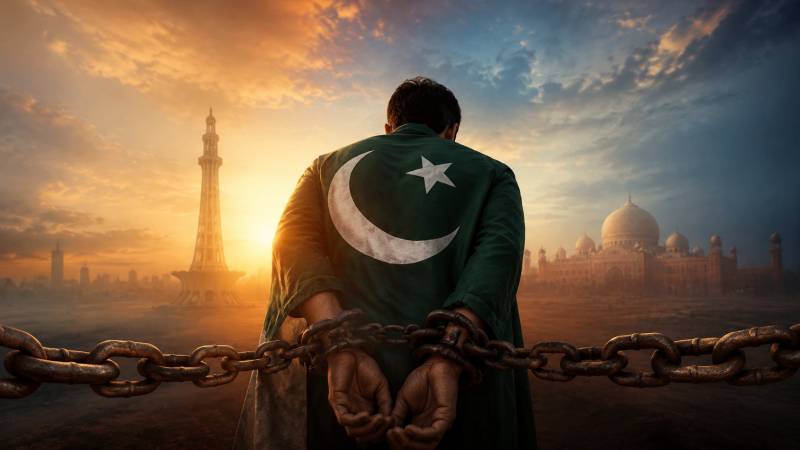
Seventy-nine years ago, we lived in chains, groaning under an exploitative colonial system and under the socio-economic monopoly of a Hindu majority. Poverty was acute. Backwardness and illiteracy marked our existence. We were vulnerable, and our voice went unheard. Millions, particularly women in rural areas, endured lives of unimaginable hardship. Hindu capital dominated markets and business, holding sway in every sphere of life, while our influential nawabs, jagirdars, pirs, mirs and ulema — the big names of today threw their weight behind the status quo to curry favours, taking pride in proximity to the rulers, many aligning themselves with the Congress. The ordinary Muslim, meanwhile, bore the brunt of alien rule and native monopoly alike.
Amid this bleak backdrop emerged visionary leaders like Sir Syed Ahmad Khan and Allama Iqbal who saw the way out: educationi to lift us from backwardness, and unity under a single platform to break the double yoke of British domination and Hindu monopoly. We found that way through blood and untold sacrifices. Our resolve broke an invincible empire, and it broke the conspirators and the cunning monopolists. Muhammad Ali Jinnah, simple, resolute, unbending — led that struggle to its victory, and a new country rose on the world map, carrying new hopes, new dreams, new aspirations.
We breathed a sigh of relief, believing emancipation meant freedom from every bondage: from economic hardship, from injustice; that it meant equality and opportunity thrown open to all, tolerance and harmony, and an egalitarian, exploitation-free society that would guarantee safety and security to its citizens under the rule of law. The Quaid-e-Azam envisioned a welfare state — secular, democratic, unhindered in its growth — where the common man, the true architect and author of freedom, would steer the destiny of the nation.
We drifted from our founders' ideals, honouring them more in the breach than the observance. Within twenty-five years we lost half the country. What remains in the truncated state that endures is polarization, instability, poor governance, institutional decay, elite capture, and corruption at its peak. Most of our national life has passed under the shadow of martial laws, authoritarian rule, constitutions suspended and abrogated, assemblies dissolved, elected prime ministers sent packing — one popular prime minister sent to the gallows. Undiluted democracy has never been allowed to take root; it has always been controlled, commanded. And our courts have too often supplied the oxygen that let usurpers legitimize their takeovers; courts that crawl for the ordinary citizen, yet fling open their doors in the dead of night for the powerful.
The economic picture is equally distressing. Nearly half our population lives below the poverty line. Eleven million people face acute food insecurity, worsened by climate shocks and floods. Our literacy rate — the lowest in the region at 63%. More than 25 million children remain out of school. Disease and crime stalk the streets. Inflation suffocates daily life. Unemployment hovers near 22 percent by independent estimates, even as more than 22 million young people enter an already overburdened job market each year — their despondency and frustration are not hard to imagine. Merit lies buried; jobs are sold. The police move swiftly and efficiently — but only to clear roads for the powerful and provide protocol for the elite, while criminals and dacoits remain beyond the law's reach. Justice is expensive and out of reach for the poor and the vulnerable. Our thanas have become hubs of power that thrive on currency and connections.
Most of our national life has passed under the shadow of martial laws, authoritarian rule, constitutions suspended and abrogated.
The poor pay taxes for the rich; the rich reap the benefits. Each government adds to a debt burden that the people alone must repay, in the form of harsher and harsher taxation —mounting debts that mortgage not just our finances but our sovereignty to foreign creditors. Why should the common man pay for the debts he did not create? And the circular debts he did not authorise? Why should he be made to pay, year after year, for the costly Independent Power Producer contracts thrust upon him by their rulers? These are the questions that continue to demand honest answers.
Rulers come and go, switching loyalties and parties as it suits them. If one member of a family sits with the ruling party, another aligns with the opposition — hedging the family's access to power either way. Like a game of cards, the winners and the losers remain the same; only the symbols on the table change. Parliament unites readily enough around its own perks and privileges, but shows little urgency in charting a real strategy to lift us out of the mirage of debts, bad governance, the grip of the IPPs, the weight of poverty — or in confronting crime, drugs, and the corruption that never seems to end.
Why, after seventy-nine years, are we still confronting our birthday problems? Nations that rose from the ashes of far greater devastation; Germany, Japan, South Korea, Taiwan, now stand as titans. Even Bangladesh, once poorer than us, now outpaces us in growth. These examples remind us that decline is not destiny if there is vision, integrity and will to reform. Let our rulers and our parliament think today about steering us out of crises, about opening a path radiant with the freedom we were promised — a freedom that has left the common man, the very soul and architect of Pakistan, trapped in a cycle of poverty, injustices, and betrayal, denied the fruits of the independence he won.
I ask: are we truly free, or still waiting to be emancipated from the shadows of servitude we fought to escape seventy-nine years ago? Can we say, even cautiously, that the colonizer and the old Hindu monopoly have simply been replaced by friendly brothers who now keep us in bondage of another kind?
The common man gave his blood for a dawn in which he alone would steer his own destiny. Instead he remains irrelevant and insignificant while the pirs, the mirs, and the opportunists who thrived at his cost yesterday continue to make windfalls today. For the true heroes of freedom, nothing has changed; they remain deprived of the very fruits their sacrifice purchased. The real Azadi will arrive only when every Pakistani is free from hunger, fear, debt, despair, corruption and elite capture and when the constitutional promises reach the streets, villages, slums, and those vulnerable who have waited for seventy-nine years.