

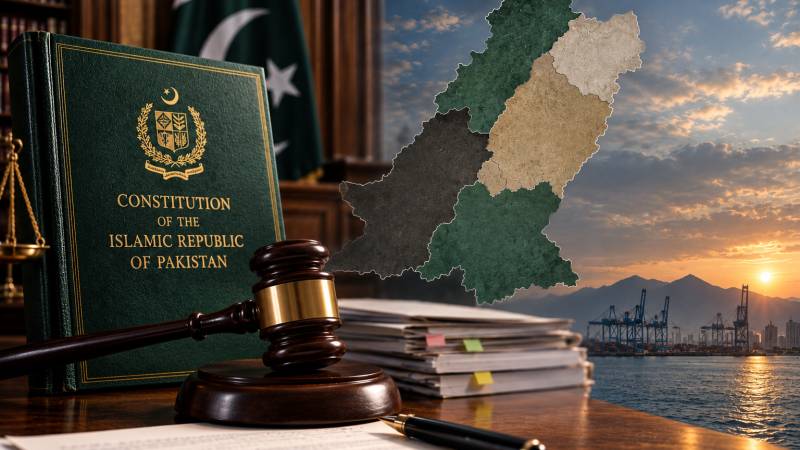
The week after 3 September 2026 should have been a pause. The Provincial Assembly of Sindh had spoken in the only language the 1973 Constitution recognises when provincial limits are in question. It rejected not only a new province carved from Sindh, but also any scheme, “by whatever name or description”, to detach a district or place any part of the province under a separate or federal arrangement. It recited its earlier instruments of 1948, 2012, 2013, 2014, 2019 and 21 February 2026, and it pointed to Article 239(4). That article is the lock on the door. A bill that would alter the limits of a province cannot even be presented to the President unless that province’s assembly has first given it the support of two-thirds of its total membership.
From Lahore and the federal capital, the same week, the demand was restated as if the Sindh Assembly had not sat. The Interior Minister said new administrative units would “eventually have to be created”, that no party could stop the process, and that if new provinces were created, Islamabad should be one of them. The Planning Minister has spoken of twelve to fifteen new units. A senior federal colleague has suggested that Islamabad might be the first experiment, later applied to the provinces. The ruling party’s Islamabad chapter has endorsed a draft for a 27-member capital assembly and provincial-style departments, while law and order and master planning would remain with the centre. This is not an administrative footnote. It is a test of whether Pakistan still intends to be a federation of four units whose identities the Constitution treats as given, or a state in which maps are instruments of weekly politics. Two confusions are being put to work together.
And a country that has already paid for one cartographic experiment cannot afford to pretend that the next one will be cheaper.
The first is the confusion between governance and territory. That Pakistan’s institutions have failed too many of its citizens is not in dispute. That is not a fact about the number of lines on the map. Article 140A already obliges every province to devolve political, administrative and financial authority to elected local governments. If Lahore or Karachi are not adequately run, the first duty is to run the cities. If Islamabad is voiceless, the first duty is to give it a proper elected municipal government. Dressing either task up as the creation of a new federating unit does not make the task smaller. It makes the Constitution larger than it was written to be.
The second confusion is new: Islamabad as a province. There is a respectable case for giving the capital an elected civic government and a budget that does not depend on the sale of CDA plots. That case can be argued under existing law. It does not require inventing a fifth federating unit as a rehearsal for the dismemberment of the other four. First, the capital is offered “provincial-style” powers with federal reservations intact. Then the same vocabulary is carried to the provinces, and the assembly that has already said no is told that it is being inflexible. Reform of the Islamabad Capital Territory is one thing. Using Islamabad as a precedent against any province whose assembly has not consented is another. The Constitution does not recognise that substitution.
There is a third unclarity, and it is political. The country does not possess a settled parliamentary mind on this question. One coalition partner in the centre is the author of the loudest demand; another has just recorded, in Karachi, that Sindh will not be divided; a third calls the debate premature; the principal opposition warns that a hasty map will weaken the federation. In such weather, “the people will decide” is not a procedure. It is an evasion. Article 239(4) already names who must decide and the majority they must form. A referendum cannot do that work. A talk-show majority cannot do it. If the lock is inconvenient, the honest course is to propose an amendment and count the votes.
The consequences of going beyond the Constitution are not theoretical. One Unit was introduced in 1955 in the name of efficiency and integration. It dissolved historic provinces and belongs to the pre-history of 1971. The 1973 compact was the reply: four federating units and a rule that none could be altered behind its assembly’s back. The Eighteenth Amendment walked further in the same direction. To reopen that compact now, in a season of uncertain mandates, is a wager that the federation’s scarcest asset, trust among its units can survive another experiment. New provinces would also force open the National Finance Commission and invite every unresolved claim to find a line of its own.
Senses, here, means something modest. It means noticing that the same governance failures are alleged in Lahore after the 2025 floods as in Karachi after Gul Plaza, and that nobody treats the division of Punjab as the remedy. It means noticing that Sindh’s mobilisation against the six-canal scheme stayed inside the constitutional order; Assembly, CCI and IRSA and that the same political community is now invited to treat its own territory as negotiable. A federation in which one province’s limits are sacred and another’s are a seminar topic is not a federation for long.
The constructive path is unglamorous, which is why it is neglected. Empower local government under Article 140A. Honour Article 158 on gas and Section 7 of the 1991 Water Accord on the river to revive the delta. Repair the NFC by argument, not by cartography. Give Islamabad a municipal voice without conscripting the capital into a campaign against the provinces. If, after that work, a province still wishes to alter its own limits, the door Article 239(4) describes remains the door.
Until then, the duty of those who hold federal office is not to announce that history has already decided. It is to read the article that is still in force, to hear the assembly that has already voted, and to let both senses and the Constitution prevail. The map is not a toy. The compact is not a draft. And a country that has already paid for one cartographic experiment cannot afford to pretend that the next one will be cheaper.