

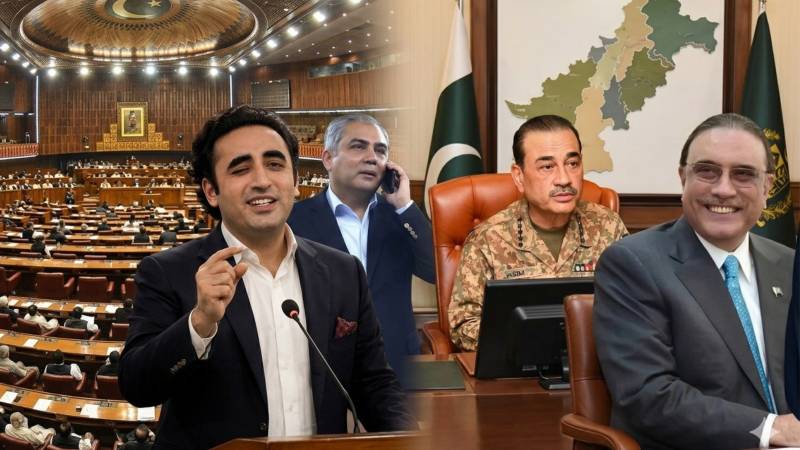
The debate over the creation of new provinces in the country has once again taken center stage in the political landscape. Conferences and seminars are being held across the nation, television discussions are focusing on the need for new provinces, and various political and administrative circles are arguing that the current provincial structure is no longer sufficient to cope with the growing population burden, urban sprawl, and the modern demands of governance. Superficially, this appears to be an administrative case: divide the large provinces, establish new administrative centers, and bring authority closer to the people's doorstep. However, the manner in which this debate has been revived has raised a fundamental question in Sindh, Balochistan, and Khyber Pakhtunkhwa: Is there an attempt, under the guise of creating more provinces, to dilute the autonomy granted to provinces through the 18th Amendment and to re-strengthen federal authority?
This question is crucial because in Pakistan, a province is not merely an administrative unit. A province is identity, history, language, culture, land, water, natural resources, and political power. Therefore, limiting the redrawing of provincial boundaries to just drawing new lines on an administrative map would be an oversimplification of Pakistan's political reality.
Here, even the words used carry political weight. If a new unit is called a "new administrative unit," it appears to be an administrative reform. But if it is to be a constitutionally recognized province, it brings with it a new assembly, a new Chief Minister, a new bureaucracy, a new share in the NFC, new representation in the Council of Common Interests, and a new distribution of political authority. In essence, a new province is not just a new administrative center but a new distribution of power and resources.
This topic is particularly sensitive for Sindh. Sindh is not just a geographical region but the cradle of a civilization thousands of years old. The Indus River, Mohenjo-Daro, the Sindhi language, the Sufi tradition, and the spiritual legacy of Shah Abdul Latif Bhittai, Sachal Sarmast, and Lal Shahbaz Qalandar have deeply connected the collective consciousness of the Sindhi nation to its land, river, and identity. In Sindhi civilization, the river is not just a source of water but a metaphor for life, agriculture, trade, music, poetry, and collective existence. That is why, for Sindh, the province is not just an administrative boundary but a historical and civilizational identity.
This is precisely why the talk of dividing Sindh is no longer just an administrative reform but becomes a question of identity, land, water, and political power. Opposition to new provinces in Sindh is not limited to the Pakistan Peoples Party; nationalist parties, lawyers, intellectuals, and various social circles also harbor a deep-seated feeling that no compromise can be made on the unity of Sindh.
On the other hand, in urban Sindh, the MQM has long been demanding new provinces or new administrative units. This demand has its own political history and arguments. The issue is not whether the MQM's demand is right or wrong. The real question is why an old political demand now appears to be part of a broader national campaign. When conferences, seminars, TV programs, political statements, and voices associated with powerful circles consistently start speaking in one direction, it is natural to ask: Is this merely an administrative necessity, or is there a broader political strategy being advanced alongside it?
The primary concern of political circles in Sindh, Balochistan, and Khyber Pakhtunkhwa is that if the current provinces are further divided into smaller units, the existing balance of power between the federation and the provinces could tilt in favor of the center. The 18th Constitutional Amendment strengthened provincial autonomy within Pakistan's federal system, devolved numerous powers to the provinces, and made them politically and administratively more powerful. The NFC Award also provided constitutional protection to the provinces' share of federal resources.
Now the question arises: if large provinces are divided into smaller units, won't their collective political power also be fragmented? Won't their bargaining power vis-à-vis the federation decrease? Won't the NFC formula be opened for renegotiation? And won't the entire process result in the federation gaining more authority in financial, administrative, and political decisions?
This is the point where the debate on new provinces moves beyond administrative reform and becomes a debate on the balance of federal power. The NFC is not merely a financial formula. It is a fundamental pillar of the distribution of power between the federation and the provinces.
In the event of new provinces being created, questions inevitably arise about how their share will be determined, what impact it will have on the shares of existing provinces, and how the entire NFC system will be restructured. If a province is divided into two or three units, will the total provincial share remain the same or be redistributed? If the total share is maintained, who will wield the political power? And if the number of provinces increases, how much more leverage will the federation gain for political influence through resource distribution?
The question of water is even more sensitive. For Sindh, the water of the Indus River is not just a natural resource but a question of life itself. New canal projects have already created intense political sensitivity in Sindh. Political circles in Sindh believe that any change in water distribution cannot be viewed separately from provincial autonomy. If new provinces come into existence, the entire balance of representation and decision-making in water distribution bodies, the Council of Common Interests, and IRSA will give rise to new questions.
Linked with water is the question of mineral resources. The issue of authority over gas, oil, minerals, and other natural resources in Balochistan has been part of a political conflict for decades. There is already a feeling in Balochistan that the federation and other parts of the country benefit from the province's resources while the local population does not receive its proportionate share. Therefore, when the talk of new provinces arises, Baloch political circles do not see it merely as a change to the administrative map. They also face the question: whose land, whose resources, and who holds the decision-making authority?
Maulana Fazlur Rehman has given this debate an even sharper political language. His stance is that the campaign for new provinces is not just an administrative necessity; behind it lies a desire to gain control over the NFC Award and provincial mineral resources. According to him, behind the debate on dividing provinces is the hidden issue of a new distribution of power and resources. But Fazlur Rehman has also raised another fundamental question: the question of priorities.
He argues that terrorism and unrest continue in Khyber Pakhtunkhwa and Balochistan; the house is on fire. At such a time, what wisdom is there in talking about dividing the house? In his view, the state's primary priority should not be the formation of new provinces but establishing peace, state writ, and the protection of citizens in those areas where people are continuously facing terrorism and bloodshed.
This argument brings the debate on new provinces to a fundamental question: why new provinces, why now, and under what priority? If the goal is truly to improve governance, then can administrative powers not be devolved to lower levels within the current provinces? Can people not be provided better services by giving municipal bodies real financial and administrative authority? Is creating a new province the solution to every administrative problem? And if new provinces are an unavoidable solution, then why is it not first clarified what their boundaries will be, how resources will be distributed, and how the consent of the concerned people will be obtained?
Here, the stance of the Awami National Party (ANP) and Aimal Wali Khan in Khyber Pakhtunkhwa also becomes important. For the ANP, the identity of a province is not merely a matter of administrative boundaries but is part of a long political and historical struggle. Therefore, their question in the debate on new provinces is the same: is this truly happening due to public need, or is there an attempt to change the existing provincial power structure?
Thus, despite different concerns, the various political forces in Sindh, Balochistan, and Khyber Pakhtunkhwa converge on a common point: could the federal balance established after the 18th Amendment be changed through the new formation of provinces?
The position of the Pakistan Muslim League-Nawaz (PML-N) is also interesting here. The PML-N is part of the federal government, so it is not easy for it to openly dissent against powerful circles. On the other hand, completely ignoring the sensitivities of Sindh, Balochistan, and Khyber Pakhtunkhwa could also be politically dangerous for it. There is a political history of demands for new provinces in Punjab, and as a party in the federal government, the PML-N must also maintain a balance between the center and the provinces. Therefore, its cautious approach on this matter is perhaps because it wants to see in which direction this campaign is heading and what its real political objective becomes.
And then there is the PPP. The PPP is currently in an extremely complex political position. It is part of the current hybrid system, an ally of the federal government, and also under pressure to work with power centers. It is being given the message that cooperation with the current setup is essential, otherwise it too may face political and other difficulties.
But despite all this pressure, the PPP has so far not retreated on several fundamental interests of Sindh. It remains firm on opposing any tampering with the current NFC Award formula, safeguarding Sindh's reservations on water distribution, resisting new canal projects, defending the 18th Amendment, and opposing the division of Sindh.
It is this contradiction that makes the PPP's current politics significant. It is within the system, but not with every decision of the system. It is part of the federal government, but it has red lines on certain fundamental questions concerning Sindh's rights. It does not want a direct war with the power centers, but if the question of Sindh's resources, water, the NFC, the 18th Amendment, or provincial unity arises, it is not possible for it to remain completely silent.
This is where President Asif Ali Zardari's role becomes crucial. That is why people are asking: has President Asif Ali Zardari silently set up a fielding against the establishment? Because his political style has never been about direct confrontation. He is a chess player. He lets each player play in their own field, maintains contacts, and attempts to shift the balance of power through political alignment rather than direct conflict.
If the current situation is viewed from this angle, then the PPP in Sindh, nationalist circles in Sindh, the ANP in Khyber Pakhtunkhwa, Maulana Fazlur Rehman at the federal level, and circles in Balochistan supportive of provincial autonomy could draw closer to each other on this single issue. Their ideologies are not the same, their political interests are also different, but if the common question becomes that provincial authority, the NFC, water, and natural resources are being undermined by increasing the center's influence through the division of provinces, then an informal political alignment could emerge.
This is precisely political fielding. It is not necessary for President Asif Ali Zardari to stand on the field himself and declare that he is against the establishment. He can keep the PPP mobilized within Sindh, Fazlur Rehman can resist from his position, the ANP can fight its case in Khyber Pakhtunkhwa, nationalist parties can raise their voices in Sindh and Balochistan, and the PML-N, while remaining in government, can maintain a calculated distance. In this way, everyone would appear to be playing in their own field, but collectively, a political siege could be established that would become an obstacle to any unilateral decision.
And if the situation escalates to a major constitutional or political confrontation, President Asif Ali Zardari also has the card of presidential resignation, which could be an extremely powerful political weapon. A resignation would not just be an act of leaving an office; it would be seen as an expression of major dissent regarding the federal setup, provincial autonomy, and the current political system. This is why the talk of resignation can also be viewed not merely as an administrative step but as a card of potential political pressure.
The real question is whether President Asif Ali Zardari will actually play such a card at this stage, or is his priority still to protect his political and provincial interests while remaining within the system? Another important question here is: are new provinces truly necessary for governance?
If Pakistan's large provinces have become administratively too vast, then new provinces could be one solution. But another solution could be a genuine local government system, devolution of powers to lower levels, financial autonomy for local governments, and administrative reforms. If people have to constantly look towards the provincial or federal capital for the resolution of their basic problems, then the issue is not just the size of the province, but also the structure of governance. Therefore, the real battle is perhaps not over new provinces, but over authority.
The question is whether the political, financial, and administrative power devolved to the provinces after the 18th Amendment is now being pulled back towards the center through new provincial divisions.
If so, then the NFC is no longer just a financial formula. Water is no longer just water. New canals are no longer just irrigation projects. Minerals are no longer just wealth beneath the ground. And provinces are no longer just lines drawn on a map. They all become centers of power.
That is why the consent of the concerned people is a fundamental question in this debate. Can a province be divided without the clear consent of its people? Can the unity of Sindh be altered against the will of the Sindhi people? Shouldn't parliamentary consensus, approval from the concerned provincial assemblies, and public consultation be basic prerequisites before the establishment of new provinces?
This question is also important because the formation of provinces in Pakistan is not merely an administrative act but a constitutional process. Its effects last for generations. Once new political boundaries are established, they create new political interests, new elites, new bureaucracies, new assemblies, and new resource distributions. Therefore, any provincial division must be viewed not just through the lens of today's governance issues but in the context of the federal balance for the coming decades.
Pakistan currently stands at an important political and constitutional crossroads. On one side are the proponents of new provinces who deem it an administrative necessity. The MQM is talking about new administrative units, arguments in favor are being presented in various conferences and seminars, and an effort to build public opinion is visible in the media.
On the other side, the PPP and nationalist circles in Sindh are sensitive on the issues of dividing Sindh, water, the NFC, and the 18th Amendment. In Balochistan, the question of natural resources and provincial authority is already acute. In Khyber Pakhtunkhwa, various forces, including the ANP and Maulana Fazlur Rehman, are raising questions about the campaign for new provinces. Fazlur Rehman is clearly stating that when the house is on fire in Khyber Pakhtunkhwa and Balochistan, it is not wisdom to talk about dividing the house.
And amidst this entire scenario, the PPP stands in a peculiar position: it is both a part of the hybrid system and the guardian of provincial interests against some of its potential decisions. It is within this contradiction that the real test of President Asif Ali Zardari's politics lies hidden.
If he maintains his red lines on the NFC, water, new canals, the 18th Amendment, and the unity of Sindh while remaining within the system, he can establish a political hurdle without direct confrontation. If he allows Fazlur Rehman, the ANP, nationalist circles in Sindh, and other provincial forces to remain active in their own domains, this could become a political fielding that would not be easy to break.
And if, at the end of this fielding, the resignation card is ever placed, then the matter will escalate far beyond new provinces. Then the question will not be how many provinces Pakistan should have. The question will be who should hold power in Pakistan? The federation? The provinces? Or the balance established by the Constitution between the two?