

On 30th July, the Interior Minister delivered a very important speech at Pakistan’s first economic summit at the Jinnah Convention Centre in Islamabad. This was the first summit of its kind. Businessmen were invited from all parts of the country. The last and key speech of the summit was delivered by Mohsin Naqvi. In his speech, he said that the current system of Pakistan had collapsed and that no matter how hard we worked or how much time we gave it, it would not work. As a solution to the collapsed system, he said we had to work on creating new provinces and new administrative units.
The next day, the DG ISPR also gave a press briefing to the media, where he not only endorsed the statement about the system’s collapse but also gave a similar solution to the problem. This sparked a new debate in the country. Some people supported the idea, while others opposed it. But it was clear that the debate about changing the system had now entered a new phase.
You may like it or not, but Mohsin Naqvi’s statement represents the mindset of some of the most powerful people in the country the people who actually run the country. You can easily understand the power of Mohsin Naqvi from a statement by Defense Minister Khawaja Asif. He said that Mohsin Naqvi is the most powerful minister in the cabinet and that, on some issues, he is not answerable to the Prime Minister.
According to the Economist Intelligence Unit’s annual report on democracy, Pakistan is under a hybrid model. Defense Minister Khawaja Asif has also given similar statements many times, saying that Pakistan is successfully running under a hybrid model. Under hybrid governance, state affairs are managed jointly by civilian and military officials. But in reality, the military plays the dominant role, while the civilian leadership provides political cover for the policies of the military leadership.
From all of this, you can understand the importance and seriousness of Mohsin Naqvi’s statement. Now, when it seems clear that there is a desire to change the system and the only visible solution presented so far is the creation of new provinces, we need to ask: can creating new provinces really solve Pakistan’s problems? Are Pakistan’s problems actually caused by the size of its provinces?
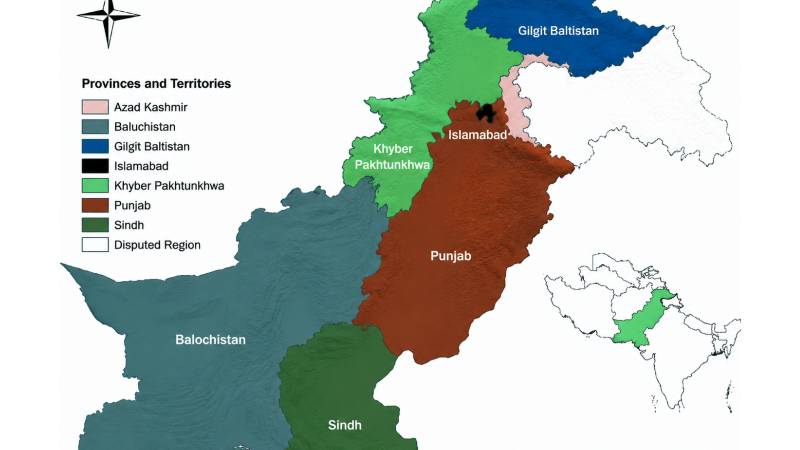
The debate over new provinces is very old in Pakistan, but the recent debate started after the 18th Constitutional Amendment. When NWFP became Khyber Pakhtunkhwa, the Hindko-speaking population started demanding a Hazara province. There are also demands for new provinces in South Punjab, Bahawalpur, Pashtun Baluchistan and South Baluchistan, as well as demands to make Karachi and Hyderabad separate provinces and to give Gilgit-Baltistan provincial status.
These demands for new provinces are largely based on geography and ethnicity, and nationalist parties support many of them. The mainstream parties, such as PML-N, PPP and PTI, are not particularly interested in creating new provinces. In some areas, they even oppose the idea. For example, the PPP opposes the creation of new provinces in Sindh.
The current idea of creating new provinces is administrative and more focused on governance. Its supporters believe that the existing large provinces are a hurdle to good governance and effective service delivery at the lower level. They want to decentralize the system and build a strong local government system. This would not only increase people’s participation in the system but also improve service delivery. They also give the examples of neighboring countries. China has 23 provinces, Afghanistan has 34 provinces, while India has 28 states and eight union territories. They believe that if these countries can create more provinces or administrative units, why can’t Pakistan?
The argument for creating new provinces and smaller administrative units is that power should be transferred to the lower levels of government.
It is absolutely true that Pakistan is facing governance failures. But Pakistan has many other serious problems as well. Around 45% of the population is living below the poverty line, 25 million children are out of school, and millions of people are unemployed. Terrorism, inflation, economic instability and political instability are also at serious levels.
Supporters of new provinces argue that larger provinces are a problem for effective service delivery. Punjab is the largest province of the country, but it also has the highest per capita income compared with the other provinces. Punjab has the highest literacy rate, lower poverty levels and performs better than other provinces on several human development indicators.
I am personally not against the creation of new provinces. But if the largest province is performing better on several development indicators than smaller provinces, how can I convince myself and others that creating new provinces is the only solution to Pakistan’s problems? If the biggest province is performing better than the smaller ones, then perhaps the size of a province alone is not the real problem.
The argument for creating new provinces and smaller administrative units is that power should be transferred to the lower levels of government. But the last local government elections in Punjab and Islamabad were held in 2015, and the elected local governments completed their terms in 2021. After that, no local government elections were held for years. Even in Islamabad, local government elections were postponed four times.
It would be better to fully functionalize the existing local government system before conducting another expensive experiment. Pakistan is also facing severe economic instability. The economy is being supported by the IMF, World Bank and friendly countries. Creating new provinces would require significant financial resources, and arranging those resources would be a major challenge for the state. It would take billions of rupees to establish and make a new province fully functional. The government has still not fully fulfilled its promises regarding the former FATA and the tribal areas of Khyber Pakhtunkhwa. In this scenario, it seems difficult to fully functionalize new provinces and allocate sufficient resources to them.
My suggestion is to stop these expensive experiments and fully implement the existing model of governance provided by the 1973 Constitution. Fill the gaps in the system and work with honesty and commitment. Evolution and strong commitment are the best options for Pakistan. Taking big steps without addressing the existing problems is risky, and making extreme decisions can create even more difficulties for the country. We should start believing in the Constitution and commit ourselves to running the country according to it at any cost. That can help bring Pakistan out of many of the problems it is facing today.