

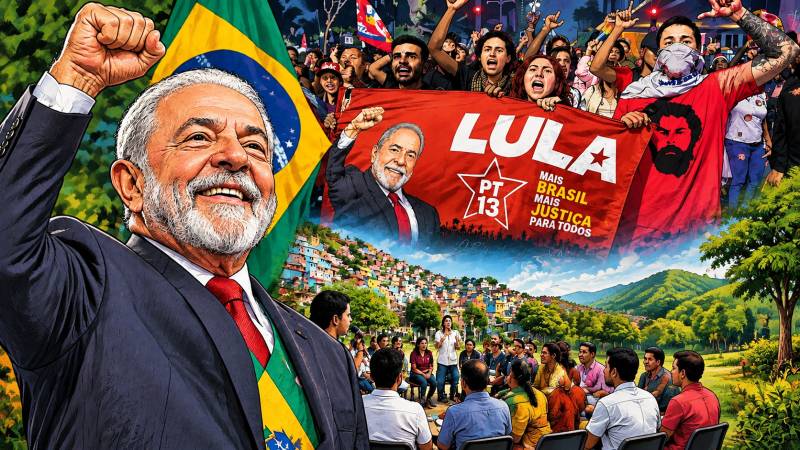
Luiz Inácio Lula da Silva’s re-election on 25 October 2026 is more than another demonstration of political resilience. Raza Rumi, writing in The Friday Times, rightly emphasises Lula’s organisation, policies and performance over charisma alone. Yet one element of his political endurance remains understated. Brazil’s constitutionally protected municipalities, substantially empowered through devolution, created democratic spaces in which the Workers’ Party could organise, govern and remain relevant even when its leaders were out of national power.
Brazil’s 1988 Constitution recognises municipalities as autonomous components of the federation. They elect mayors and councils, legislate on local matters, collect designated taxes and receive constitutionally structured transfers. Their autonomy is not absolute, nor is their capacity uniform. But municipal government is a durable arena of democratic competition, not merely an administrative privilege granted by a state government.
Here lies perhaps Brazil’s most important lesson for Pakistan’s unfinished debate on devolution. Brazil’s Constitution does not merely instruct states to establish municipalities; it recognises them as autonomous constituents of the federal order, with constitutionally defined powers and responsibilities. Pakistan’s Article 140A, by contrast, acknowledges local government but leaves much of its authority and institutional security dependent on provincial legislation. The difference is between constitutional recognition and constitutional protection. Brazil has embedded municipal autonomy within its federal architecture; Pakistan has yet to complete that architecture below the provincial tier. The challenge is not simply to create local governments, but to secure their place in the constitutional order.
The demographic contrast makes Pakistan’s deficiency more conspicuous. Brazil, with an estimated 214 million people, has 5,569 municipalities—about 38,500 residents per municipality. Pakistan, with a projected population approaching 260 million, has more people living within a fraction of Brazil’s geographical expanse. Yet its extensive network of local bodies does not possess equivalent constitutional standing.
Indeed, Pakistan is hardly short of councils. A widely used 2017–18 inventory recorded 2,055 urban councils, including 1,598 urban union committees, alongside 7,979 rural union councils and thousands of village and neighbourhood bodies. These are historical classifications, not a reliable count of today’s institutions, which provincial reforms have repeatedly redesigned. Nevertheless, they expose the paradox: numerous councils do not necessarily amount to meaningful devolution. What Brazil constitutionally protects, Pakistan largely leaves to provincial discretion. An elected council without dependable finance, control over relevant officials or secure authority is too often a local office rather than a local government. The test is not how many councils appear on a chart but how much power they can exercise on citizens’ behalf.
For Lula’s Workers’ Party, the municipal tier was more than a delivery channel. Before Lula won the presidency in 2002, party-led administrations in São Paulo and Porto Alegre served as laboratories for governance. Porto Alegre introduced participatory budgeting in 1989, inviting neighbourhood assemblies to influence public investment. Residents could see which priorities were chosen, which services improved and which promises went unfulfilled. That experiment had limitations and was weakened after the party lost the mayoralty. But it established something national rhetoric cannot supply; the opportunity to earn political credibility through demonstrable local performance. Councillors and mayors could cultivate competence, build relationships and become leaders without waiting for patronage from the federal centre. Even after electoral defeat, parties could continue political work elsewhere.
Bolsa Família illustrates the same tiered logic in social policy. Federal authorities establish rules and finance cash benefits; municipalities register eligible households through CadÚnico a social welfare targeting registry for low-income populations, connect them with local health and education services, and help maintain programme data. National resources reach citizens through institutions that know their communities. Benefits are designed as entitlements rather than favours personally bestowed by politicians. These arrangements helped make Lula-era policies visible and durable. His sustained appeal among poorer Brazilians also reflects many other forces; trade unions, social movements, electoral coalitions, economic performance and campaign mobilisation. Municipal devolution cannot be credited as the single cause of his electoral success. It helped provide an institutional setting in which party organisation and a public-service record could outlast a change of national leadership.
The difference is between constitutional recognition and constitutional protection. Brazil has embedded municipal autonomy within its federal architecture; Pakistan has yet to complete that architecture below the provincial tier.
Lula’s 580 days in prison, the subsequent annulment of his convictions and his return to the presidency in 2022 form a compelling story. His latest victory adds another chapter. But the deeper lesson is not simply that a popular politician can return. It is that a political movement has greater opportunities for continuity where public power is distributed across multiple elected tiers. Pakistan’s constitutional architecture tells another story. Article 140A requires provinces to establish elected local governments and devolve political, administrative and financial authority. It does not, however, specify the same detailed guarantees of powers or fiscal security found in Brazil. Article 160 provides a more elaborate framework for financial distribution between the federation and provinces. Our republic protects provincial shares more precisely than it protects municipal autonomy.
The consequences are deeply political. When municipal bodies cannot reliably plan, tax, administer and deliver services, national and provincial legislators become brokers of local development. Constituents approach powerful patrons for what functioning institutions should provide as a matter of right. Parties learn to prize proximity to a national leader over competence in local administration. Most damagingly, the struggle for federal or provincial office becomes an existential contest. Pakistan has seen Benazir Bhutto, Nawaz Sharif and Imran Khan subjected to imprisonment or political exclusion in different circumstances. Their experiences should not be conflated, nor should any leader be exempt from lawful accountability. But a system with few meaningful alternative arenas for political service raises the costs of defeat and makes every attempted comeback depend too heavily on the centre.
An honourable comeback should have a democratic route. A party defeated nationally ought to be able to govern cities, improve districts, nurture younger leadership and rebuild public confidence. A former leader should be able to return through lawful organisation, public performance and credible elections—not through a private bargain or a confrontation that immobilises the state. Devolution cannot guarantee such a return. It can keep legitimate avenues for one open. Pakistan already has a valuable national social-protection platform in the Benazir Income Support Programme. Empowered municipalities could better coordinate schooling, nutrition, preventive healthcare and local assistance around it, while national safeguards protect beneficiary selection and payments from patronage. The Brazilian lesson is institutional integration, not mechanical imitation.
The constitutional remedy is equally clear; protected local functions and tenure, credible elections, predictable Provincial Finance Commission transfers, and authority over the personnel who implement municipal decisions. A proposed Article 160A could give local finance a constitutional floor alongside Article 140A. Functions, funds and functionaries must travel together. Brazil has its own clientelism, inequalities and political polarisation. But its tiered federation demonstrates that democratic life need not depend entirely on controlling the national capital. Political parties can lose at the top and still govern, serve and renew themselves below. Pakistan does not merely need another political comeback. It needs a republic in which coming back does not require bringing the system to its knees.
Endnote: The Pakistani council figures derive from the Commonwealth Local Government Forum’s 2017–18 country profile. Its summary reports 619 urban councils, while its detailed inventory lists 2,055, including urban union committees. These historical classifications are not a verified 2026 count.