

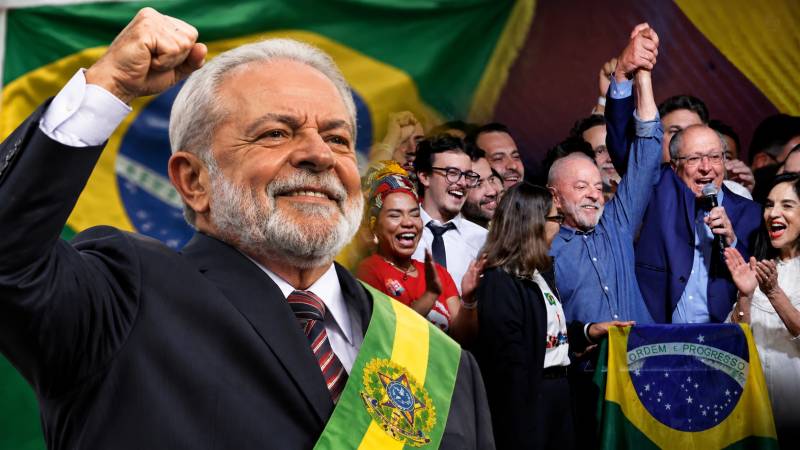
Brazilian President Luiz Inácio Lula da Silva, commonly known as Lula, has won the second round of the presidential election held on 25 October 2026, securing election to the presidency for a fourth term. According to Brazil’s electoral authority, Lula received 51.79 per cent of the vote, while his opponent, Flávio Bolsonaro, secured 48.21 per cent. This result represents not merely a contest between two political candidates, but also reflects the ongoing struggle between competing political visions concerning Brazil’s social divisions, democratic institutions, economic policies, and future. To understand Lula’s victory in the context of left-wing politics, it is essential neither to view it simply as an electoral triumph nor to regard it as a guarantee of immediate socialist transformation. Its significance lies in a fundamental question: can an elected government, while operating within the existing framework of a capitalist economy, take effective measures to reduce poverty and class inequality, protect workers’ rights, address environmental destruction, and overcome the crisis in public services?
There is no doubt that Lula’s political journey has a background distinct from that of conventional ruling-class politics. Coming from a working-class background, Lula was active in Brazil’s labour movement and played a significant role in the founding of the Workers Party (PT) in 1980. His political identity has remained closely associated with workers organisations, social rights, and the struggle against economic inequality. The fundamental political context of Lula’s victory can be traced to Brazil’s social and economic inequalities. Brazil is the largest economy in Latin America, yet the benefits of its economic development have not been distributed equally among all sections of society.
From the perspective of Marxist political economy, elections in such a society are not merely contests based on the popularity of individual candidates; they are also arenas of political struggle over competing class interests, social expectations, and the distribution of state resources. This does not mean that every voter’s decision is determined solely by their class position. Religion, race, region, political identity, culture, and democratic values also influence voting behaviour. Nevertheless, it is impossible to provide a comprehensive explanation of political outcomes while ignoring economic inequality. The significance of Lula’s political programme lies in its potential to use state policies to provide greater protection to those sections of society that are disadvantaged by the unequal distribution of power within the market, measures to increase the minimum wage, strengthen social protection, improve public healthcare and education, and eradicate poverty form part of this debate. However, it is also important to recognise that social welfare programmes and changes to the fundamental structure of capitalist property relations are two distinct matters. Poverty-reduction programmes can bring genuine improvements to people’s lives, but they do not automatically eliminate the unequal distribution of ownership over wealth and the means of production. Therefore, in assessing Lula’s government, it will be essential to examine the extent to which social reforms move beyond temporary relief and lay the foundations for lasting economic and institutional change.
For developing countries, economic sovereignty means not merely political independence, but also the ability to make decisions in accordance with their national priorities concerning technology, industry, energy, financial policy, and natural resources.
Lula’s victory cannot be understood in isolation from the global political economy. Brazil must maintain relations simultaneously with the United States, China, European countries, and other global economic powers. China is one of Brazil’s major trading partners, while trade, investment, and diplomatic relations with the United States are also important. According to one analysis, a key challenge for Lula’s government will be to strike a balance between advancing economic relations with China and maintaining practical cooperation with the United States. An important aspect of Lula’s political outlook in this context is the question of Brazil’s national sovereignty. For developing countries, economic sovereignty means not merely political independence, but also the ability to make decisions in accordance with their national priorities concerning technology, industry, energy, financial policy, and natural resources. Nevertheless, within the global capitalist system, the limits of a country’s sovereignty are influenced by its trade dependence, debt, access to technology, and relations with international financial institutions. Therefore, the crucial question for Lula’s government is whether Brazil can manage its global economic relations in such a way that the benefits of national development reach broader sections of society.
Alongside positive expectations regarding Lula’s political programme, it is also necessary to examine its limitations. One of the most significant obstacles facing Lula’s new term is the influence of right-wing and conservative forces within the legislature. According to one report, the political balance of power in the new Congress could make it difficult for Lula to implement his social and fiscal policies. In addition, public debt, high interest rates, and pressures relating to public expenditure will also constrain the government’s options.This situation reveals a broader political contradiction: a government can change through elections, but the distribution of economic power, ownership, and interests within state institutions does not necessarily change at the same pace. Therefore, the success of a left-wing government cannot be assessed solely on the basis of the ideological affiliations of its leaders. More important questions include: do the real wages of the country’s working class increase, and does employment security for workers improve?
Lula’s victory raises an important question for the global left: can a programme of social justice be advanced through democratic politics when the fundamental structure of the economy remains based on private ownership and the logic of capital? This question cannot be answered fully through the experience of any single country. Nevertheless, Brazil’s experience provides an opportunity to reflect on the relationships that can be established between electoral politics, the labour movement, popular organisation, and state policies. Left-wing politics should avoid drawing conclusions from two opposing extremes. The first is the assumption that electoral victory automatically brings about social revolution; the second is the belief that every form of reform within the capitalist system is meaningless. Historical analysis demonstrates that reforms can bring about genuine improvements in people’s lives. However, sustaining these changes requires organised public participation, the protection of workers’ rights, democratic accountability, and continuous debate about the economic structure. For Lula’s government, too, the real test will be whether the popular support secured through elections can be translated into economic and social improvements that people can experience in their everyday lives.