

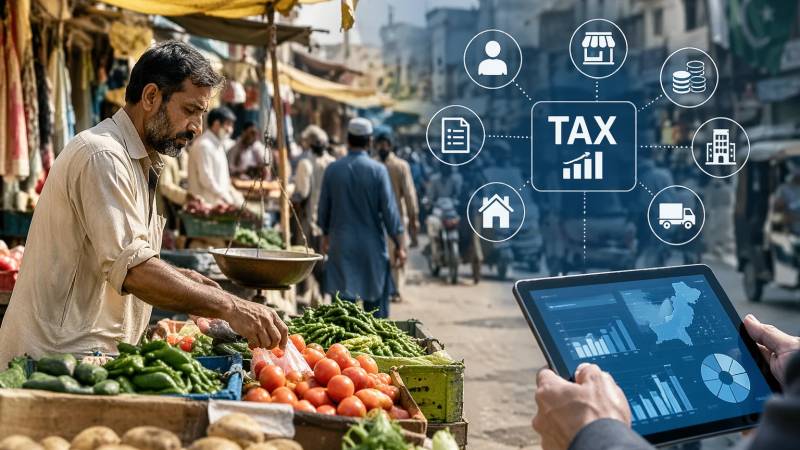
Pakistan’s capacity to mobilise taxes is greatly under-explored. With a tax to GDP ratio of 8.5% along with an undeclared economy almost the size of official economy, the potential of tax collection is astronomical. With an estimated total economy twice the size of Rs1,000 trillion official economy at a modest tax collection of 16% puts a revenue of Rs32,000 billion in sight…— Haroon Khawaja, Lost FBR hits a dead end
The government needs to put in place a simplified, low-rate tax scheme to tap into the tax potential of Pakistan's burgeoning retail sector. A simplified sales tax of 4% and an income tax of 1% could net $15 billion annually—The Retail Sector's $15 Billion Tax Potential
Part I proposed a National Economic Registry capable of distinguishing taxable capacity from dependency, lawful informality from criminal activity, and taxpayers from citizens entitled to social protection. The next question is harder: how large is Pakistan’s informal economy, how many persons within it genuinely possess taxable capacity, and how much revenue can reasonably be raised through a broad, low-rate system?
The answer cannot begin with one dramatic estimate. Pakistan’s informal economy has been measured repeatedly, with markedly different results because researchers measure different things through different methodologies. Islamabad Policy Research Institute’s 2025 study estimates informality at about 59% of gross domestic product (GDP). State Bank work, using an electricity-consumption approach, has produced materially lower estimates, while currency-demand and Multiple Indicators Multiple Causes models generate still other results.1
This dispersion is not a weakness in the evidence. It is a warning against false precision. Informality cannot be observed directly like customs imports or bank deposits. Cash usage, electricity consumption, labour-market discrepancies, currency demand and structural models capture different dimensions. The sensible conclusion is that Pakistan has a very large unrecorded economy by any reasonable measure.
The labour-market evidence is less ambiguous. Pakistan Bureau of Statistics’ Labour Force Survey 2024-25 puts the labour force at about 85.6 million, with nearly 80 million employed. Gallup Pakistan’s analysis of the same survey, using the broader international statistical framework, places informal employment above 80% of employment. Even under the narrower non-agricultural definition, PBS reports informal employment at 72.5%, rising to 76.2% in rural areas and remaining 68.5% in urban Pakistan.2
PIDE’s latest employment analysis reaches the same broad conclusion from another direction. A very large majority of Pakistani workers are informal, which means economic shocks often appear as reduced income, underemployment or labour-market withdrawal rather than registered unemployment.3
A country with more than sixty million workers outside conventional formal employment cannot build its direct-tax system around six or seven million income-tax returns. Nor should sixty million informal workers be converted mechanically into sixty million taxpayers. A subsistence farmer, unpaid family helper, home-based worker, daily wager and low-income street vendor may belong in the economic registry without belonging in the income-tax net. The objective is to identify economic status first and taxable capacity afterwards.
That is why the target of 30 million-plus genuine taxpayers is more defensible than the indiscriminate slogan of “bringing everyone into the tax net”. Thirty million would represent only about one-third of the labour force. Pakistan’s employers, professionals, traders, contractors, landlords, transporters, self-employed persons, agricultural earners and persons deriving investment income outside formal payroll systems provide a sufficiently large universe to test this proposition empirically.
Artificial intelligence makes identification possible without sending tax inspectors door to door. A National Economic Registry can classify adults into dependent, employed, self-employed, employer, pensioner, student, unemployed and other categories. It can then compare declared status with bank turnover, property ownership, vehicles, electricity consumption, commercial utility connections, imports, exports, withholding records and business registrations.
AI should identify anomalies for human verification, not create tax liability autonomously. That distinction is essential if economic intelligence is not to become digital harassment.
According to the Pakistan Economic Survey 2025–26 released by the Ministry of Finance, Pakistan’s Gross Domestic Product (GDP) at current market prices reached Rs. 126.9 trillion in the fiscal year (FY 2026). If we add informal economy, it will not be less than Rs. 200 trillion—20% tax on it will yield Rs. 40 trillion at federal level alone. The arithmetic should be stated openly. Even to collect Rs. 10 trillion from individuals at 10%, taxable personal income must be about Rs. 100 trillion. If 30 million persons constituted the effective personal tax population, average taxable income would be around Rs. 3.3 million annually. That is an ambitious long-run base, but it is not a number that should be accepted or rejected by intuition. It should be constructed person by person through the proposed registry.
The Rs. 500 trillion broader economic base, referred to in Part I, must also be understood correctly. It cannot be treated as another estimate of annual GDP. It represents a much wider information universe of income, assets, expenditure and transactions. Any income-tax model must eliminate double counting between salaries, business income, corporate profits, consumption and asset values.
Sales taxation offers the largest broad-base potential. Our PRIME study records the authorities’ own admission that, against a statutory sales-tax rate of 18%, the effective collection rate has been only a fraction of that because of exemptions, exclusions, fraud and structural leakage. Reported sales-tax fraud itself has run into trillions of rupees.5
A harmonised 10% value-added tax on goods and services, with basic necessities protected, can plausibly yield Rs. 10 trillion if the effective taxable consumption and value-added base approaches Rs100 trillion. This cannot be achieved merely by reducing 18% to 10%. It requires invoice matching, point-of-sale capture, input-credit integrity, removal of distortions such as the Third Schedule to the Sales Tax Act, 1990, seamless federal-provincial data and prompt refunds.
This correction strengthens rather than weakens the reform case. To generate Rs. 3 trillion from a 5% tariff would require imports of nearly Rs. 60 trillion. Unless imports expand dramatically, that figure cannot honestly be attributed to customs duty alone.
Where, then, does the Rs. 35 trillion-plus national potential come from? From taxes Pakistan continues to underuse or treat separately: meaningful taxation of high agricultural incomes, urban immovable property and land values; rational motor-vehicle and environmental levies; provincial and local own-source revenue; withdrawal of unjustified exemptions; and an alternate minimum tax on very high net wealth where declared income is inconsistent with visible asset accumulation.
Our earlier work has placed combined federal and provincial potential around Rs. 34 trillion under comprehensive structural reform. The gap between that figure and Rs. 35 trillion is hardly the issue. The real point is that national tax capacity is far above present collection if the base is widened and rates are rationalised.7
The route to this potential is not a 40% income-tax rate, an 18% sales-tax rate or dozens of withholding provisions. It is the opposite: a wider economic map, lower predictable rates, elimination of privileged exclusions and the capacity to know who earns what without forcing every transaction through punitive withholding.
AI changes the enforcement frontier. It enables the State to move from taxing visibility to taxing capacity. The worker repairing motorcycles in a rented workshop should not be presumed a tax evader merely because he has never filed a return. The owner of multiple commercial properties, businesses and high-value assets should not remain invisible merely because his income does not pass through payroll.
An intelligent State should be able to tell the difference. Pakistan’s problem is not absence of economic activity. It is that enormous economic activity remains disconnected from the fiscal State. AI can make it visible. Low, predictable rates can make compliance worthwhile. Credible enforcement can make concealment costly.
That combination—not another filer campaign is how thirty million genuine taxpayers and revenues approaching Rs. 35 trillion become a serious policy proposition rather than another slogan.
Endnotes
1. Aneel Salman & Muneeb Shah, An Appraisal of Pakistan’s Informal Economy: Causes, Patterns, and Socioeconomic Footprints, Islamabad Policy Research Institute, 2025; State Bank of Pakistan, Informal Labour Markets in Pakistan; and related estimates surveyed in the cited literature.
2. Pakistan Bureau of Statistics, Labour Force Statistics; Gallup Pakistan, Analysis of Labor Force Participation in Pakistan, using the latest Labour Force Survey and international informality classifications.
3. Muhammad Jehangir Khan, Muhammad Ajmal Khan & Nasir Iqbal, Beyond the Remittance Shock: Domestic Layoffs and the Coming Unemployment Crisis, PIDE Knowledge Brief No. 145.
4. Huzaima Bukhari & Dr. Ikramul Haq, Towards Broad, Flat, Low-rate and Predictable Taxes, Third Edition, PRIME Institute, 2024, especially Chapters 1 and 7. The study proposes 10% personal and 20% corporate income-tax rates under a substantially broader base.
5. Huzaima Bukhari & Dr. Ikramul Haq, Towards Broad, Flat, Low-rate and Predictable Taxes, Third Edition, Chapter 7, discussing the gap between the statutory sales-tax rate and effective collection, exemptions and reported fraud.
6. Pakistan Bureau of Statistics external-trade data and Pakistan Economic Survey 2025-26. FY2025-26 merchandise imports were about US$70 billion; at a flat 5% customs duty the arithmetic yield is roughly Rs1 trillion at prevailing annual exchange-rate averages.
7. Dr. Ikramul Haq, Paradigm shift in tax policy, Business Recorder; and Huzaima Bukhari & Dr. Ikramul Haq, Towards Broad, Flat, Low-rate and Predictable Taxes, Third Edition, on combined federal-provincial tax potential and broad-base reform.
8. See also Estimation and Causes of Informal Economy in Pakistan, and related empirical work on Pakistan’s informal economy, for alternative methodologies and estimates.
[To be continued]