

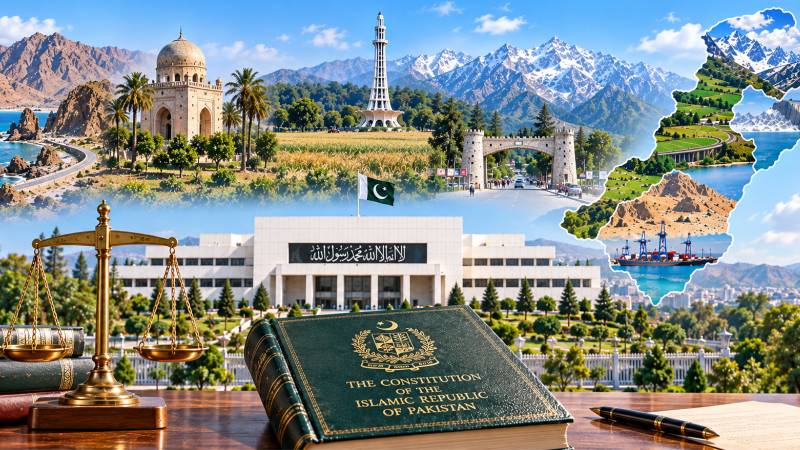
Federations particularly those created by the will of the geographically and historically recognized political and cultural sub-nationals, require a careful handling through a plural, inclusive, representative and democratic governance. Federal constituents have tenure-based state governments with political, economic and financial autonomy. These governments further devolve political and financial powers to the third tier of governments. It makes no big difference whether the Federation itself is governed by a presidential or parliamentary form of government provided it has institutional checks and balances, and does not intrude in the states’ domain.
The Constitution defines the political, economic, financial, and legislative purview and authority between the federation and states, and provides a constitutional framework for the resolution of disputes within the federal structure. The Constitution remains supreme. All national and state political, economic and financial institutions follow it in letter and spirit. The observance of the constitutional and plural governance and laws has grown strong and is well embedded in the collective outlook of the developed nations because of the continued democratic practice, and a conscious belief in the sanctity of the basic law governing their countries. However, the situation in developing countries is different.
The Constitution, being social contract between rulers and the ruled, ensures people’s participation in electing or expelling their rulers through regular general elections. These societies believe in accountability through ballot box. This binds political parties and their leaders, and public office holders to respect their public mandate. In the absence of any constitutional way of governance, justice, transparency and fair play in political, economic, and financial dealings of the federation, the small federal constituents develop doubts and concerns which, if left unaddressed for a long period, metastasized into fault lines harming the federal harmony.
Our leaders made blunders by succumbing to the temptation of unconstitutional ways of governance at a number of occasions. The constitutions were betrayed, federal principles violated, economic and financial justice among federal units ignored. The administrative, economic and financial resources were divided among the constituents of West Pakistan according to a complicated system based on population, needs for development and generation of revenues, while Bengal received its share of the federal resources and jobs on parity basis. All this propelled Punjab to a dominant position in West Pakistan rendering its establishment arrogant and unruly, and giving a fillip to its human acquisitive instincts for resources, wealth and affluence.
The failure to ensure constitutional governance, political representation and economic and financial justice among federating units can transform accumulated grievances into fault lines that ultimately threaten federal harmony.
While the smaller federal units including Sindh, KPK and Balochistan were grappling with administrative and political problems, economic and financial deprivation, the Lahore bureaucracy - an enthusiastic protagonist of a strong Centre - tightened its grip on power. Similarly, the well touted industrialization in Ayub Khan’s era was lopsided, mainly concentrated in the central Punjab and Karachi. The industrialization in Karachi opened the way for the en mass migration of people from Punjab, and KPK. The Pashtun population in Karachi increased manifolds with the city giving a cosmopolitan look. The interior of Sindh and South Punjab received scanty industrial dividends.
The disproportionate dominance of Punjabis in the industry, and industrial and developmental institutions including Pakistan Industrial Development Corporation, Water and Power Development Authority, Agricultural Development Bank, Pakistan International Airlines, Civil Aviation, Railways, State Bank, Commercial banks, economic and financial institutions, superior services added up to the fears of the small provinces, refueling their campaign for the dissolution of the One-Unit. General Yahya Khan dissolved it in March 1969 relieving the small provinces from the dictatorial grip of Lahore.
Punjab did not have a political leader of public following or strong credentials when the general elections of 1970 were announced. The Pakistan Muslim League was splintered into many factions. The mainstream political parties with some public following were National Awami Party, Jamiat e ulema Islam, Jamaat Islami, and Pakistan Muslim League (Khan Abdul Qayum Khan). Zulfikar Ali Bhutto, after his dismissal from Ayub Khan’s cabinet, emerged as a political force to reckon with riding a high tide of public popularity in the rough sea of Pakistani politics. He became the undisputed leader of Punjab and Sindh.
The ruling military junta could not handle the post-election situation, and we lost the country’s bigger part. This was, probably, an unprecedented example that the bigger part of a federation sought secession owing to the accumulated anger over a period of over two decades. The military junta declined to invite Bengalis to form the federal government. After disgrace and humiliation, power was transferred to Bhutto under pressure from some senior military leaders. His PPP had won 84 seats mainly from Sindh and Punjab. The National Assembly adopted the 1973 Constitution with inadequate political, economic and financial autonomy provided to the federating units.
The division of the central divisible resources was based mainly on population. This was a gross anomaly. Bengalis all along demanded the division of the financial resources among the East and West on the basis of the population while we remained adamant to take the territory as the main criteria to define the share of the two wings. The West Pakistan was larger in territory but smaller in population.
In the new Pakistan, Punjab has a larger population, (estimated at 127.7 million in 2023 Census) than the total population of all the three federal units estimated at 111.3 million with Sindh: 55.7 million, Balochistan: 14.8 million, KP: 40.8 million. Some federal units doubt the correctness of the 2023 census. Obviously, Punjab takes the bigger share of the financial resources, and federal administrative jobs. It enjoys the same position in public enterprises and corporations. The anomaly in the distribution of resources from the central pool among the federating units was rectified in the 18th Amendment.
There is a big political imbalance among the federal units. The combined number of the directly elected National Assembly Members from all the three small federating units come to a total of 122 with Sindh: 61, KPK: 45 and Balochistan: 16. Their total strength in the National Assembly is reduced to insignificance by Punjab’s 141 MNAs. This means a political leader capturing the overwhelming majority of seats from Punjab would not need the support of any other province in forming the federal government. In such an anomalous situation, the upper House needs to have more administrative, financial and legislative powers.
Precisely for this reason the Pakistan Muslim League (Nawaz) and PTI in their heydays ignored smaller units and concentrated on Punjab. This political imbalance has tempted Punjab-dominated establishment to adopt infrastructural developmental projects tilted to Punjab’s needs, tamper with Sindh’s rights to irrigation waters as defined in the IRSA, and develop projects for dams and new water canals grossly ignoring the terms and conditions of the Water Accords signed in 1993. Sindh, as the lower riparian state, has more rights over the waters of Indus River as provided by the domestic and international laws. Egypt being the lower riparian state, has 80% of the Nile waters leaving only 20% for Sudan which is the second lower riparian state. All the eight or nine upper riparian states have no right to the Nile waters as per the Water Agreement signed in 1923.
We know that the water canals irrigating Nasirabad Division Balochistan take off from Guddu and Sukkur Barrages. The water scarcity in Sindh automatically affects this part of Balochistan. The violations of these constitutional rights exasperate the concerns and anger of the small federating units against Punjab establishment. The people of small provinces have no ill will against the common populace of Punjab.