

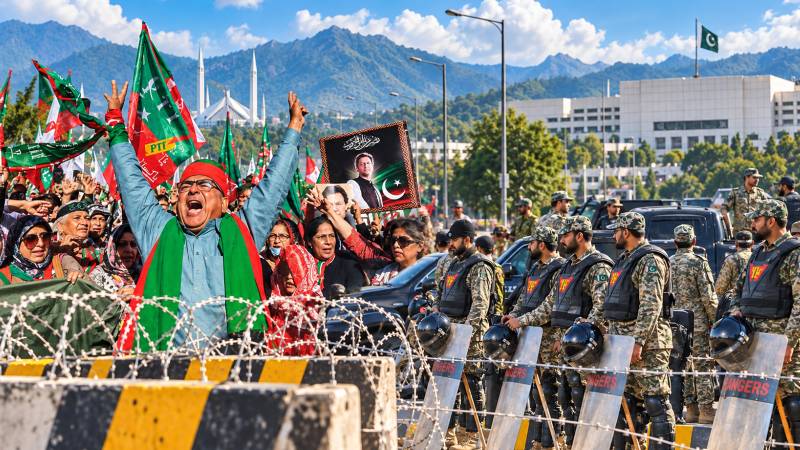
With the Pakistan Tehreek-e-Insaf announcing a march towards Islamabad on September 27, the country is once again witnessing a familiar confrontation between politics, administration and the police. The immediate question is whether and how the march should be allowed to proceed from Khyber Pakhtunkhwa to Islamabad. Beneath it lies a more fundamental question: who should command the police, and where should the authority of each institution begin and end in KP? This question has acquired particular significance following the Khyber Pakhtunkhwa Cabinet’s approval of the proposed Police Act 2026.
I have always believed that the Inspector General of Police should enjoy meaningful professional autonomy. A police chief cannot effectively command a force if operational decisions are dictated by political authorities or by powerful institutions outside the police chain of command. At the same time, police autonomy cannot mean that the IGP becomes unaccountable or that transfers and postings become a matter of personal discretion.
The objective should be a system in which the elected government provides policy and democratic oversight, the IGP exercises professional command, and intelligence and security agencies provide information and assessment rather than instructions. The history of KP’s police legislation is important. The Police Act 2017 gave the IGP a comparatively strong statutory position and substantial operational, administrative and financial autonomy. This was a deliberate attempt to create professional policing insulated from day-to-day political interference.
In 2024, the KP Government amended that law, including provisions giving the Chief Minister a greater role in the transfer and posting of senior police officers. Those amendments were challenged before the Peshawar High Court. On 15 January 2026, a five-member larger bench struck down key provisions, restored the IGP’s authority and declared approval of Chief Minister unconstitutional in transfer postings of grade 18 and above police officers.
The proposed Police Act 2026 now seeks to introduce several provisions similar in substance to those introduced through the 2024 amendments. This raises an obvious question: if provisions of that nature have already been judicially examined, has the new Bill genuinely addressed the constitutional concerns identified by the High Court, or is it substantially the same arrangement in a new legislative form?
Governmental involvement in policing is not unusual. The elected government must remain responsible for public policy, resources, law-and-order priorities and democratic accountability. Similar governmental involvement in senior police postings exists in other provinces. The real issue is where governmental oversight ends and professional police command begins. In Punjab, for example, senior police postings have involved the Chief Minister, while the IGP also exercises transfer and posting powers at other levels. Yet practical experience suggests that political involvement can sometimes extend beyond DPOs and RPOs to DSPs and even lower ranks.
A few months ago, I personally encountered an example in Punjab. When I sought the transfer and posting of a DSP, I was informed that the matter would have to be processed for approval by the Chief Minister. On another occasion, concerning the transfer of a constable of the Telecommunications Department who had completed the relevant tenure in a district, the matter was referred to the office of the Chief Minister of Punjab for approval. This is not an argument for reproducing such a system in KP. It demonstrates the need to distinguish legitimate governmental oversight from informal political interference.
The government should govern. The IGP should command. Intelligence agencies should inform. Courts should adjudicate. And the police should enforce the law impartially.
I experienced this distinction personally while serving as IGP Islamabad from 2014 to 2016. At that time, even the posting of an ASP or DSP required approval at the level of the Interior Minister, with files passing through the Chief Commissioner and officers of the Ministry of Interior. The present arrangement, under which wider posting powers have reportedly been delegated to the IGP Islamabad, demonstrates that governmental accountability and professional delegation can coexist.
The better model for KP is therefore neither complete government control nor complete police independence. The IGP should have professional authority over transfers and postings, exercised according to transparent criteria: integrity, experience, professional performance, seniority, suitability and knowledge of the area. The Chief Minister should be entitled to know why an officer is being proposed and, where necessary, seek further information or reconsideration through a prescribed legal mechanism. But the political executive should not become the day-to-day police commander.
The same principle should apply to intelligence and security agencies. Before an officer is posted to a sensitive position, the competent authority may properly seek information about his integrity, professional conduct, criminal or political associations, security profile and suitability. Such information can be extremely valuable. But providing intelligence is different from making the posting decision.
An intelligence agency may inform the competent authority that it has information raising questions about an officer’s suitability. It should not ordinarily dictate that a particular officer must be posted as DPO of a particular district or RPO of a particular region. In simple terms, intelligence agencies should be the eyes and ears of the government and the police command—not the hands that make police postings.
This distinction becomes especially important in the present political environment, where the KP government is controlled by PTI while the federal government is politically opposed to it. Every police decision can easily be viewed through a political lens. The answer should be rules that remain acceptable when political circumstances change. The September 27 march also demonstrates why institutional boundaries matter.
The Islamabad High Court has recently considered the proposed march and the constitutional right of peaceful assembly, while recognising that lawful restrictions may be imposed to protect the rights and safety of others. The important question is whether citizens travelling towards Islamabad should be stopped merely because authorities apprehend that some of them may subsequently participate in an unlawful activity.
There is a difference between preventing an unlawful act and preventing a person from undertaking a lawful journey because of an assumption about what he might do later. Preventive policing is necessary, but it must be based on law, credible information and a reasonable connection with an identifiable threat. Political affiliation or political intention alone should not become a substitute for evidence of criminal conduct.
Recent events in KP further demonstrate the dangers of institutional confusion. The KP Assembly has discussed allegations concerning the alleged abduction or harassment of provincial ministers and lawmakers, including allegations referred to by Speaker Babar Saleem Swati concerning Minister for Communication Shakeel Khan. There have also been conflicting accounts surrounding KP Chief Minister Sohail Afridi’s confrontation with Punjab Police in Lahore. The larger lesson is that when police become caught between competing political authorities and competing institutional directions, the credibility of the police itself suffers.
I am not arguing that the IGP should become an unaccountable authority. The greater the autonomy given to the police chief, the greater should be the requirement for transparent procedures, recorded decisions, minimum tenures, objective criteria for important postings and effective accountability. Nor should the Chief Minister have no role. An elected government must remain responsible for policy, resources and democratic accountability regarding law and order and security of the citizens in his territory.
What should be avoided is a system in which the IGP merely signs orders already determined elsewhere. Equally, the IGP should not be able to make important postings solely according to personal preference without scrutiny. The solution is accountable professional autonomy. A good police law should answer four simple questions: Who makes the policy? Who provides the information? Who makes the operational decision? And who is accountable if the decision proves wrong?
The present political crisis makes this discussion urgent. Whatever happens on September 27 should be dealt with strictly according to law. But the immediate political contest should not determine the permanent structure of police governance. A principle worth establishing today should remain valid when political circumstances change tomorrow. The government should govern. The IGP should command. Intelligence agencies should inform. Courts should adjudicate. And the police should enforce the law impartially. That is not independence from government. It is professional independence under the law.