

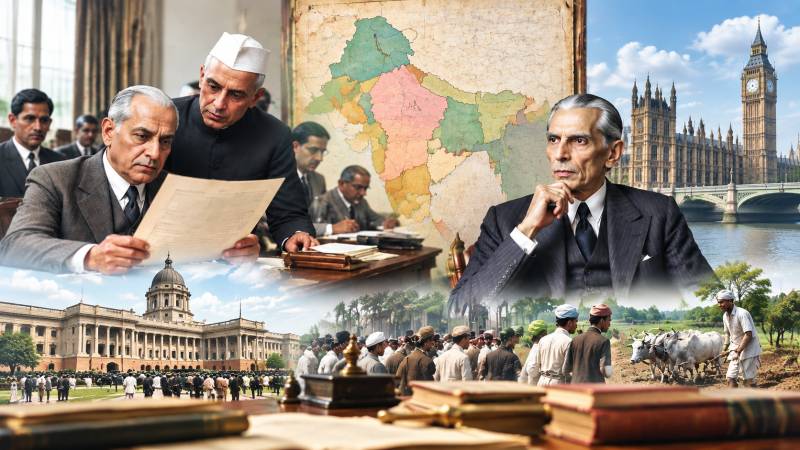
The politics of provincialism was further strengthened by the Nehru Report. In response to the Simon Commission, the All-Parties Conference, held in Delhi in 1928, appointed a committee under Motilal Nehru to prepare a constitutional framework for India. The Nehru Report advocated a federal structure with provincial autonomy. However, the Muslim League objected particularly to its proposal that residuary powers should belong to the Centre rather than to the provinces, prompting Jinnah to present his own Fourteen Points. After a prolonged political struggle, the people of the NWFP were able to secure political reforms in 1932 in the context of the Round Table Conference process in London, while Sindh was separated from Bombay in 1936.
The Government of India Act of 1935 was particularly important because it abolished the system of provincial dyarchy and provided the provinces with their own governments and legislatures, with provincial departments placed under ministers responsible to the provincial legislatures. Thus, even before the Lahore Resolution, the provinces were already constitutionally established political units, and the central question was increasingly how much political authority should be vested in the provinces rather than in the Centre. Subsequently, the elections of 1937 and 1946, and their results, greatly affected the politics of Pakistan and the development of provincialism.
These developments, and the growing political importance of the provinces, were recognised by the Muslim League. The emergence of the Muslim-majority provinces as the territorial basis of the proposed Muslim state also brought about a significant shift in the social and class orientation of Muslim politics. The political focus increasingly moved away from the salariat and urban middle classes of the Muslim-minority provinces towards the agriculturist classes of the Muslim-majority provinces, encompassing both landlords and peasants. This shift was accompanied by an expanding process of communal mobilisation, through which class interests and communal identities increasingly became intertwined in the political mobilisation of the masses. The Muslim League consequently sought to build a broader political base among the agriculturist classes, while incorporating the landed interests and other dominant social groups within its political structure and mobilising the wider peasant population around the communal question. Thus, the changing territorial basis of Muslim politics was accompanied by a corresponding transformation in its social and class base, as provincial politics increasingly became an arena in which agrarian interests, class relations and communal mobilisation converged.
The creation of Bangladesh was therefore not simply a consequence of the events of 1971; it also represented the culmination of a much longer struggle over provincial autonomy, political representation and the constitutional distribution of power between the provinces and the Centre.
The Nehru Report of 1928 deemed the creation of new provinces sustainable by balancing ethno-linguistic identity with financial viability and administrative considerations, explicitly stipulating that: “The re-distribution of provinces should take place on a linguistic basis on the demand of the majority of the population of the area concerned, subject to financial and administrative considerations.” It was precisely from this ideological foundation that language became a foundational criterion for the demarcation of states in post-independence India during the 1950s. Conversely, the suppression of such pluralism in Pakistan played a catalytic role in the rise of the secessionist movement in East Pakistan. Initiated by the 1952 Language Movement, this friction culminated in the creation of Bangladesh as an independent nation in 1971. In the western wing, localized linguistic clashes emerged in Karachi in 1972 following the provincial assembly’s declaration of Sindhi as the sole official language of Sindh. This legislative shift deeply alienated urban Urdu-speakers, ultimately paving the way for the crystallisation of the Muhajir identity movement within the province.
While Pashtun, Baloch and Punjabi elites increasingly favoured Urdu, particularly in the later colonial and early postcolonial periods, they had historically shown little inclination to promote their own languages as languages of administration, education or wider political communication. Instead, they had successively adopted the languages associated with dominant political powers—Persian and English under earlier and colonial regimes, and Hindustani/Urdu as it increasingly acquired political and administrative significance. In this sense, their orientation tilted towards what can be called Pakistaniyat, a conception of national identity increasingly dominated by a common, centralised political culture rather than by the linguistic identities of the constituent regions.
Historically, however, the linguistic question across the provinces was not simply a matter of choosing between indigenous languages. The provinces largely adopted the languages preferred or promoted by the colonial rulers, with relatively little fundamental change in the established linguistic hierarchy. Even where linguistic forms differed, such as between the Arabic-Persian and Devanagari scripts, the broader process remained one in which colonial power shaped the languages and scripts that acquired administrative, educational and political legitimacy.
In the light of the 1940 Lahore Resolution of the All-India Muslim League, it is now almost a cliché to say that Pakistan was created by the provinces. The Resolution stated that “the areas in which the Muslims are numerically in a majority as in the North-Western and Eastern Zones of India, should be grouped to constitute ‘Independent States’ in which the constituent units shall be autonomous and sovereign.” Yet, six years later, the Muslim League amended the wording of the Resolution, marking an important shift in the constitutional conception of the proposed Muslim state.
The case for Pakistan as a federation with provincial autonomy is very strong and has deep roots in the very history of the Pakistan Movement, as the Sindh, Punjab and Bengal Assemblies, in one way or another, voted in favour of Pakistan. One of the architects of the 18th Amendment to the Constitution, Chairman Senate Mian Raza Rabbani, has argued that, in the case of Pakistan, it was the provinces that created Pakistan. According to Raza Rabbani, the Sindh and Punjab Assemblies opted for Pakistan and democratically voted in favour of it, while the Pashtuns decided through a referendum, and “Baluchistan also joined the federation through the ‘Maslahati Commission’,” while the tribal areas decided through jirgas to join Pakistan. In short, the provinces not only contributed to the creation of the federation of Pakistan but, in doing so, also ceded a part of their authority to the federation.
As the prominent political analyst Afrasiab Khattak has argued, the Indian subcontinent was essentially partitioned twice due to the contested dynamics of provincial autonomy: first in 1947 and, secondly, with the creation of Bangladesh in 1971. In March 1946, a high-powered, three-member delegation appointed by British Prime Minister Clement Attlee—historically designated as the Cabinet Mission was dispatched to India to facilitate the British withdrawal by structuring a viable constitutional framework. Because the leadership of the Indian National Congress and the All-India Muslim League failed to reach a consensus, the Mission formulated its own plan, which proposed a minimalist federal Centre restricted exclusively to Defence, Foreign Affairs and Communications. Crucially, the plan introduced a three-tier grouping of provinces, with all subjects other than those assigned to the Union, as well as residuary powers, vested in the provinces.
Group A consisted of Madras, Bombay, the United Provinces, Bihar, the Central Provinces and Orissa. Group B comprised Punjab, Sindh and the North-West Frontier Province, while British Balochistan was represented separately as a Chief Commissioner’s Province. Group C encompassed Bengal and Assam. The plan provided for substantial autonomy to the provincial groups, while also allowing provinces to reconsider their participation in the groups after the initial period under the proposed constitutional arrangements.
Significantly, Muhammad Ali Jinnah accepted the Cabinet Mission Plan. However, the representatives of the Indian bourgeoisie, most notably Jawaharlal Nehru and Sardar Vallabhbhai Patel championed a highly centralized state structure and ultimately favoured partition over a weak federal Centre. Following this systemic rejection of substantive provincial autonomy, Jinnah was left with no viable political alternative but to rigorously insist upon the partition of British India to establish Pakistan. On the other occasion, when the Bengalis were denied their electoral victory in the 1970 election, the resulting political crisis culminated in a civil war and finally in the separation of Bangladesh from Pakistan. Thus, the contradiction between provincial political authority and the centralised conception of the state, which had remained unresolved since the colonial period, re-emerged within Pakistan itself. The creation of Bangladesh was therefore not simply a consequence of the events of 1971; it also represented the culmination of a much longer struggle over provincial autonomy, political representation and the constitutional distribution of power between the provinces and the Centre.