

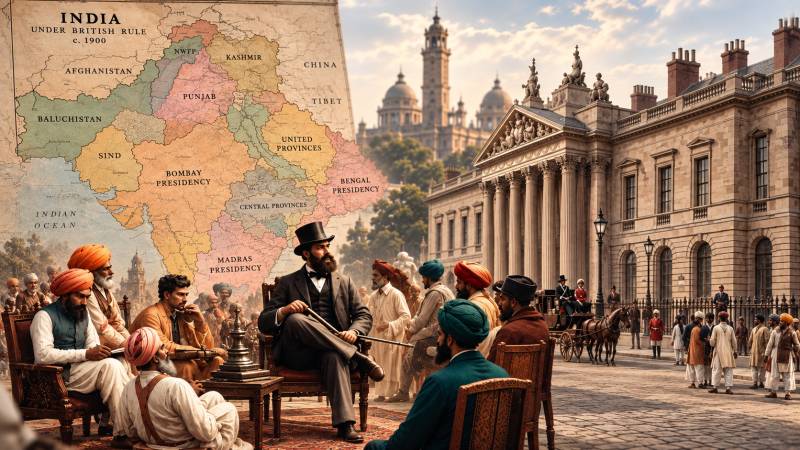
As an administrative unit, there were provinces even before the Partition of India and, indeed, before the British occupation. However, although the historical reality is far more complex, it may be stated, in simple terms, that the organization of territories largely depended on the dynasty or ruler and often reflected the needs of the ruling elites. These territories were generally created according to the economic, political, and administrative imperatives of their time and were, therefore, always open to change. Thus, many parts of present-day Afghanistan, Iran, India and Pakistan became administrative units under various powerful rulers. These rulers generally established an urban centre as their principal seat of power and appointed deputies, often military generals, to administer and control relatively small or very large parts of a territory. Some kings appointed their brothers and sons as deputies in provinces, called subedars, along with relatives, loyal servants, and military generals. These arrangements were not permanent and could change according to circumstances.
Prior to the revolutionary uprising of 1857, India was governed by competing powers and rulers. ‘Kompany Ki Hukoomat’ (the rule of the East India Company) created the ‘Presidencies’ of Bengal, Madras, and Bombay, each headed by a governor. Following the Regulating Act of 1773, Calcutta became the seat of the Governor-General, whose authority extended over the other governors. The end of Company rule came after the revolutionary uprising of 1857, when the British Crown took direct control under the Government of India Act of 1858. However, this transfer of power was the culmination of a much longer process of territorial expansion that had already brought large swathes of the subcontinent under Company control. From the First Afghan War in 1839 onwards, and through successive wars, treaties, and agreements with local rulers, the Company expanded its territories in the northwest and elsewhere in what are now parts of Pakistan.
Sindh was annexed in 1843 and incorporated into the Bombay Presidency, while Punjab was annexed in 1849 and constituted as a separate province. British influence and control were subsequently extended over Balochistan and the frontier territories through a combination of agreements, treaties, and military interventions in and around Afghanistan. British Balochistan was eventually formed, while the frontier territories were maintained as a buffer zone between Afghanistan and British India. In 1901, the North-West Frontier Province (NWFP) was created from the frontier districts separated from Punjab. Thus, by the early twentieth century, a substantial part of present-day Pakistan had already been incorporated into, or brought under the political and administrative control of, the expanding colonial state, with some arrangements with princely states in various parts of present-day Pakistan.
The British occupation brought with it modern tools and system of governing and government, which subsequently brought, for the first time, the whole subcontinent under a single rule after the earlier imperial formations associated with Ashoka and Aurangzeb. It brought the subcontinent together administratively on the one hand, while dividing its people and communities along different lines on the other, through a distinctive interpretation of history, land settlements, the Census, and new political arrangements and electoral system. The impacts of the colonial system brought a qualitative change in social and class formations. Its economic and social impacts were unevenly felt across different strata of society, and therefore the reactions to these changes were diverse and distinct. It was this colonial framework, and the reactions to it from different social groups, that subsequently shaped and moulded the politics of the subcontinent. These developments came to be understood generally as the ‘divide and rule’ policy: on the one hand, it was deliberate; on the other, it also generated natural reactions among different communities, groups, and classes within the framework established by the colonial power.
The colonial restructuring of administration did not merely redraw territorial boundaries; it also created new political arenas in which emerging regional communities, social groups, and classes could organize, compete for power, and develop political identities.
‘The politics of provincialism’, as I call it, was therefore a result of both the deliberate policy of the British colonial power and the reaction to it by different communities and social groups, especially landlords, middle farmers, trading and business classes, and salariat classes in various regions of the subcontinent. The challenge posed by the educated, militant urban middle classes to colonial power at the turn of the twentieth century compelled the colonial state to seek a balance elsewhere. Power was increasingly extended towards rural middle social groups, while the big landlords were already within the colonial folds and part of its power politics. This process helped empower emerging rural middle classes as a counterbalance to the educated, urbanite, militant middle classes.
The Government of India Act of 1919, based on the Montagu–Chelmsford Report on Indian Constitutional Reforms (1918), was described as “a plan for the enlargement of our provincial councils, for the enhancement of their status, [and] the multiplication of their functions,” alongside “the work of calling into existence an electorate capable of bearing the weight of responsible government.” Under the Act, provincial administration was divided through the system of diarchy into “transferred” and “reserved” subjects. The principal “transferred” subjects included education; local bodies such as municipalities and district boards; public health and sanitation; medical administration, including hospitals and dispensaries; agriculture; co-operative societies; veterinary services; fisheries; industries and industrial development; public works, particularly provincial roads and buildings; excise; registration; and religious and charitable endowments, among others.
This arrangement opened a new arena of political participation and access to provincial administration for the emerging rural middle classes, particularly the cultivating and farming classes. It created a new political stimulus among these groups and encouraged them to enter the expanding sphere of provincial politics. Around the same time, the rural middle classes were also actively involved in movements against the Rowlatt Act and in the Khilafat Movement. Much of the leadership that emerged through these movements, as well as in reaction to them, subsequently became active in the politics that led to the creation of Pakistan and, in one form or another, provided leadership to different strands of regional and national politics. Many of the prominent leaders who entered political life during this important conjuncture through political activism in the Khilafat Movement and through the opportunities created by the colonial administration for the advancement of the rural middle classes, particularly the cultivating classes were destined to play important roles in provincial politics.
In the NWFP, these included Khan Abdul Ghaffar Khan, Khan Abdul Qayyum Khan, Dr. Khan Sahib, Allah Bakhsh Yousafi, Malik Khuda Bakhsh, Barrister Muhammad Jan Khan, Abdul Akbar Khan, and Mian Akbar Shah. In Sindh, the emerging political leadership included G. M. Syed, Haji Abdullah Haroon, Shaikh Abdul Majeed Sindhi, Ghulam Muhammad Bhurgri, Pir Illahi Bakhsh, Taj Mahmood Amroti, Maulana Din Muhammad Wafai, Pir Turab Ali Shah, Pir Muhammad Ali Jan, Pir Muhammad Umar Jan, and Pir Muhammad Rashidullah Shah Jhando. In British Balochistan, Abdul Samad Khan Achakzai emerged as an important political figure of this generation. In Punjab, several of the leaders who later formed the core of the Majlis-i-Ahrar-i-Islam were at the forefront of the Khilafat Movement. Sir Fazl-i-Husain, by contrast, stood apart from this current and was opposed to the Khilafat Movement; he subsequently became the principal leader of the Unionist Party and represented a different trajectory of rural and provincial politics.
In this sense, while creating a framework in which it could remain afloat amid competing social groups, communities, and classes, the colonial power also endowed particular ruling and social classes with political and administrative power. The constitutional changes introduced under the 1919 reforms coincided with, and contributed to, a broader transformation in the political role of the rural middle classes. The colonial restructuring of administration, therefore, did not merely redraw territorial boundaries; it also created new political arenas in which emerging regional communities, social groups, and classes could organize, compete for power, and develop political identities. It was within this changing colonial framework that the foundations of what I call the politics of provincialism began to take shape.