

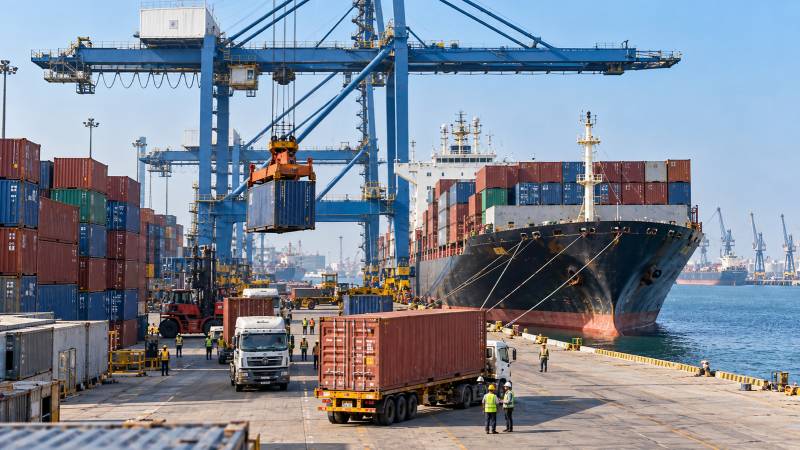
Pakistan is pursuing the right trade reform while retaining a fiscal design that can defeat it. The National Tariff Policy 2025-30 has begun reducing customs duty, additional customs duty and regulatory duty with the declared objective of moving the economy from import substitution towards export-led growth. The direction is sound. The difficulty is that government still tends to look at the tariff schedule while exporters look at the payment order generated at the port.
A tariff is conventionally understood as customs duty. An economic barrier is broader. If an importer must pay sales tax, a value-addition levy and advance income tax before release, importing may remain costly even when customs duty is zero. Amounts later adjustable are still working capital taken today. Where refund is delayed or income tax withheld at source becomes minimum tax, the distinction between a tax and a tariff becomes largely semantic.
The government deserves credit for reforms already undertaken. The FBR’s salient features for Budget 2026-27 record reductions in customs duty on industrial inputs, cuts in additional customs duty over more than 3,000 tariff lines, and a substantial reduction or elimination of regulatory duty. The Pakistan Economic Survey 2025-26 says the longer-term destination is a four-slab structure of 0, 5, 10 and 15 percent, with additional and regulatory duties gradually phased out by 2030. It also records a fall in both simple and trade-weighted average tariffs. These are meaningful changes, not cosmetic adjustments.
Dr. Manzoor Ahmad, noted expert in trade policy, has made an important intellectual and policy contribution to this transition. He has been consistently advocating the urgency of tariff reforms. His work, while challenging Pakistan’s attachment to import substitution, explains how high protection leaves firms inefficient and exporters disconnected from global value chains.
Dr. Manzoor specifically notes that higher withholding taxes on commercial importers worsen the bias against small and medium enterprises. After the latest national budget, he went further and argued that advance taxes on imports merit reassessment because they distort trade and hurt manufacturers. That point deserves to become the next stage of reform. There is another wall behind the customs wall. The problem was visible years ago. At the PIDE conference on Doing Taxes Better in March 2020, tariff policy was examined not merely as protection but as a tripod of protection, export promotion and revenue generation.
Data presented by Jamil Nasir showed that between 2014-15 and 2018-19, around 41 to 50 percent of FBR revenue was collected at the import stage, while customs duty itself accounted for only about 13 to 18 per cent of total collection. The difference is where the hidden burden sits.
Jamil Nasir identified high import-stage incidence as an incentive for smuggling, undervaluation and misdeclaration. He argued for time-bound strategic protection and the phasing out of all species of import duties and taxes on input goods. A study, Towards Broad, Flat, Low-rate and Predictable Taxes, approaches the issue from the tax side: a low, simple customs regime integrated with broader, lower-rate domestic taxation, without sales tax and withholding income tax at import for productive inputs. The objective is not indiscriminately cheap imports; it is to stop using the border as a substitute for an effective domestic tax system.
The present law demonstrates why this matters. Section 3 of the Sales Tax Act, 1990 imposes sales tax on goods imported into Pakistan. Importation is itself within the charging provision, independently of the customs rate. The Twelfth Schedule then imposes a three percent minimum value-addition tax at the import stage on taxable imported goods, subject to listed exclusions. The legal label is sales tax; the commercial reality is an upfront cash demand before the importer can use or sell the goods.
Exports are not produced in isolation from imports. Modern manufacturing depends on machinery, technology, components, services and raw materials sourced from wherever they are most efficient. A country aspiring to export competitively must first allow its producers to import competitively.
Income tax is layered on top. Section 148 of the Income Tax Ordinance, 2001 requires Customs to collect advance tax on imports. The current FBR withholding-tax rate card contains differentiated rates for categories of imports and importers. The taxable value is itself linked to the customs valuation and may be increased by customs duty, sales tax and federal excise duty. One tax therefore becomes part of the base on which another is calculated.
Section 148(5) of the Income Tax Ordinance, 2001 exposes the true nature of the arrangement. Advance income tax is collected at the same time as customs duty and, where the goods are exempt from customs duty, at the time customs duty would have been payable if the goods were dutiable. The legislation thus makes border collection survive the disappearance of customs duty. Reducing a tariff line to zero may change the customs column without eliminating the fiscal barrier confronting the importer. None has taken note of it till toady!
This is not an argument against destination-based VAT on imports. A genuine VAT taxes imports to place imported and domestic goods on equal footing. Neutrality depends on what follows: immediate credit and prompt refund. Pakistan’s problem is that the import stage has become a revenue-holding mechanism, with the port remaining the easiest place for FBR to secure cash.
In fiscal year (FY) 2025, net sales tax collection was Rs. 2,282 billion, up from Rs. 1,864 billion in FY 2024. The domestic sales tax accounted for 41.5% of total sales tax collection, while sales tax on imports contributed 58.5%. When the greater share of a consumption tax is secured at the border rather than through the domestic value chain, tax administration begins to shape trade policy. The incentive of the collector is naturally to preserve the point at which collection is easiest, even when industrial policy requires the opposite.
The income-tax problem is conceptually more serious. Income tax should tax income. A transaction at the border establishes that goods have been imported; it does not establish that income has been earned. Where collection operates as minimum tax, the amount ceases to be merely an advance against eventual income-tax liability. It becomes a floor imposed upon the act of importing. Economically, that is a para-tariff whatever its legislative label.
Dr. Manzoor's call to reconsider advance import taxes opens the door to a complete reform. ‘Total Border Tax Incidence’ should measure tariff rationalisation. For every Pakistan Customs Tariff code, government should publish customs duty, additional customs duty, regulatory duty, federal excise duty, sales tax, value-addition tax and income tax collection at import stage, identifying what is creditable, refundable or minimum tax. Only then can policymakers know the real cost at which an imported input enters a Pakistani factory or market.
The statutory reform should follow in stages. First, machinery, raw materials and intermediate goods imported for verified productive use should progressively be removed from section 148 of the Income Tax Ordinance, 2001 and the three percent value-addition tax. This should be a rule in law, not another exemption certificate.
Large firms can navigate concessionary schemes and dedicated staff can manage documentation; small firms frequently buy the same inputs in the domestic market at tax-loaded prices. A supposedly export-oriented tariff regime should not make scale a condition for obtaining internationally priced inputs.
Second, sales tax must become genuinely neutral. Verified industrial inputs should receive automatic full input credit with refunds within a fixed short period, or an equivalent mechanism should ensure that tax is captured later in the value chain without becoming a financing charge on production.
E-invoicing, invoice matching and risk-based audit make this administratively possible. The state should monitor transactions, not finance itself indefinitely from exporters’ working capital.
Third, revenue forgone at the border must be replaced by broad-based domestic taxation, not by quietly rebuilding tariffs under different statutory names. Pakistan needs lower-rate, broad consumption taxation, wider direct taxation of real income and digital capture of wholesale and retail transactions.
The state should tax consumption and income where they arise rather than load the formal import channel until informal trade becomes commercially attractive. This is also, why simplification is an anti-smuggling policy, not merely a business-friendly slogan.
Protection itself requires redesign. The government’s restructuring of the National Tariff Commission is the institutional counterpart of liberalisation. A high-powered committee followed a review committee convened by Dr. Manzoor Ahmad, and the Prime Minister approved reforms including more members, multiple benches and digitisation. Strong trade-remedy capacity can answer proven injury without preserving blanket protection.
Implementation should be judged by outcomes, not the number of tariff lines amended: the effective burden on imported inputs, refund time, working-capital cost, SME access, export diversification and productivity. Customs revenue cannot be the measure of success. The Ministry of Commerce’s tariff portal provides a useful public architecture; the next step is to display the full border-tax incidence alongside the tariff.
Exports are not produced in isolation from imports. Modern manufacturing is a chain of machinery, technology, components, services and raw materials sourced from wherever they are most efficient. A country aspiring to export competitively must first allow its producers to import competitively. Reducing a customs rate from 20 to 10 per cent is reform. Reducing it to zero while recreating the burden through other statutes is accounting. Pakistan now needs tariff rationalisation in substance, not merely in name.