

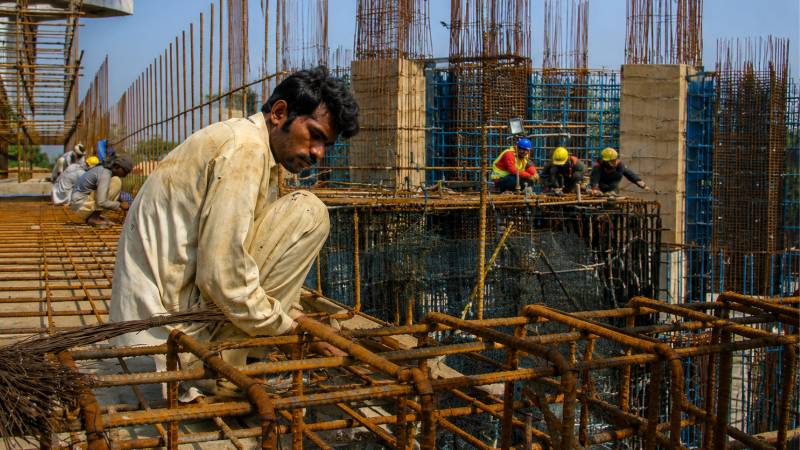
The government’s proposal to establish a Construction Industry Development Board (CIDB) is a welcome move. Pakistan’s construction sector is too important to the economy to be held back by weak enforcement, fragmented responsibilities and limited accountability. It generates employment and drives demand across more than 40 allied industries, including cement, steel and transport. But before another institution is created, one question needs to be asked: What exactly should the CIDB change?
Pakistan does not lack construction standards, professional requirements or regulatory institutions. The bigger challenge is ensuring that these standards are consistently applied, responsibilities are clearly defined and poor performance has consequences. The country already has the Building Code of Pakistan 2021, along with other construction-related codes developed through the Pakistan Engineering Council (PEC). The CIDB should therefore be designed not simply as another licensing or approval authority, but as a platform that brings greater coherence to the sector while working alongside existing institutions rather than duplicating their mandates.
From Rules to Results
The real test of construction regulation is not how many rules exist, but what happens on the ground. Public infrastructure can deteriorate earlier than expected, while projects can face delays, cost pressures and quality concerns. The proposed CIDB should focus on closing this gap between standards and actual results by working with PEC, provincial and local authorities and other relevant institutions to establish clearer responsibilities, consistent standards and stronger monitoring. Its value should ultimately be visible in better-performing projects, not in additional paperwork.
A particularly useful role for CIDB would be to establish a credible system for tracking the performance of contractors and consultants. Registration alone provides limited information. What matters is whether a contractor completes projects on time, maintains required quality and safety standards and delivers assets that perform over their intended life. This record should increasingly influence public procurement: contractors with repeated quality failures should not continue to benefit simply by submitting the lowest bid, while those with a strong record should be recognized. CIDB could also publish clear performance indicators and periodic scorecards, where appropriate, covering project completion, quality, safety, cost performance and defects. Such a system would gradually move the industry from a lowest-price culture towards a performance culture.
The Lowest Bid Is Not Always the Lowest Cost
The proposed extension of the Defect Liability Period from one year to three years, with a possible move to five years, is a positive step. Public infrastructure should not begin deteriorating soon after completion. The government has announced this as part of the broader construction-sector reform package currently under consideration. But a longer liability period alone will not guarantee better infrastructure. The deeper issue is how public projects are evaluated.
The cheapest project is not necessarily the least expensive project. A road requiring repeated repairs or a building needing major remedial work can ultimately cost taxpayers much more than a project that was slightly more expensive initially but built to a higher standard. Pakistan should therefore move gradually towards lifecycle-cost procurement, particularly for major public infrastructure, giving appropriate weight to durability, maintenance requirements, energy efficiency and expected useful life alongside initial price. Longer liability periods should also be supported, where appropriate, by suitable retention arrangements, performance guarantees, insurance and reliable contractor performance records, with requirements tailored to the size, complexity and risk of each project.
Consultants Must Also Be Accountable
The government’s proposal to bring consultants under a stronger accountability framework is equally important. Construction failures are not always the result of poor workmanship; weak designs, inadequate feasibility studies, inappropriate specifications and technical errors can create serious financial and structural consequences. Consultants should therefore be accountable for professional decisions within clearly defined responsibilities. At the same time, accountability should be balanced with professional fairness through clear standards, independent design reviews and appropriate professional indemnity arrangements. The objective should be higher professional standards and better project outcomes, not simply greater exposure to penalties.
An important governance question is that the proposed CIDB is expected to both develop the construction industry and regulate it. Both functions are necessary, but they should not undermine each other. The developmental side should help the industry improve its skills, technology, productivity and competitiveness, while the regulatory function must be able to act independently when standards are not met. These functions could therefore be clearly separated or ring-fenced within the institution, with defined responsibilities, professional leadership and transparent accountability. Private-sector representation should be welcomed because the board needs practical industry knowledge, but appropriate conflict-of-interest safeguards will be essential to protect the independence and credibility of regulatory decisions.
The CIDB should therefore be designed not simply as another licensing or approval authority, but as a platform that brings greater coherence to the sector while working alongside existing institutions rather than duplicating their mandates.
Develop the Industry, Not Just Regulate It
This is where CIDB can make a more lasting contribution. A modern construction industry needs better skills, higher productivity, new technology and stronger domestic capabilities. Construction is changing rapidly through Building Information Modelling, prefabrication, modular construction, energy-efficient materials, digital project management and climate-resilient infrastructure. Pakistan cannot prepare for this future simply by regulating conventional practices more strictly. CIDB should therefore promote technology adoption, skills development, productivity, innovation, local manufacturing and international best practices, while also developing reliable industry data on construction costs, productivity, contractor performance, material trends and sector capacity.
Malaysia offers a useful example. Its Construction Industry Development Board was established under the Construction Industry Development Board Act 1994 and is mandated to regulate, develop and facilitate the construction industry. Its functions include contractor registration, quality and safety, skills and training, research, construction standards, industry information and development of the sector. Pakistan can learn from this broader approach. Its proposed CIDB should not become merely a regulator of construction; it should help build the capacity, productivity and competitiveness of the industry itself.
What About a Construction Development Bank?
The proposal for a dedicated Construction Development Bank deserves serious but careful consideration. Construction companies can face difficulties obtaining working capital, performance guarantees and project-based financing. The government has accordingly directed that the proposal for a specialized Construction Development Bank be examined through consultations with the State Bank of Pakistan and Pakistan Banks Association, including its financial feasibility. Before creating a new financial institution, however, the government should determine whether the problem is actually a shortage of banking capacity or a shortage of suitable financial products. Specialized construction-finance windows within existing banks, supported by appropriate guarantee mechanisms, project-based lending and financing against verified receivables, could address many of these difficulties without immediately establishing another bank. If such measures prove inadequate, a dedicated Construction Development Bank could then be considered on the basis of demonstrated market need and financial feasibility.
Another issue will determine whether CIDB succeeds: coordination between the federal government, provinces and local authorities. Construction regulation and implementation involve several levels of government and professional institutions, and a federal CIDB that simply adds another layer of approvals could make the existing system more complicated. The better approach is one national direction with clearly defined institutional responsibilities. The federal government, provincial authorities, local governments, professional bodies and the private sector should have appropriate representation, with each institution’s role clearly defined. The objective should be effective coordination rather than centralization for its own sake.
Measure What Matters
Ultimately, CIDB should be judged by outcomes, not by the number of licenses issued or regulations introduced. Are projects completed on time? Are they delivering better value for money? Are public assets lasting longer? Are contractors and consultants being held accountable? Is the industry becoming safer, more productive and technologically stronger? These are the indicators that should determine whether the reform has succeeded.
The proposed CIDB is a good opportunity, but its real value will depend on its design. If it becomes primarily a licensing and compliance body, its impact will be limited. If it brings together standards, performance management, professional accountability and industry development, it could significantly improve the way Pakistan builds. The objective should be to shift the construction sector from volume to value from building more to building better. Pakistan does not simply need to build more. It needs to build better, build for longer, and get greater value from every rupee invested.