

Two recent reports drew my attention to a glaring institutional deficit: Pakistan lacks a consolidated, reliable and publicly accessible database through which citizens and policymakers can independently assess the performance of two vital pillars of national stability—national security and economic governance. Consider Naveed Hussain’s column, “Taliban’s Double Game,” published in The Express Tribune on October 11, 2026. It describes Pakistan’s worsening security situation and the Afghan Taliban’s alleged role in allowing militancy to threaten Pakistan’s long-term stability. While the column discusses the threat posed by terrorism, it does not provide a consolidated account of the security operations undertaken in response. This reflects a wider institutional problem: the absence of a dedicated, publicly accessible official database that systematically records both militant violence and counterterrorism operations.
It raises a fundamental question: how can an analyst or the state itself evaluate the effectiveness of Pakistan’s counterterrorism strategy without maintaining a comprehensive, reliable and publicly accessible record of militant attacks, security operations and their outcomes? For a country that has confronted persistent militancy for more than two decades, this is not merely a statistical issue. Without consistent, disaggregated data, policymakers cannot adequately assess whether their strategies are working, while citizens are left to interpret competing figures published by independent monitors and media organisations.
International indexes such as the Global Terrorism Index (GTI) frequently shape public discussion of Pakistan's security situation. The 2026 edition ranked Pakistan first among 163 countries for the impact of terrorism in 2025, while Afghanistan ranked eleventh. The ranking is a serious indication of the scale of Pakistan's terrorism problem. However, the GTI measures the impact of terrorism through indicators including attacks, fatalities, injuries and hostages; it is not designed to assess the full range of state counterterrorism operations. Consequently, its figures cannot, by themselves, provide a comprehensive assessment of national security performance.
To understand the wider picture, we need to examine both dimensions of the crisis: fatalities resulting from terrorist attacks and those attributed to security operations. These categories must remain distinct. Terrorist attacks measure the human cost of militant violence, while fatalities during security operations reflect another dimension of the conflict. Neither category, considered in isolation, can establish whether the state's overall strategy is succeeding. Consider the data maintained by the Centre for Research and Security Studies (CRSS), an independent organisation, for January 2021 through September 2026. Of the 12,356 fatalities recorded during this period, 6,535 resulted from terrorist attacks and 5,821 were attributed to security operations. Security-operation fatalities accounted for 47.11 per cent of the combined total, compared with 52.89 per cent attributed to terrorism (Table 1).
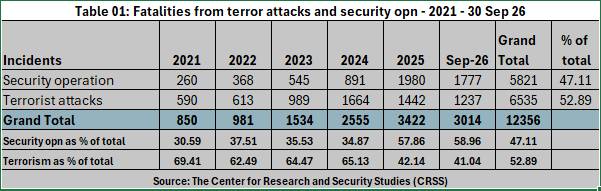
The annual breakdown reveals a substantial change in the composition of recorded fatalities. Security-operation fatalities accounted for 30.59 per cent of the total in 2021. Their share fluctuated between approximately 31 and 38 per cent through 2024, before rising to 57.86 per cent in 2025 and 47.11 per cent during January–September 2026. In 2025, the 1,980 fatalities attributed to security operations exceeded the 1,442 resulting from terrorist attacks. During the first nine months of 2026, the respective figures were 1,777 and 1,237.
This shift deserves serious examination, but it should not be mistaken for proof of either operational success or failure. Does the growing share of fatalities attributed to security operations reflect an increase in the number of operations, more lethal engagements, changes in militant activity, or a combination of these factors? Have the operations reduced subsequent attacks, improved civilian protection and strengthened the capacity of civilian law enforcement? Fatality figures alone cannot answer these questions. They identify a trend that requires further investigation.
Measuring performance is not a substitute for effective policy; it is a necessary condition for identifying shortcomings, correcting mistakes and holding institutions accountable.
The longer-term trend reinforces the urgency of that investigation. Combined fatalities from terrorist attacks and security operations rose from 850 in 2021 to 981 in 2022, 1,534 in 2023, 2,555 in 2024 and 3,422 in 2025. During January–September 2026, the total had already reached 3,014—approximately 88 per cent of the previous year's figure. If the average monthly rate recorded during the first nine months continues through December, the 2026 total would reach approximately 4,019, about 17.4 per cent above the 2025 total. This is a simple annualized projection, not a prediction of the final outcome. Nevertheless, it underlines the scale of the challenge confronting the country.
The persistence of terrorist attacks alongside the rising share of fatalities attributed to security operations demands a more comprehensive evaluation of Pakistan's counterterrorism strategy. Such an assessment requires incident-level records, consistent classifications and indicators extending beyond fatalities. These should include the frequency and geographical distribution of attacks, civilian casualties, injuries, investigations, prosecutions, the disruption of militant networks and the effectiveness of local policing.
The absence of an official, reconciled national database also complicates the work of independent monitors. By October 11, 2026, CRSS had recorded 3,133 fatalities, whereas the South Asia Terrorism Portal (SATP) recorded 4,258 for the same period—a difference of 1,125. This divergence does not, by itself, establish that either dataset is inaccurate. CRSS maintains its own incident-level records, while SATP draws on mainstream media and regional outlets, including Khyber Chronicles, The Frontier File and The Balochistan Post. Differences in source coverage, inclusion criteria, reporting practices and verification can produce different totals. The important questions are which incidents account for the discrepancy, how those incidents were verified and whether the classifications are consistent.
SATP's record, extending back to 2001 and including a historical estimate approaching 80,000 fatalities, is frequently used in assessments of Pakistan's security situation. Yet, without an authoritative national baseline, researchers and officials lack a common reference against which to reconcile competing figures. The problem is not simply that independent datasets disagree; it is that the state has not established a dependable, transparent mechanism for systematically resolving those differences. The responsibility for creating such a system cannot be left entirely to independent monitors. The National Counter Terrorism Authority (NACTA) is mandated to coordinate national counterterrorism policy, yet the absence of a comprehensive, regularly updated and publicly accessible incident database makes it difficult for citizens to assess the implementation and outcomes of the National Action Plan (NAP).
Consider Point 15 of the NAP, which calls for zero tolerance for militancy in Punjab. The principle is understandable, but a national strategy requires comparable indicators across all provinces. CRSS data show that Punjab accounted for 1,757 of 33,210 recorded fatalities between 2013 and 2025, or 5.29 per cent. Khyber Pakhtunkhwa accounted for 52.72 per cent and Balochistan for 21.49 per cent. Together, the latter two provinces accounted for more than 74 per cent of the recorded fatalities. These figures demonstrate the geographical concentration of recorded fatalities; they do not, by themselves, establish the success or failure of any provincial policy. That assessment also requires evidence about the frequency and nature of attacks, local exposure to militancy, policing capacity and operational outcomes. Nevertheless, the distribution underlines the need for a national framework that measures security performance consistently across provinces rather than relying on policy declarations that cannot be independently evaluated.
The remedy is practical. NACTA and the Ministry of Interior should establish a publicly accessible national database recording terrorist attacks, security operations, civilian deaths, security-force fatalities, militant fatalities, injuries, locations and attributed perpetrators. Each entry should indicate whether the attribution is confirmed, provisional or disputed. The system should maintain a transparent record of corrections and revisions while protecting information whose disclosure could compromise ongoing operations or individual safety.
Independent monitors should be able to compare and reconcile their records against this official baseline. Quarterly assessments should measure not only fatalities but also attack frequency, civilian protection, investigations, prosecutions and the capacity of civilian law enforcement. Where figures differ, the relevant institutions should explain why rather than leave the public to choose between competing totals. Pakistan cannot evaluate its security strategy through aggregate fatality counts alone. Nor can a high number of fatalities attributed to security operations be treated, without further evidence, as proof of success. Until reliable, disaggregated data become central to policy evaluation, public debate will remain vulnerable to incomplete reporting, inconsistent classifications and competing narratives.
A government that cannot demonstrate what is working and what is failing cannot credibly claim to be reforming its national security architecture. Measuring performance is not a substitute for effective policy; it is a necessary condition for identifying shortcomings, correcting mistakes and holding institutions accountable. But this deficiency is not confined to national security. It extends to another key sector: economic governance, where the absence of reliable, publicly accessible data on economic performance will be the subject of the next part of this column.