

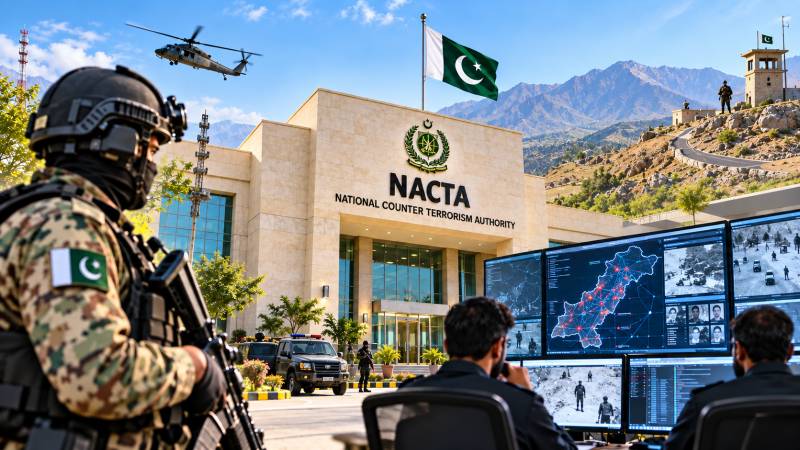
From recent political upheaval and subsequent instability to last year’s conflict with India, from navigating a turbulent Middle East to confronting the consequences of regional conflicts, Pakistan continues to face challenges on multiple fronts. Yet perhaps the greatest and most persistent challenge remains one of its own: the continuous war on terrorism. For more than two decades and even before the fall-out of the terrorist attacks of 9/11, Pakistan has faced an unrelenting security environment, with external forces and hostile elements determined to keep the country under constant pressure. Through it all, Pakistan has continued to fight, adapt and endure.
Pakistan’s unique geographical location as a crossroads between East and West, and between North and South is both a blessing and a curse. According to author Peter Frankopan, “Trade and transportation routes that weave Asia together intersect in Pakistan which explains why the country has so many rich variations, so many different traditions, and… a long and proud tradition of tolerance. The area that comprises modern Pakistan saw some of the greatest cultural and intellectual achievements in world history”. However, for a long time Pakistan has lacked a comprehensive approach that would enable the country to address the menace of militancy and terrorism. The National Counter-Terrorism Authority (NACTA), needs to be empowered in order to disrupt terrorist networks and address the factors that breed militancy. NACTA is leading agency coordinating Pakistan's efforts against terrorism and extremism, and it has a responsibility to take on the changing nature of extremist violence, often sponsored by outside elements.
Pakistan’s parliament has already given a strong mandate to NACTA through the NACTA Act 2013, but in reality the authority has struggled to become the central hub of Pakistan’s counter-terrorism architecture. NACTA was modeled on the U.S. Department of Homeland Security which was created after 9/11, reflecting a recognition that the threat of terrorism required a coordinated national response rather than fragmented institutional efforts.
The U.S. Department of Homeland Security protects the United States from threats like terrorism, cyber-attacks, natural disasters, and illegal border crossings. Pakistan’s creation of NACTA followed a similar logic: to provide a central framework for bringing together the institutions responsible for confronting terrorism and extremism. Today, a strong NACTA that can meet the rising challenges of living in this tough neighborhood is the need of the hour.
NACTA was created to bring Pakistan’s military, intelligence agencies, police, provincial Counter Terrorism Departments and federal ministries together, but weak coordination and limited institutional capacity have prevented it from becoming the central hub of the country’s counter-terrorism architecture.
According to the Center for Research and Security Studies (CRSS), around 813 people were killed in terror-related incidents and 518 injured during the first quarter of 2026 alone in Pakistan. These fatalities and injuries included civilians, security personnel and militants across 248 incidents involving both “terrorist attacks” and counterterror operations. Just last week, Pakistan’s military spokesperson said dozens of terrorist groups operating in Taliban-ruled Afghanistan are training, arming and planning cross-border attacks. The question remains: how can NACTA transform from a largely coordinating and policy-oriented institution into an organisation capable of making the country’s fragmented counter-terrorism machinery function as one integrated system?
NACTA’s purpose has always been to ensure that the military, intelligence agencies, provincial Counter Terrorism Departments, police forces and federal ministries operate within one national framework. However, the authority has suffered from a lack of political ownership and weak coordination within the state machinery itself. The first meeting of NACTA’s Board of Governors was held in 2018, a full five years after it was set up in 2013. The delay occurred despite the board being the highest-level mechanism responsible for bringing together key ministries, intelligence leadership and provincial authorities.
NACTA’s own 2018 annual report showed that around three-quarters of the organisation’s approved workforce had not been hired. An institution responsible for analysing terrorism, extremism, intelligence and national security threats could not exactly perform under these circumstances. In subsequent years as well, NACTA was unable to hire permanent professionals specialising in counter-terrorism analysis, intelligence, terror financing and strategic assessment.
Fortunately, the new head of NACTA is Major General Faisal Naseer, who has spent much of his professional life confronting the very threats that NACTA was ultimately established to address. He is someone who can bring about coordination at the highest levels and has vast experience dealing with counter terrorism given his previous postings. His appointment to head NACTA therefore comes at a critical moment and potentially presents an opportunity to put the country’s counterterrorism framework on a stronger and more unified footing. What many may not fully appreciate is that dealing with terrorism is not simply another assignment for him. It is a challenge he has encountered throughout his career.
The time has come to confront this dark enemy of terrorist forces with renewed determination and, ultimately, to put an end to the cycle that has cost Pakistan so much. But doing so will require more than another operation or another institution working in isolation. NACTA itself must first be put in order. Relevant agencies, intelligence structures, law-enforcement bodies and counterterrorism capabilities must be brought together under a genuinely unified national strategy, with clearly defined responsibilities, effective coordination and one common objective. This may be one of Pakistan’s most important opportunities to finally confront terrorism as a single national challenge rather than a collection of separate battles. And perhaps, at this particular moment, the right man has finally arrived for the right job.