

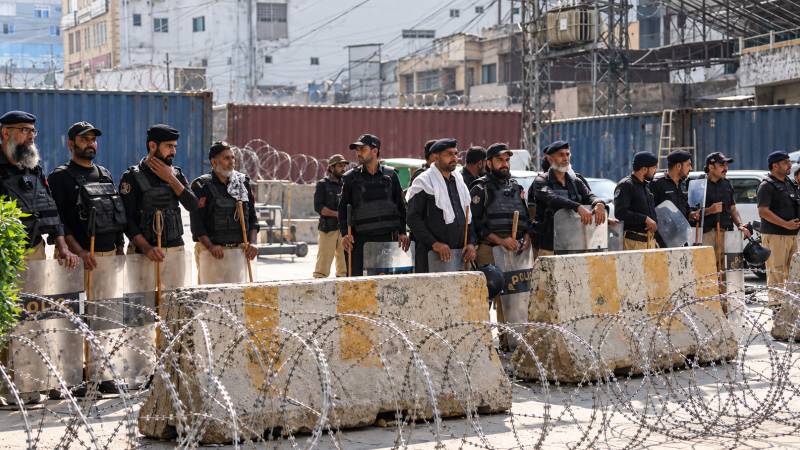
The federal government’s invocation of Articles 232 and 234 of the Constitution to impose Governor’s Rule in Khyber Pakhtunkhwa (KP), alongside a state of emergency across 12 districts, has brought the nation’s counter-terrorism debate to a critical juncture. While federal ministers justify this drastic intervention by citing a surge in terror incidents and an alleged breakdown in provincial cooperation, an objective look at empirical security data reveals a deeply selective policy.
Since the Taliban’s takeover of Kabul in August 2021, Pakistan’s security crisis has been overwhelmingly concentrated in two provinces: Khyber Pakhtunkhwa and Balochistan. Comprehensive casualty data spanning from 2021 through September 2026 reveals that out of 12,299 total fatalities nationwide, KP suffered 7,282 fatalities (59.2%), while Balochistan accounted for 4,176 fatalities (33.95%). Together, these two provinces represent a staggering 93.16% of all terrorism-related fatalities in the country over the last six years, leaving all other provinces combined with less than 7%.
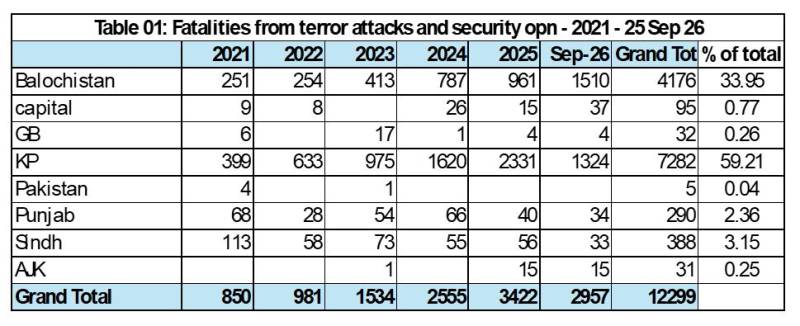
If severe security threats and rising fatalities were the sole criteria for suspending provincial autonomy, a glaring question emerges: Why was Governor’s Rule imposed exclusively in KP and not in Balochistan? While KP has borne the heaviest overall burden of casualties over the six-year period, Balochistan experienced an even higher surge in fatalities in 2026 alone (1,510 deaths compared to KP's 1,324). The selective application of constitutional emergency provisions strongly indicates that the federal decision was driven less by a pure security imperative and more by political confrontation between the federal center and the opposition-led administration in Peshawar.
At the same time, the former provincial leadership in KP cannot escape scrutiny. While citizens across the province face daily threats to their lives, safety, and livelihoods, the provincial executive consistently diverted state focus and resources toward political agitation especifically advocating for the release of the PTI chief. Securing the release of a party leader is a legal and judicial matter, not an executive function that should eclipse the governance of a vulnerable province. Political street activism does not address the threat posed by armed non-state actors. Even if the PTI chief were released tomorrow through judicial processes, armed militant groups like Tehrik-i-Taliban Pakistan (TTP) would not lay down their weapons; their conflict is waged against the constitutional authority of the Pakistani state itself, not in response to party politics. This political posturing masks a stark empirical paradox: the very political groups locked in confrontation are statistically among the least affected by the violence.
Together, Khyber Pakhtunkhwa and Balochistan represent a staggering 93.16% of all terrorism-related fatalities in Pakistan over the last six years. The selective imposition of Governor’s Rule in KP raises serious questions about whether security imperatives or political confrontation drove the federal decision.
Casualty data covering fatalities from terrorist attacks and security operations between 2021 and 2026 illustrates who actually pays the price for non-state violence. Out of 12,299 total fatalities over this six-year period: (a) Civilians accounted for 2,844 deaths (23.12%) (b) Security and Government Officials suffered 2,881 deaths (23.42%) (c) Politicians, Religious Parties, and Religious Figures combined accounted for 495 deaths (3.86%).
Together, ordinary citizens and frontline security personnel constitute over 46% of all conflict fatalities. While political leaders and religious scholars face documented threats, statistically they remain the least affected by the ongoing violence. Despite being insulated from the bulk of casualties, political actors regularly trade accusations of facilitation and treason, prioritizing political survival over functional counter-terrorism coordination. Furthermore, while kinetic operations eliminated 5,850 militants and insurgents between 2021 and 2026, total violence levels peaked in 2025 at 3,422 deaths and remain extraordinarily high at nearly 3,000 in 2026. This data underscores the limits of both prevailing approaches: military force alone has not quelled the violence, while political calls for negotiations frequently ignore the tactical realities on the ground.
Historically, state negotiations have often served as a tactical pause for insurgents rather than a path to resolution. Peace talks conducted through local jirgas prior to major operations such as in Swat in 2009 frequently collapsed because insurgent factions used negotiation windows to regroup, rearm, and consolidate local control. When agreements falter, local populations are left suspended in an uneasy calm, caught between promises of reconciliation and the inevitability of renewed conflict. Prior to its suspension, the PTI-led KP government advocated for police-led counter-terrorism operations, with the military restricted to a supporting role. However, this model ignores the police force's severe structural constraints. In KP and Balochistan, law enforcement operates under near-warzone conditions.
Rather than serving as an effective frontline buffer, security officials have become primary targets. Data from January through October 2026 shows that out of 271 kidnapping cases recorded nationwide, 84 targets were government and security officials. More critically, out of 58 individuals executed following abduction, 41 were security personnel accounting for over 70% of post-abduction killings. Furthermore, security infrastructure was targeted in 63 distinct sabotage attacks across both provinces. Expecting an under-resourced police force to lead operations against groups armed with military-grade weaponry, thermal optics, and advanced tactical training is unrealistic. At the same time, federal reliance on top-down executive measures like Governor's Rule risks alienating local populations without resolving these structural law enforcement deficits.
A sustainable security strategy cannot be built on executive overreach, political distraction, or selective dialogue. It requires leverage, enforceable mechanisms, political consensus, and an alignment between state authority and counter-terrorism mandates. That alignment remains virtually non-existent. Groups like the TTP seek arrangements that directly challenge Pakistan’s constitutional order, while Baloch separatist organizations pursue armed secession. Peace becomes unattainable when one side seeks accommodation within the state’s legal structure while the other seeks to dismantle it.
Ultimately, Pakistan is fighting three simultaneous battles: against militant violence, against regional insurgency, and against political fragmentation. The third battle continues to actively undermine the first two. Political leaders at both the federal and provincial levels must move beyond street agitation, legal distractions, and executive suspensions. They must articulate a comprehensive, unified national strategy that combines kinetic pressure, institutional coordination, and law enforcement reform. Peace is not a strategy; it is the objective. The strategy itself remains missing.