

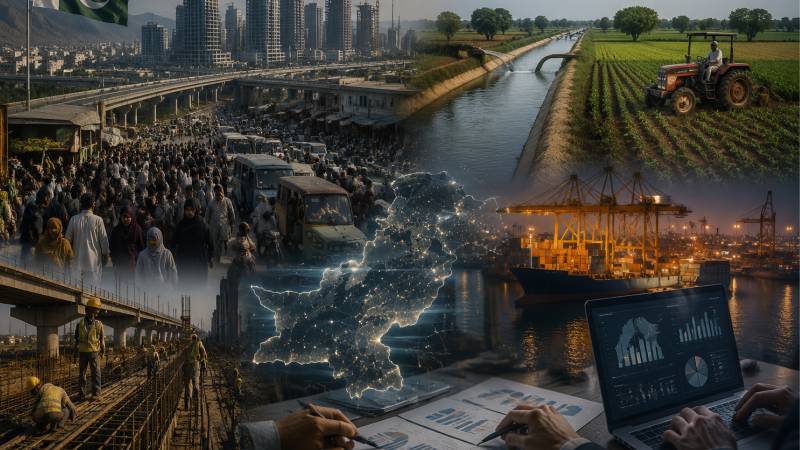
When you look at how developing economies work, few things stir up as much disagreement as population numbers. Pakistan, with about 252 million people by 2025-26, is the fifth most populated country. Seeing its large, young population as an economic strength can inspire policymakers to harness its potential better. Having studied emerging markets for years, I believe a balanced view is best: population is a powerful, often overlooked asset that has repeatedly stopped economies from collapsing. However, its benefits aren't guaranteed; they're easily lost without other reforms, and they are fragile. Ignoring demographics means missing Pakistan's proven ability to bounce back; idealizing them means ignoring the structural issues that could turn potential into disaster.
A big, young population, where about 66% are under 30 and nearly 67 million are between 15 and 29, creates a strong domestic market. This market can handle outside shocks better than smaller economies. Private spending makes up most of the GDP, keeping demand for basic goods, services, and simple manufacturing strong even when exports fall or global challenges grow. During the severe crisis from 2021 to 2024, when foreign reserves could barely cover two weeks of imports, the rupee dropped. There were high risks of default; it was this internal economy, supported by remittances that often hit over $41 billion annually, resilient farming, and active city businesses that kept basic economic activity going. Even though GDP growth stalled or shrank, a total collapse was avoided. Domestic demand has grown by an average of 4-5% recently, providing a crucial support level during unstable times.
This resilience is real. Remittances, which come from people moving abroad and their established networks, act as a widespread stabilizing force. They support household spending, the current account, and the rupee's stability when official reserves are low. Agriculture, which employs many rural people, uses its abundant labor to ensure food supplies and export crops like rice and cotton, even after floods caused by climate change. In FY2025-26, the overall GDP grew by 3.7%, the fastest in four years, reaching about $452 billion, with per capita income rising to around $1,901. The construction sector grew by 5.73%, partly because population growth itself creates needs for housing and infrastructure, showing a cycle that, though stressed, keeps activity going.
Large domestic markets boost local services and small businesses, encouraging entrepreneurship in areas hesitant about foreign investment due to political and security worries. Demographics also increase Pakistan's importance on the world stage. Lenders and allies consider the potential consequences of instability, migration, security problems, and market disruptions, which supports debt rollovers and backing from countries like China, Saudi Arabia, and the UAE. This helped prevent default during past crises. After May 2025, with improved diplomatic standing, IMF agreements, growing reserves, lower default risk, and low inflation, the focus shifted from stabilizing to recovering.
The downsides are clear and unavoidable. Population alone doesn't guarantee prosperity; it amplifies both strengths and weaknesses. With a 2.07% annual growth rate, the period until around 2055 offers a chance for economic gains, but also means high dependency, putting pressure on education, healthcare, water, and jobs. With about 57% of the population of working age, the outlook is promising, but 7% unemployment, widespread underemployment among young people, and low skills literacy (around 63%), education spending at about 0.8% of GDP, and millions out of school present significant challenges. Without quick improvements in skills and productivity, the demographic dividend could become a trap, reducing income growth per person, lowering savings (among the lowest in the region), and increasing reliance on imports, worsening trade deficits. This should motivate policymakers to pursue strategic reforms urgently.
Real-world patterns show Pakistan's two sides: its consumption-driven economy, with over 80% of GDP from private spending, boosts short-term growth but leads to demand leaks through imports, causing deficits as production falls behind. Investment remains low, limiting the capital deepening needed to create the 25-30 million jobs required over the next decade. The current 3-4% growth is not enough, risking social unrest among a large young population. Climate vulnerability makes this worse: freshwater per person has dropped sharply since independence, risking resource strain by 2050 with 390 million people, unless productivity increases significantly. High fertility has delayed this transition, straining public services with problems like stunted growth, learning gaps, and infrastructure shortages.
This resilience is real. Remittances, which come from people moving abroad and their established networks, act as a widespread stabilizing force.
This understanding shows that in countries with weak systems like Pakistan, population helps boost resilience rather than driving growth. Their informal networks, agriculture, and remittances maintain stability because the state's capacity is limited. However, this effect has limits: without investing in people's skills through targeted vocational training, expanding access to quality education, and diversifying exports, the benefits decrease, leading to lower incomes, financial pressure, and more crises. East Asia grew through education and industry; Pakistan needs to act quickly by implementing comprehensive skills development programs and export diversification strategies. Reducing fertility early could increase income by 37% by 2050, showing that policies can influence demographics.
The period after May 2025, with stronger reserves, budget surpluses, and financial inflows, offers a short but critical opportunity to treat population as strategic infrastructure instead of a passive burden. From 2026 to 2030, the goal should be 5-6% real GDP growth by channeling young people into productive roles. Prioritize vocational, digital, and green skills programs linked to services, agribusiness, and light manufacturing. Encourage domestic trade as a center for innovation to refine products and business models locally before expanding globally. Support policies that increase savings and investment, streamline subsidies, and promote climate-smart agriculture to address demographic and environmental challenges. Acting now can shape a resilient future for Pakistan.
Gains in credibility must lead to increased productivity, not another spree of consumption. Use remittances to help small and medium-sized businesses, diversify exports beyond textiles, and work with international partners for technology transfer. A possible positive outcome by 2030 includes an economy reaching about $600 billion, per capita income near $2,500, strong reserves, and youth employment absorbing the demographic surge; the alternative stagnation with 390 million people by mid-century means frustration from joblessness and instability. Success depends on rejecting both the idea that demographics are destiny and uncritical optimism.
Pakistan's population is neither a cure-all nor a curse; it is proven, raw potential, resilient in crises but needing careful management. The window after 2025, built on hard-earned credibility, is valuable. Use it practically, basing actions on solid data rather than assumptions, and scale will become a key advantage in a competitive world. Measured in the millions of individual futures, the choice will determine whether Pakistan merely survives or truly succeeds.