

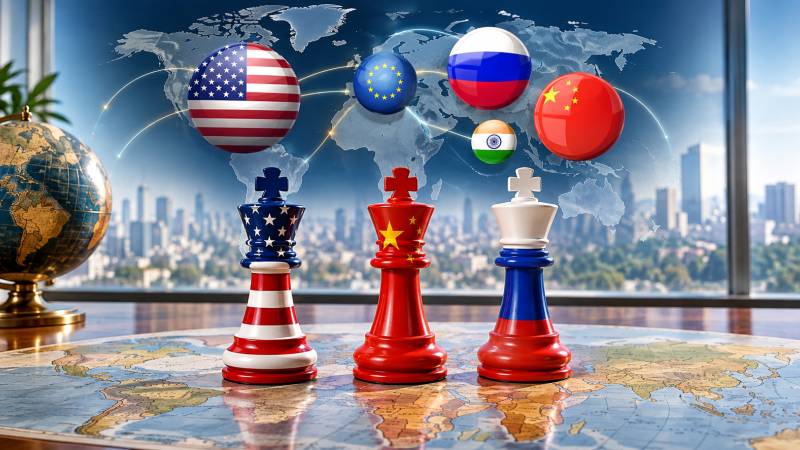
For much of the past decade, competition among the world's major powers has been one of the central organizing principles of U.S. foreign policy. During his first term, President Donald Trump pursued strategic competition with China and Russia, an approach that, despite important differences in tactics and rhetoric, largely continued under President Joe Biden. In his second term, however, Trump appears to be moving toward a different conception of international order, one in which great powers may increasingly seek accommodation with one another while asserting greater authority within their respective spheres of influence. Such an approach could represent a profound shift in American foreign policy. Rather than seeking to preserve a U.S.led international order through alliances and sustained competition with rival powers, Washington could become more willing to negotiate an informal division of geopolitical space among the United States, China, and Russia.
There is an understandable logic behind such a strategy. If the world's major powers recognize one another's core security interests and avoid direct confrontation within their respective spheres, they may reduce the risk of catastrophic great-power conflict. Yet the strategy also carries a potentially serious contradiction in seeking accommodation with America's rivals, Washington could weaken the alliances and partnerships that have been among the greatest sources of American power since World War II.
A Return to Spheres of Influence?
One of the central features of great-power accommodation would be an implicit recognition of spheres of influence; regions in which major powers expect greater freedom to pursue their strategic interests. Applied to Europe, such thinking could make Washington more willing to accept some degree of Russian control over occupied Ukrainian territory as part of a broader settlement with Moscow. allianceApplied to Asia, the same logic raises difficult questions about how the United States would respond to China's ambitions in its immediate neighborhood, particularly regarding Taiwan.
The United States, in turn, could seek greater recognition of what it considers its own strategic interests in the Western Hemisphere. There are historical precedents for major powers attempting to manage international order through negotiation and accommodation. Following the Napoleonic Wars, the Concert of Europe sought to preserve continental stability through cooperation among Europe's leading powers. At the end of World War II, Franklin D. Roosevelt, Winston Churchill, and Joseph Stalin met at Yalta to negotiate crucial aspects of the emerging postwar order.
These arrangements emerged under very different historical circumstances, but they demonstrate that competition and cooperation among great powers have long existed side by side. International order has often depended not simply on defeating rivals, but also on developing mechanisms through which major powers can coexist. The critical question is whether such a system could work under today's vastly different geopolitical conditions.
America's Alliance System Is Part of Its Power
The greatest weakness in a strategy based on great-power accommodation may be that American power does not derive solely from the size of the U.S. economy or the strength of its military. One of Washington's greatest strategic advantages is its extensive network of alliances and partnerships. For decades, NATO, U.S. alliances in the Indo-Pacific, security partnerships in the Middle East, and close political and economic relationships with other states have multiplied American influence. China and Russia possess considerable military, economic, and political power, but neither has historically enjoyed an alliance network comparable in scale and depth to that of the United States.
This is why tensions between Washington and its traditional allies matter strategically. If America's partners begin to question the reliability of U.S. commitments, they may increasingly seek alternative relationships and arrangements. Washington could then find itself negotiating with Beijing and Moscow from a weaker strategic position, not because America's military or economy suddenly became weak, but because one of the principal multipliers of American power had diminished.
The central strategic question is whether the United States can reach accommodations with its great-power rivals without sacrificing the alliance and partnerships that helped make it a global power in the first place.
There are already signs that major U.S. partners are seeking greater diplomatic and economic room for maneuver. The European Union has pursued an ambitious trade agreement with India, while senior leaders from Canada, the United Kingdom, France, and Germany have engaged directly with Beijing. The deteriorating U.S.–Canada relationship provides an especially striking example of this trend. The Trump administration has imposed steep new tariffs on categories of Canadian imports, prompting Ottawa to announce retaliatory measures. Prime Minister Mark Carney has responded by emphasizing Canada's economic sovereignty, diversification of international partnerships, and determination to reduce its vulnerabilities. He has gone so far as to acknowledge that “America has changed” and that Canada will not simply return to its old relationship with the United States. The significance extends beyond a bilateral trade dispute: when one of Washington's closest and most deeply integrated allies begins openly discussing greater economic and strategic independence, it raises questions about the longer-term cohesion of the U.S.-led alliance system.
These developments should not automatically be interpreted as an abandonment of the United States. International alignments are more complicated than a simple choice between Washington and Beijing. But they may indicate that America's traditional partners increasingly want to diversify their relationships and preserve greater strategic autonomy. China, meanwhile, continues to deepen its economic and diplomatic engagement across Europe, Africa, the Middle East, South Asia, and Latin America. Trade, infrastructure, technology, investment, and diplomacy provide Beijing with multiple instruments through which it can expand its influence. If Washington becomes increasingly confrontational toward traditional partners while Beijing presents itself as an alternative economic and diplomatic partner, the long-term balance of global influence could gradually shift.
The Iran War and the U.S. Security Umbrella
The Middle East provides an important test of this broader argument. The war involving the United States and Iran has exposed vulnerabilities associated with American hard power in the region. U.S. military facilities in the Gulf have faced serious threats, while the conflict has renewed questions about the sustainability and credibility of America's traditional regional security architecture. For decades, several Arab states have relied heavily on the United States as an external security guarantor. But prolonged regional instability and uncertainty over American policy could encourage these states to diversify their security relationships rather than depend overwhelmingly on Washington. In this context, the Mecca Joint Defense Agreement signed by Saudi Arabia, Türkiye, and Pakistan deserves particular attention. The agreement establishes a collective-defense framework under which an armed attack against one member is regarded as an attack against all three. It also provides for expanded political and military coordination, joint exercises, defense-industrial cooperation, and collaboration in emerging military technologies.
Officially, the three governments maintain that the agreement is defensive and is not directed against any particular country. Nevertheless, its broader geopolitical significance should not be overlooked. The agreement brings together Saudi Arabia's financial resources, Türkiye's considerable military and defense-industrial capabilities, and Pakistan's military strength and nuclear status. In my assessment, its emergence should be viewed as part of a broader trend in which regional powers are developing security mechanisms that provide them with greater strategic autonomy. This does not necessarily mean that Saudi Arabia, Türkiye, or Pakistan intends to abandon its relationship with Washington. Rather, it may suggest that important regional powers increasingly see value in developing additional security options instead of relying exclusively on a U.S.-centered regional architecture. If that trend continues, America's Middle Eastern partners may remain partners but increasingly on more independent terms.
Economic Power and the Dollar
Military alliances are only one component of global power. Economic and financial influence is equally important. There has been considerable debate about de-dollarization and efforts by some governments to reduce their dependence on the U.S. dollar in international transactions. The dollar nevertheless remains at the center of the international financial system, and predictions of its imminent displacement should be treated cautiously. Yet a significant long-term decline in the dollar's international role, should one occur, could have major implications for American economic and geopolitical power. The dollar's reserve-currency status provides the United States with important financial advantages and reinforces Washington's ability to exercise economic influence internationally. A gradual diversification away from the dollar would therefore not merely represent an economic development; it could eventually have geopolitical consequences. For that reason, de-dollarization should neither be dismissed nor treated as inevitable. Instead, it should be monitored as one indicator of whether the international system is gradually moving toward a more distributed economic and political order.
From American Primacy to Multipolarity?
The broader question is whether the international system is entering a period in which American primacy is gradually giving way to a more multipolar distribution of power. The concept popularly known as the Thucydides Trap describes the dangers that can arise when a rising power challenges an established power. Chinese President Xi Jinping has himself invoked the concept in discussing U.S.–China relations. The idea does not mean that conflict is inevitable, nor does it mean that the rising power necessarily prevails. Rather, it highlights the instability and danger that can accompany major shifts in the global balance of power. China's rise presents precisely this type of strategic challenge.
The United States must therefore decide not only how to compete with China, but also what kind of international system it wants to preserve. A strategy based on accommodation among great powers might reduce direct confrontation in some areas. Yet if that accommodation comes at the expense of America's relationships with allies and partners, it could ultimately weaken the very power Washington hopes to preserve. The greatest strategic danger to the United States may therefore not simply be China's rise or Russia's resurgence. It may be the erosion of the alliance system that has amplified American power for more than seven decades.
What Happens to the Rest of the World?
A world increasingly organized around great-power spheres of influence would also create profound uncertainty for smaller and medium-sized states. Countries that cannot independently compete with the world's largest military and economic powers have traditionally depended on alliances, international institutions, and principles of sovereignty and territorial integrity to constrain stronger states. If those rules become increasingly subordinate to bargains among great powers, smaller and regional powers may respond by seeking new alliances, developing independent military capabilities, hedging between competing blocs, or constructing regional security arrangements of their own.
The Mecca Joint Defense Agreement may be an early illustration of this broader impulse. The emerging international order, therefore, may not simply divide neatly among Washington, Beijing, and Moscow. It could become increasingly fragmented and multipolar, with regional powers seeking greater strategic autonomy while simultaneously maintaining relationships with several major powers. Such an order would be very different from both the bipolar Cold War system and the period of American primacy that followed it.
The Question Washington Must Answer
If these trends persist, the coming decades could produce a substantially different international order; one in which the United States remains one of the world's most powerful states but exercises considerably less influence over the rules, institutions, and security arrangements of the international system than it did in constructing the post-1945 order. That outcome is not inevitable. The United States retains enormous economic, military, technological, diplomatic, and institutional advantages. But its ability to translate those resources into global influence depends substantially on whether other countries continue to see Washington as a reliable and desirable partner.
The debate over great-power competition, therefore, is ultimately about something larger than how Washington manages its relationships with Beijing and Moscow. The central strategic question is whether the United States can reach accommodations with its great-power rivals without sacrificing the alliance and partnerships that helped make it a global power in the first place.