

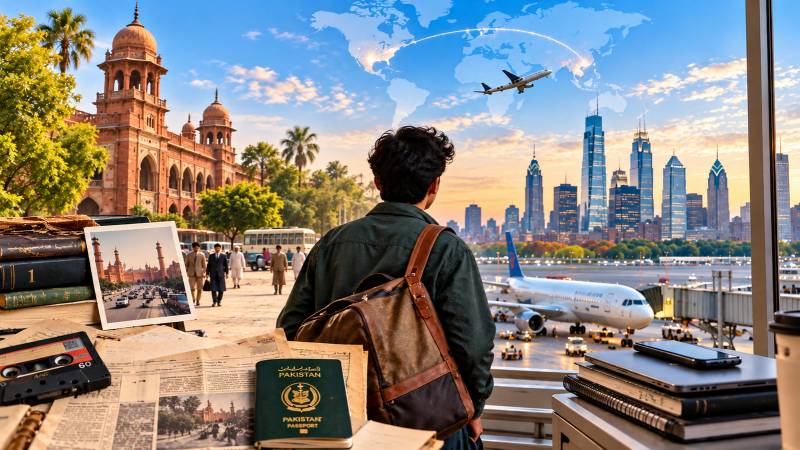
In 1987, I left a boarding school in Lahore to study at a university in Philadelphia. I was young, curious and probably more confident than my experience justified. I knew I was travelling a great geographical distance, but I could not have understood that I was also crossing between different intellectual, cultural and historical worlds. America represented not merely a university education, but an opening into bigger and better possibilities—a place where ideas could be questioned, identities explored, and a young student from Pakistan could imagine a life beyond the boundaries into which he had been born. Looking back, as 2027 approaches, I realise that my journey coincided with one of the great turning points in modern history. The world I entered in 1987 has almost completely disappeared.
The physical journey itself belonged to another age. Air travel was already modern, but everything surrounding it remained analogue. Tickets were printed on paper. Calls home were expensive, carefully timed and sometimes difficult to connect. There was no WhatsApp message to announce an arrival, no video call from a dormitory room and no digital map guiding a new student through an unfamiliar city. News from Pakistan came through newspapers, occasional telephone conversations and letters that carried not merely information but anticipation. Distance was real. When one left home, one truly left.
For a student arriving from Lahore, America appeared enormously advanced. Its universities possessed libraries of a scale that was difficult to imagine, laboratories equipped with technologies unavailable at home, and an academic culture in which professors could be challenged without the sky falling. The campus brought together young people from different countries, religions and social backgrounds. For someone educated in Pakistan’s more hierarchical environment, this openness was transformational. It suggested that authority could be questioned, that knowledge was not the private property of the powerful, and that one’s origins did not have to determine one’s destination.
America itself seemed more assured then. It was divided on many issues, but it retained a basic confidence in its institutions and its future. Ronald Reagan was president, the country was recovering from the Iran-Contra scandal, and the stock market crash of October 1987 had exposed the vulnerabilities of modern finance. Yet the larger national mood remained optimistic. The United States still appeared to believe that tomorrow would be better than today, that talent from anywhere could find a home there, and that its political system however imperfect possessed the capacity to correct itself.
The geopolitical world was simpler to describe, although infinitely more dangerous or maybe not as only time will tell. Two nuclear superpowers dominated international affairs, the United States and the Soviet Union. Europe was divided by the Iron Curtain, Germany was divided, and the Berlin Wall remained the concrete symbol of an ideological struggle that had shaped the world since the Second World War. Mikhail Gorbachev was introducing glasnost and perestroika, attempting to reform the Soviet system without destroying it. In December 1987, he and Reagan signed the Intermediate Range Nuclear Forces Treaty, eliminating an entire class of nuclear weapons. Few of us understood that we were witnessing the beginning of the end of the Cold War.
Pakistan occupied a particularly consequential position in that struggle. General Zia ul Haq was president and army chief, while Muhammad Khan Junejo served as prime minister within a political system whose civilian appearance concealed its military boundaries. Pakistan was the principal conduit for American and Saudi support to the Afghan resistance against the Soviet occupation. The country was treated as an indispensable Western ally, but the money, weapons, militancy and institutional distortions generated by that war would outlive the Soviet withdrawal. Even then, Pakistan was learning the dangerous habit of mistaking geopolitical importance for national development.
The Pakistan I left had a population of roughly 100 million. It had one television network, a limited number of newspapers, few telephones and an economy in which banks, government offices and businesses operated through files, signatures, cheques and personal relationships. Information travelled slowly and power was easier to centralize. A government could largely control the national conversation by controlling television and the press. Pakistan was politically restricted but socially more intimate where communities were physical, reputations local and memory human.
The wider world was equally tangible. Music lived on vinyl records and cassette tapes. Photographs were limited by the number of exposures on a roll of film. Newspapers arrived once a day, and television programmes were watched at the time broadcasters decided to show them. Libraries were not decorative spaces but the repositories of human knowledge. To research a subject required patience, discipline and the ability to follow one reference towards another. The scarcity of information made learning difficult, but it also made concentration possible.
Forty years later, almost every element of that world has been transformed. Nearly six billion people are now online. The smartphone has absorbed the telephone, camera, newspaper, television, map, bank branch, music player, marketplace and library. A student leaving Lahore today can remain continuously present in the family home through video calls and instant messages. He can navigate Philadelphia before arriving, access lectures from the world’s finest professors, translate unfamiliar languages and consult an artificial intelligence system capable of explaining almost any subject.
The conquest of distance is one of the miracles of our age. Families separated by continents can speak every day. Knowledge once confined to elite institutions is available to anyone with a connection. A young person in Burewala, Lahore or Karachi can build software, sell services internationally or participate in a global classroom. In banking, where I eventually spent much of my professional life, paper ledgers, telex messages and branch based transactions have given way to instantaneous payments, digital platforms, algorithmic risk assessments and financial markets that operate continuously across borders.
Technology has transformed the means of human life, but it has not transformed human nature; the unfinished journey is from knowledge to wisdom, power to responsibility, and connection to genuine human understanding.
Yet every liberation has produced a new form of dependence. In 1987, information was scarce and controlled by gatekeepers. By 2027, information is limitless, but truth has become harder to establish. Social media platforms give everyone a voice while algorithms decide which voices will be heard. These systems are not designed primarily to reward wisdom or accuracy. They reward attention, outrage, fear and emotional intensity. We have moved from a society in which a few institutions determined reality to one in which millions of competing realities are manufactured every hour.
Artificial intelligence takes this transformation further. Digital technology originally helped human beings store and transmit knowledge. AI can now produce, interpret and manipulate it. Machines can write, diagnose, translate, design, forecast and imitate human voices and faces. The question is no longer whether machines can perform physical or repetitive work. It is whether they will become participants in activities we considered distinctly human that of judgment, imagination, persuasion and creation. The opportunity is extraordinary, but so is the danger of surrendering human agency to systems that few people understand and even fewer control.
Geopolitically, the apparent simplicity of 1987 has also vanished. The Soviet Union collapsed in 1991, leaving the United States as the world’s sole superpower. For a brief period, liberal democracy, globalization and open markets appeared to have triumphed. But history had not ended. China transformed itself from a poor, predominantly rural country into a manufacturing, technological and military power. Russia re-emerged as a disruptive nuclear state. India became a major economic and strategic actor. Türkiye, Saudi Arabia, the UAE, Brazil, Indonesia and other middle powers began pursuing more independent foreign policies.
The result is not a new Cold War with two disciplined blocs but a fragmented multipolar order. The United States remains the most powerful country, yet it can no longer determine outcomes everywhere. China challenges American economic and technological primacy, Russia relies on military and nuclear power, Europe struggles to convert wealth into strategic autonomy, and international institutions built after 1945 appear increasingly unable to manage war, migration, debt, climate change and technological rivalry. In 1987, Reagan and Gorbachev were dismantling nuclear weapons. As 2027 approaches, nuclear states are modernizing their arsenals and arms control arrangements are weakening.
Globalization has undergone a similar reversal. For three decades, corporations dispersed production across the world in pursuit of maximum efficiency. China became the factory of the world, consumers gained access to cheaper goods, and capital crossed borders with unprecedented freedom. But the financial crisis, the pandemic, geopolitical rivalry and wars exposed the fragility of extended supply chains. Semiconductors, energy, food, data, critical minerals and payment systems are now treated as instruments of national power. The world remains interconnected, but interdependence is increasingly weaponized.
The population of the planet has risen from five billion in 1987 to more than eight billion. Some societies are ageing and shrinking while others, particularly in Africa and South Asia, remain young and rapidly expanding. Pakistan’s population has grown to over 250 million, but its state capacity, educational system, exports and productive economy have not expanded proportionately. The country has become nuclear armed, urban, connected and politically more difficult to silence. Yet it continues to oscillate among civilian, military and hybrid arrangements without resolving the fundamental distribution of authority and accountability.
This is perhaps Pakistan’s great forty year paradox. Technology has democratized expression but not power. Millions can now speak, record, expose and mobilize, yet institutions remain weak and economic transformation elusive. Pakistan has entered the digital age without completing the institutional, educational and industrial transformations required to prosper within it. Connectivity has raised expectations faster than the state has developed the capacity to meet them.
The United States has changed as well. The America that once seemed so confident in its openness now appears more anxious about immigration, identity, inequality and decline. The attacks of September 2001, prolonged wars, the financial crisis, racial tensions, political polarization and the rise of China have altered its psychology. American universities remain centres of extraordinary knowledge and innovation, but they too have become battlegrounds over speech, ideology and belonging. The country that taught many of us to question authority now sometimes appears uncertain about how much disagreement it can tolerate.
And yet one should resist easy nostalgia. The world of 1987 was not necessarily better. It contained authoritarianism, censorship, apartheid, rigid social hierarchies, limited opportunities for women, the constant threat of nuclear annihilation and immense poverty hidden from comfortable view. The modern world is wealthier, healthier, more educated and more connected. It has given individuals freedoms and opportunities that would have been unimaginable forty years ago.
What we have gained in access, however, we may have lost in attention. What we have gained in connectivity, we may have lost in intimacy. And what we have gained in information, we may have lost in certainty. In 1987, the principal obstacle was not knowing enough. In 2027, it may be our inability to distinguish knowledge from noise. The scarce resources of the coming age will not be data or computing power but trust, judgment, meaning and human presence.
When I think of that young student leaving a boarding school in Lahore, I remember more than an individual crossing the Atlantic. I see someone crossing from an old century into a new one without knowing it. He carried books, paper documents, a few telephone numbers and a conception of the world shaped by physical distance. He arrived in an America that represented intellectual freedom, institutional confidence and the promise that talent could transcend geography.
Forty years later, the distance between Lahore and Philadelphia has almost disappeared, yet the world itself feels more divided. We can communicate with anyone, know almost anything and build instruments of astonishing power. What we have not developed at the same speed is the wisdom to govern them. That may be the central lesson of these forty years. Technology has transformed the means of human life, but it has not transformed human nature. Power still seeks to preserve itself, fear still overwhelms reason, and societies still depend on justice, institutions and trust. The world has travelled from the analogue to the digital and is now entering the age of artificial intelligence. The greater journey from knowledge to wisdom, from power to responsibility and from connection to genuine human understanding still remains unfinished.