

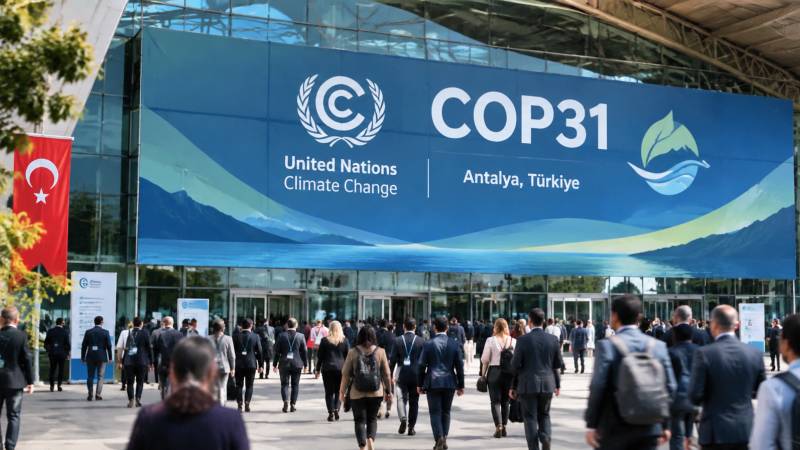
When the 31st United Nations Climate Change Conference opened in Turkiye on November 9, Pakistan arrived with a familiar argument and a different challenge. The country remains among the world's most climate-vulnerable nations, despite contributing less than one per cent of global greenhouse gas emissions. But after successive climate disasters, a new national climate plan and years of international negotiations, simply reminding the world of its vulnerability is no longer enough.
Pakistan now needs to demonstrate how it intends to use the support it is seeking, where that investment will go and how it will protect communities facing increasingly unpredictable weather. The stakes are visible in the country's recent history. The catastrophic floods of 2022 affected approximately 33 million people, killed more than 1,700 and caused $14.9 billion in damages. Economic losses were estimated at $15.2 billion, while reconstruction needs reached $16.3 billion.
The 2025 monsoon floods provided another devastating reminder. The Ministry of Planning's preliminary assessment placed economic losses at approximately Rs822 billion. More than 1,000 people died, around four million were displaced and hundreds of thousands of homes were destroyed. These figures represent more than damaged infrastructure. They expose a development model increasingly vulnerable to climate shocks. Roads, schools, hospitals, irrigation networks and agricultural land are repeatedly exposed to hazards capable of reversing years of economic and social progress.
The question facing Pakistan in Antalya is therefore not simply how much money the international community will promise. It is whether the country can secure finance that arrives in time, reaches the most vulnerable and reduces the cost of the next disaster. COP31, taking place from November 9 to 20 at Antalya Expo Centre, is being presented as a conference of implementation. Türkiye is hosting the summit, while Australia is leading the negotiations under an agreed arrangement between the two countries. The emphasis is on moving from climate ambition towards measurable delivery. That shift matters for Pakistan because the international climate debate has moved beyond the promises made at earlier summits.
At COP29 in Baku, developed countries agreed to take the lead in mobilising at least $300 billion annually for developing countries by 2035, within a wider ambition to scale climate finance from all sources to $1.3 trillion annually. COP30 in Belém subsequently called for efforts to triple adaptation finance by 2035. Yet the distance between a global financial commitment and money reaching a flood-prone district in Pakistan remains considerable.
Developed-country public adaptation finance reached approximately $28.2 billion in 2024, against estimated annual adaptation requirements of around $305 billion by 2035 for developing countries. For Pakistan, which faces mounting climate exposure and serious fiscal constraints, the distinction between announced and accessible finance is fundamental. The country cannot afford to treat climate resilience as another programme funded through expensive borrowing. It needs predictable grants, concessional financing, technology transfer and mechanisms that recognise the disproportionate burden carried by climate-vulnerable economies.
One of the most important developments shaping Pakistan's position at COP31 is its Third Nationally Determined Contribution, or NDC 3.0, submitted to the UNFCCC in September 2025. The plan commits Pakistan to reducing projected greenhouse gas emissions by up to 50 per cent by 2035 compared with its business-as-usual emissions pathway. The target comprises two parts: a 17 per cent reduction that Pakistan intends to achieve through domestic resources and policies, and a further 33 per cent dependent on international financial assistance, technology transfer and capacity-building.
The World Bank had previously estimated that Pakistan would require approximately $348 billion between 2023 and 2030 for climate-related development, including $152 billion for adaptation and resilience and $196 billion for mitigation. These figures cover different planning periods and assessments, rather than competing estimates of precisely the same programme. The challenge is turning these financial requirements into a credible investment programme.
Pakistan's NDC identifies grants, concessional loans, public-private partnerships, green bonds, carbon markets and climate insurance as potential financing sources. It also proposes improving the country's capacity to prepare projects, track climate spending and demonstrate measurable results. Speaking at a Climate Implementation Bridge meeting in New York in September, Finance Minister Senator Muhammad Aurangzeb identified three essential conditions for effective climate action: a sound policy framework, access to finance and the capacity to deliver projects at the national level. He also acknowledged an uncomfortable weakness in Pakistan's previous experience. Some international support following the 2022 floods remained unutilised because suitable projects had not been prepared. The message is clear: money is important, but institutions must be capable of using it effectively.
The question facing Pakistan in Antalya is therefore not simply how much money the international community will promise. It is whether the country can secure finance that arrives in time, reaches the most vulnerable and reduces the cost of the next disaster.
Pakistan's rapid expansion of solar energy features prominently, with discussions focusing on battery storage, energy security and greater flexibility in the national electricity grid. Water, food security and public health form another important part of the agenda. Sessions examine climate-resilient water, sanitation and hygiene systems, alongside disease surveillance and the risks associated with vector-borne and waterborne diseases and extreme heat.
The National Disaster Management Authority is scheduled to present work on technology in disaster management. For a country where flood forecasting, evacuation planning and early warnings can determine whether extreme weather becomes a humanitarian catastrophe, these discussions have considerable practical importance. Other sessions focus on adaptation finance, private investment, climate-smart agriculture, food waste reduction and strengthening local resilience.
One particularly notable planned development is the November 12 launch of NIGRAAN, described in the official programme as Pakistan's Geo-AI platform for climate risk and early warning. If implemented effectively, integrating geographic information, weather data and disaster intelligence could help authorities identify exposed communities and improve preparedness. The programme also addresses glacier-related risks, climate-resilient settlements, green skills, youth participation and water and sanitation financing. The significance of this programme lies in its breadth. Pakistan is attempting to present climate action not simply as an environmental ministry's responsibility but as an issue involving energy, agriculture, finance, health, education, disaster management and provincial development. Whether these sessions produce actual partnerships and funded projects will be a more meaningful measure of success than the number of events held.
Pakistan's public statements in the run-up to COP31 reveal a consistent message: the country is prepared to strengthen its climate commitments, but international finance and implementation support must accompany them. In March 2026, Pakistan's Permanent Representative to the United Nations, Ambassador Asim Iftikhar Ahmad, addressed a briefing by the COP31 Presidency. Describing Pakistan as a country on the frontlines of the climate crisis, he said: "The urgency of COP31 is real and personal for us."
He referred to the 2022 floods and accelerating glacier melt, warning of their implications for water security. He argued that a successful COP31 must advance the New Collective Quantified Goal on climate finance, strengthen the Global Goal on Adaptation and ensure that the Fund for Responding to Loss and Damage is adequately resourced. At COP30 in Belém, Pakistan's then climate secretary and head of delegation, Aisha Humera Chaudhry, delivered a similarly direct message to UNFCCC Executive Secretary Simon Stiell.
She said: "Pakistan is submitting its NDCs and Biennial Transparency Reports in line with its obligations, but we are not seeing commensurate delivery on commitments from the other side." Chaudhry argued that adaptation must be treated as an equal pillar to emissions reduction. She also warned that even tripling adaptation finance would not be sufficient given the low existing baseline. Her intervention highlighted an important element of Pakistan's position: climate-vulnerable countries should not have to compete for limited funding between reducing emissions and protecting populations from damage that is already taking place.
Finance Minister Aurangzeb has focused on the implementation gap. At the September 2026 launch of the COP31 Action Agenda, he welcomed the proposed Climate Implementation Bridge, or BRIDGE, as a mechanism for translating national climate plans into investable projects. Pakistan has been selected as one of the initiative's first five pilot countries, alongside Ethiopia, Fiji, Indonesia and Uzbekistan. BRIDGE aims to connect national climate plans with financing, project pipelines and institutional capacity. However, it should not be mistaken for an automatic financial grant or guaranteed investment allocation.
State Minister for Climate Change Dr Shezra Mansab Ali Khan Kharal also highlighted Pakistan's estimated $565 billion investment requirement and limited fiscal space during a pre-COP31 consultation on October 21. She called for a clearly defined negotiating position on adaptation finance, loss and damage and the risks confronting the country's mountainous regions. These statements suggest that Pakistan's diplomatic message is becoming more specific. Climate finance is not simply assistance for environmental projects. It is an investment in economic stability, food security, public health and the protection of development gains.
The most important difference between COP30 and COP31 is the opportunity to move from negotiating financial targets to building mechanisms that can deliver them. At COP30, Pakistan's delegation pressed for stronger adaptation finance, an effective Loss and Damage Fund and recognition of the threats facing the Hindu Kush, Karakoram and Himalayan mountain systems. At COP31, Pakistan has a more developed national climate framework and a practical opportunity to demonstrate how it can be implemented. The BRIDGE initiative, the pavilion's investment-focused sessions and NDC 3.0's detailed costing provide a stronger basis for discussions with development banks, governments and private investors.
In Balochistan, prolonged drought and water scarcity threaten agricultural livelihoods, livestock and access to drinking water. In the northern mountains, glacier melt and glacial lake outburst floods threaten settlements, roads and hydropower infrastructure. Along the coast, sea-level rise and salinity affect communities dependent on fishing and agriculture. In the Indus Basin, floods and periods of water stress expose weaknesses in storage, irrigation and water management. These pressures can increase food prices, deepen rural poverty and accelerate migration towards already overstretched cities.
NDC 3.0 recognises water security, climate-smart agriculture, ecosystem restoration, health and disaster preparedness as central adaptation priorities. It also calls for district-level adaptation planning and stronger coordination between federal and provincial governments. The government has increasingly framed climate change as an economic and security challenge. In discussions with Türkiye ahead of COP31, Federal Climate Secretary Aisha Humera Moriani emphasised cooperation in flood management, glacier and avalanche risk reduction, early-warning systems and climate-resilient infrastructure. This is an important shift in Pakistan's climate diplomacy. Resilience is not an isolated environmental objective but a foundation of economic and social stability.
COP31 offers Pakistan an opportunity to move beyond presenting itself as a victim of climate change and demonstrate that it can translate international commitments into practical outcomes. Its credibility will ultimately depend on two things: whether the international community delivers accessible, affordable climate finance, and whether Pakistan develops the institutional capacity, transparency and political commitment to use it effectively. The country has the plans, the investment estimates and a growing diplomatic platform. What remains to be demonstrated is the ability to turn them into protection for the millions of people whose livelihoods and futures are increasingly shaped by a changing climate.