

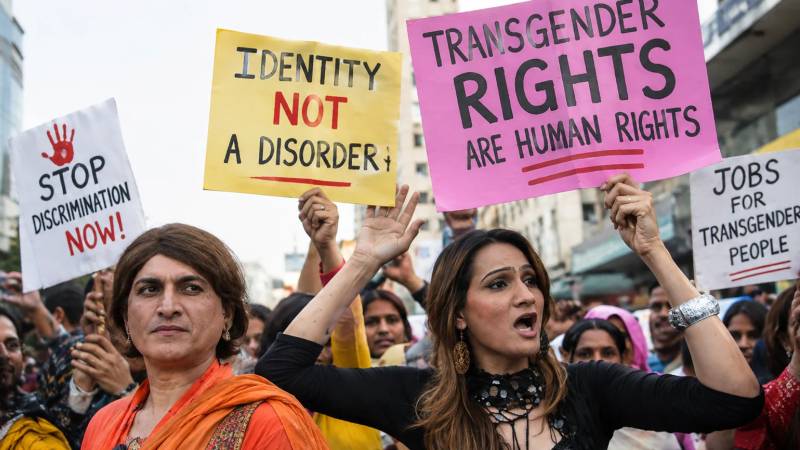
Being born transgender is not an option anyone picks. A transgender child can be born in any home, even mine or yours. What happens to that child is a choice, and most of it is made by the rest of us. The environment we provide and the job market available in our country for transgender people decide a lot of things. We mostly see transgender people begging at road signals, dancing at weddings and, after dark, a few of them selling something else. Sadly, these are the only options left when every other road has been shut.
The numbers have said this for years. A 2016 survey by the Good Thinkers Organisation, reported in Dawn, found that 68pc of the trans community was tied to dancing and 22pc to begging. Nine per cent did skilled labour. One per cent worked in an office, public or private. Later surveys of trans women, which took place across Lahore, Rawalpindi and Islamabad, tell the same story, with sex work filling the gap that dancing leaves.
Now even dancing is being eradicated. In parts of Khyber Pakhtunkhwa, jirgas and clerics have banned khawaja siras from performing at weddings. In September 2025, elders in Swabi formed a committee to expel trans people from the district, a move the HRCP condemned. Take away the wedding work, and the street is where people have to end up. At a protest over prices in Karachi this July, one placard put it plainly: “We beg on the streets, you beg at the IMF.”
The state has done nothing other than make big announcements. The Transgender Persons (Protection of Rights) Act, 2018 bars discrimination in hiring. Sindh announced a 0.5pc quota in government jobs in 2019. This April, its spokesman, Sukhdev Hemnani, was still directing departments to enforce it, and departments still weren’t transparent about how many people had been hired. Punjab’s local government department fixed a 2pc quota in 2021 and spoke of about 1,500 posts. Khyber Pakhtunkhwa’s new policy, announced in February, promises police recruitment and a welfare fund but sets no job quota. A similar provincial package in 2018 mostly stayed on paper.
What actually reaches people is much thinner. When Dawn went looking in 2022, it found two trans people who had been hired by the Islamabad deputy commissioner’s office at Rs18,000 a month and were then let go. Two hired by the Sindh government had also been let go. The only regular government employee it could find was Natasha at Nadra, who had joined on open merit in 2011.
Not much has changed since. In Faisalabad this year, a trans woman working as a victim support officer at a police service centre told The Express Tribune that her post is a contract job paying Rs30,000 a month, below the minimum wage, with no route to becoming a permanent employee. In Lahore, the excise department once stationed three trans people on Wahdat Road to embarrass tax defaulters, for Rs1,000 a day. That was merely a social media stunt; nobody makes a living on it.
Punjab’s skills programme, Pehchan, is the most serious effort so far. The Punjab Skills Development Fund says it trained 1,054 trans people and that more than 980 found jobs. That is worth building on. But the announcement names the training partners, not the employers, and there is no figure for how many are still working a year later.
Private companies have done even less. In 2019, Unilever Pakistan and Akhuwat said 18 trans people had been given jobs at a warehouse in Unilever’s supply chain, and the company later started a trainee programme with Akhuwat and NOWPDP. Fountain House in Lahore runs a textile recycling unit that employs trans workers. These are good examples, and they are close to the whole list. Big firms here win gender diversity awards every year, but those awards count women; trans people rarely come up.
On top of this is the legal confusion. In May 2023, the Federal Shariat Court struck down parts of the 2018 Act, including the right to self-identify. Trans activists and PPP leader Farhatullah Babar appealed to the Supreme Court that summer. An HR manager reading the news can be forgiven for not knowing what the law expects. Most do nothing. I think these five practical steps would make a real difference.
First, make the quotas really count. The federal government and every province should publish, once a year, how many quota posts were advertised and how many trans people were actually hired. All unfilled posts should carry forward to the next year. There should also be a relaxation in the age limit, as the activist Jannat Ali asked back in 2021, because many trans people are pushed out of school young and reach the job market late.
Second, quota jobs should be proper jobs. A quota post should be a regular post on a pay scale, paying at least the minimum wage. Hiring someone at Rs18,000, or on a contract that ends when the government changes, is only an advertisement policy, not a job.
Third, give companies a reason to hire. Bangladesh did this in its 2021 budget, offering a tax rebate to firms that hire trans workers, and a year later it cut the number of hires needed to qualify from 100 to 25. Pakistan could replicate it in the next budget. The SECP could also ask listed companies to report trans hires alongside the gender figures many of them already publish.
Fourth, tie training to hiring. Schemes like Pehchan should sign up employers before a course starts, and the government should publish how many graduates are still employed after 12 months. A certificate doesn’t pay rent on its own.
Fifth, protect people once they are hired. Every office hiring under a quota or a tax scheme should name one officer to hear complaints, and staff should get basic training before the new hire arrives. The Faisalabad officer described what she heard at a dairy farm where she worked before: people said it felt strange to see her treating animals. Many trans workers leave jobs because of their colleagues, not the difficulty of the work.
None of this is expensive. The 2023 census counted 20,331 transgender people, and activists say the real number is many times higher. Either way, this is a problem the country can afford to fix, and it must be settled. The trans woman at the signal was someone’s child once. She could have been born in your house. The least we can do is make sure that, if she wants a decent job, there is one she can do.