

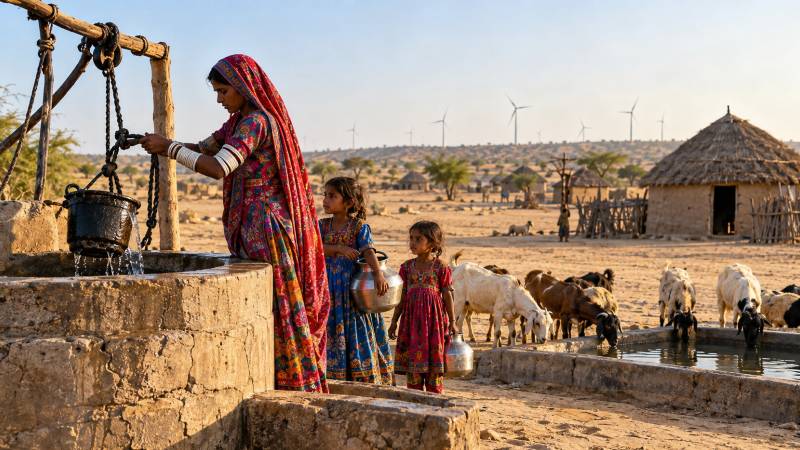
Tharparkar’s development paradox is difficult to ignore. The district possesses substantial natural resources, including vast mineral reserves, and supports millions of people and livestock. Yet many of its residents continue to struggle with inadequate access to clean drinking water, healthcare, education and sustainable livelihoods. Recurring droughts, food insecurity and weak public services deepen these challenges, leaving communities vulnerable to crises that return year after year. Covering approximately 19,389 square kilometres, Tharparkar is predominantly desert, with nearly 97 per cent of its territory characterised by arid conditions. Its population of around 1.6 million people is spread across approximately 2,880 villages. These geographical realities make service delivery difficult, but they do not explain why basic necessities remain inaccessible to so many communities.
The central question is not whether Tharparkar can be developed, but why development has failed to produce lasting improvements in people's lives. The district needs a shift from temporary relief and isolated projects towards sustained investment, accountable governance and planning rooted in local realities. Access to safe drinking water remains one of Tharparkar’s most persistent challenges. Many communities depend on groundwater, traditional wells and other local sources that may become unreliable during prolonged dry spells. In some areas, groundwater contains excessive fluoride and other contaminants, creating serious concerns about long-term public health.
The World Health Organisation’s guideline value for fluoride in drinking water is 1.5 milligrams per litre. Where concentrations exceed this level, prolonged consumption can increase the risk of dental and skeletal fluorosis. Reliable water testing, transparent reporting and appropriate treatment are therefore essential, particularly in communities where residents have few alternatives. Reverse osmosis (RO) plants have been introduced to improve access to drinking water. However, installing a plant does not guarantee a dependable supply. Facilities require electricity, regular maintenance, trained operators, replacement parts and effective monitoring. When these systems stop functioning, communities are left to return to unsafe or distant water sources.
Public reporting has raised concerns about the gap between planned and operational RO facilities in Sindh. Figures attributed to the National Commission for Human Rights indicate that hundreds of plants were installed, but a significant number were not functioning. The precise figures and their geographical coverage require verification; nevertheless, the underlying policy question remains important: who is responsible for ensuring that these facilities continue to serve the communities for which they were built?
Water policy must also move beyond emergency interventions. Rainwater harvesting, the restoration of traditional water-storage systems, groundwater monitoring and community-managed conservation initiatives can contribute to a more resilient water supply. Infrastructure should be selected according to local conditions rather than imposed through a uniform model. For Tharparkar, clean water is not simply a development indicator. It affects health, education, household income and the amount of time women and children spend collecting water instead of pursuing other activities. Drought is a recurring feature of life in Tharparkar. The district’s dependence on rainfall makes agricultural production uncertain, while prolonged dry periods reduce pasture availability and place livestock at risk. Historical accounts describe repeated drought episodes over several decades, illustrating the need for long-term preparedness rather than reactive crisis management.
For many households, livestock is both a source of income and a form of financial security. Animals provide milk, meat and other products, while their sale can help families meet urgent expenses. When drought reduces grazing land and water availability, however, livestock owners face rising costs, declining productivity and the possible loss of their principal assets. Agriculture faces similar constraints. Rain-fed cultivation is vulnerable to unpredictable rainfall, and limited access to storage, transport, credit and reliable markets can prevent farmers from earning fair returns. Even a successful harvest may not translate into financial stability when producers have little bargaining power or must sell quickly to meet household needs.
Tharparkar’s vast mineral wealth stands in stark contrast to its persistent water scarcity, recurring droughts, malnutrition, inadequate healthcare and educational inequalities, underscoring the urgent need for sustainable development, accountable governance and community-led solutions.
Development planning should therefore support climate-resilient farming, improved livestock healthcare, fodder banks, veterinary services and better market access. Farmers and livestock owners also need timely weather information and practical guidance on managing scarce water resources. Small-scale processing, local enterprises and improved links between producers and markets could diversify household incomes. Such initiatives must be designed around the district’s environmental limits. Promoting water-intensive activities without assessing local water availability risks creating new problems while attempting to solve existing ones.
Tharparkar’s natural resources offer economic opportunities, but mineral wealth alone cannot guarantee broad-based prosperity. Mining and related investment must be assessed in terms of local employment, environmental protection, infrastructure, public revenue and benefits for surrounding communities. Transparent arrangements are essential to ensure that economic activity contributes to durable improvements in public services and living standards. Food insecurity and malnutrition remain serious concerns in Tharparkar. Children are particularly vulnerable when households face inadequate diets, unsafe water, recurring illness and limited access to healthcare. Malnutrition can affect physical growth, cognitive development and educational outcomes, with consequences that extend well beyond childhood.
Figures attributed to Pakistan’s 2018 National Nutrition Survey have placed stunting among children in Tharparkar at approximately 60 per cent, with underweight prevalence reported at 60.1 per cent. The survey also reported a combined stunting and wasting figure of 19.8 per cent. These figures should be checked against the original tables, including their definitions, sample sizes and geographical coverage, before publication. Whatever the final verified estimates, tackling malnutrition requires more than distributing food during emergencies. Children need regular health assessments, immunisation, safe drinking water, sanitation and access to nutritious food. Pregnant and breastfeeding women also require appropriate nutritional support and maternal healthcare.
Nutrition programmes should be coordinated with local health facilities, schools and community organisations. Their performance must be measured through transparent indicators, including child growth, treatment outcomes and the continuity of services, rather than the number of camps held or supplies distributed. The district’s reported cases of suicide also demand careful attention. A figure of 116 suicides in 2025 has been cited in discussions of Tharparkar, but it requires independent verification and clear sourcing. Suicide is a complex issue that cannot responsibly be attributed to a single factor such as poverty or malnutrition. Understanding its causes requires reliable data, sensitive reporting and attention to social, economic and psychological pressures.
Accessible mental-health support, trained healthcare workers and confidential referral services should form part of a wider public-health response. For residents of remote villages, reaching a functioning health facility can involve long journeys and substantial expenses. Transport costs, medicine shortages, limited diagnostic facilities and the absence of specialised staff can turn treatable conditions into serious emergencies. Upgrading hospitals is an important step, but buildings and equipment cannot substitute for consistent staffing, medicine supplies, functioning laboratories and emergency transport. Facilities must be assessed according to the services they actually provide, not merely their official designation.
The reported upgrade of Chachro Hospital, an initiative discussed since 2014, illustrates why projects need transparent timelines and clear accountability. Its current status, service capacity and staffing should be confirmed through official records and independent reporting. Mobile health units and outreach teams can help remote communities, particularly during droughts and periods of heightened disease risk. However, they should complement—not replace—permanent facilities capable of providing continuous care.
A practical district health strategy would map underserved settlements, identify travel barriers and establish measurable standards for staffing, essential medicines, emergency referrals and maternal and child healthcare. Public dashboards and regular independent inspections could help residents determine whether promised services are being delivered. Education is another area in which persistent inequalities constrain Tharparkar’s future. Census figures cited for the district place overall literacy at 36.39 per cent, with literacy among men at 48.50 per cent and women at 23.49 per cent. These figures require confirmation against the relevant census tables, but the reported gender gap highlights a major policy challenge.
Girls in remote settlements may face several barriers simultaneously: long distances to schools, inadequate transport, a shortage of female teachers, financial pressures and concerns about facilities and safety. Where secondary education is unavailable nearby, families may find it particularly difficult to keep girls enrolled. Building more schools is necessary, but infrastructure alone will not guarantee attendance or learning. Schools need qualified teachers, functional classrooms, appropriate sanitation, learning materials and regular monitoring. Teacher absenteeism and persistent vacancies must be addressed through fair recruitment, support and accountability.
The Sindh School Education Statistics and related surveys can help identify gaps in enrolment, school availability and educational outcomes. Their findings should guide resource allocation, with particular attention to settlements where children have limited access to primary or secondary education. Scholarships, transport assistance, community engagement and flexible support for children affected by drought could help reduce dropout rates. Adult literacy programmes and vocational training would also expand opportunities for young people and women who have missed formal education.
Education should be understood as a long-term investment in the district’s ability to manage its own development. A population with stronger educational opportunities is better placed to participate in local decision-making, access employment and hold public institutions accountable. Tharparkar’s challenges are interconnected. Water scarcity contributes to poor health; drought affects agriculture and livestock; unstable household incomes can disrupt education; and inadequate healthcare increases the consequences of malnutrition. Addressing these problems through disconnected projects is unlikely to deliver lasting change.
The government should establish a coordinated, multi-year development framework for Tharparkar, with clearly defined responsibilities, realistic budgets and measurable targets. Water facilities should be assessed for functionality; healthcare centres for staffing and service delivery; schools for attendance and learning; and livelihood programmes for their effects on household income and resilience. Public spending and project progress should be reported in accessible formats. Independent audits, community monitoring and accessible complaint mechanisms can help identify failures before they become entrenched. Local residents, including women, farmers, livestock owners, teachers and healthcare workers, should participate in deciding priorities and evaluating results.
Development must also account for environmental sustainability. Mining, infrastructure and commercial activity should be accompanied by credible assessments of their effects on groundwater, land, grazing areas and local communities. Economic growth that undermines the resources on which residents depend cannot provide a durable solution. Tharparkar is not a barren district without prospects. Its people possess extensive knowledge of living in an arid environment, while its livestock, agriculture, cultural heritage and mineral resources offer opportunities for development. What remains necessary is a public policy framework that connects these assets to reliable services and tangible improvements in everyday life.
The measure of progress should not be the number of projects announced or facilities inaugurated. It should be whether families can obtain safe drinking water, children receive adequate nutrition, girls complete their education, patients access timely treatment and households can withstand drought without losing their livelihoods. Tharparkar does not need development that appears only during a crisis. It needs development that lasts supported by evidence, sustained investment, transparent institutions and meaningful community participation.