

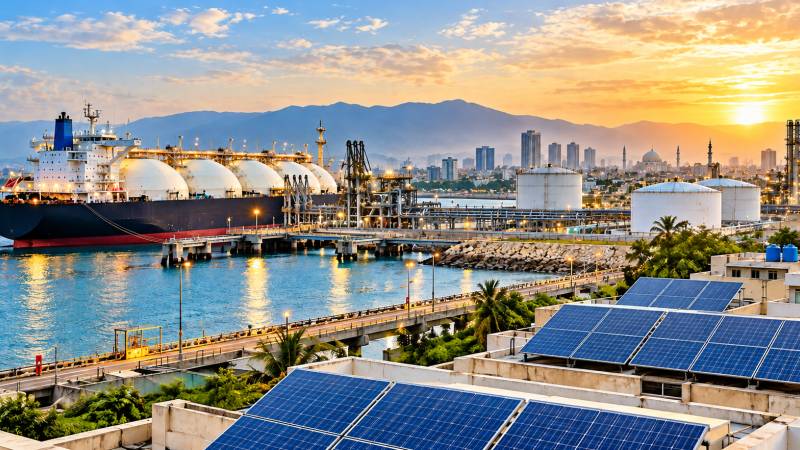
Pakistan’s energy economy is caught in an unusual contradiction. On one hand, the country has had more liquefied natural gas (LNG) than it could use, forcing it to divert contracted cargoes to other markets. On the other, when the 2026 Middle East conflict disrupted LNG supplies, Pakistan had to worry about shortages and look again towards the expensive global spot market. At the same time, the gas sector’s circular debt has reached around Rs3.3 trillion, with the costs eventually spreading across the wider economy through higher energy prices, pressure on public finances and losses within state-owned companies.
So how did a fuel once introduced as part of the solution to Pakistan’s energy crisis become such a significant economic burden?
A new report offers an important starting point. On October 1, 2026, Recourse, Africa Change Lab and The Big Shift Global released Gas Is Bad Economics for the Global South, examining the economics of fossil gas in five developing countries, including Pakistan. Its central argument is that countries investing heavily in gas as a “bridge fuel” towards cleaner energy can become locked into debt, volatile international prices and infrastructure that may become less useful as energy markets change. Pakistan provides an important case study of that argument.
A Solution For A Time Of Shortage
Between 2014 and 2016, Pakistan developed infrastructure and long-term arrangements to import LNG. There was a clear reason for doing so. Domestic gas production was declining, industries were struggling with shortages, and prolonged power cuts were hurting businesses and households. Imported LNG offered a relatively quick way to supply fuel to power plants, reduce dependence on expensive furnace oil and provide gas to industry. But the underlying challenge was and remains — energy access. For households and businesses, access means more than having an electricity or gas connection. Energy must also be reliable and affordable. An imported-fuel system therefore cannot be judged only by how much energy it brings into the country, but also by whether its costs help expand affordable and dependable access.
It would be unfair to judge decisions made a decade ago entirely with the benefit of hindsight. Policymakers in 2015 could not have known how quickly solar technology would become cheaper or precisely how Pakistan’s electricity demand would change. The more important question is whether the country’s long-term energy arrangements were flexible enough to adapt when prices, technology and demand changed. Today, that question is worth billions of dollars.
A March 2026 study by the Institute for Energy Economics and Financial Analysis (IEEFA) found that Pakistan had to make arrangements to divert about 45 surplus LNG cargoes contracted from Qatar and Italy’s ENI to other markets. Based on projections by Pakistan’s Petroleum Division, IEEFA estimates that, if the mismatch between demand and contracted supply is not addressed, Pakistan could face as many as 177 surplus cargoes through 2032, with a potential liability of about $5.6 billion, or more if oil prices rise. This is a projection of financial risk rather than a loss Pakistan has already incurred, but it illustrates how expensive long-term contracts can become when the assumptions behind them change.
Then Came The Solar Revolution
While Pakistan remained tied to long-term gas arrangements, consumers were changing the energy market themselves. As grid electricity became more expensive and solar panels became cheaper, households, shops, factories and farmers increasingly began producing their own electricity. IEEFA estimates that Pakistan’s distributed solar capacity reached around 34 gigawatts in 2025, including grid-connected and off-grid systems. Meanwhile, electricity demand from the national grid in fiscal year 2025 was almost 11 per cent lower than in fiscal year 2022. Solar was not the only factor: high electricity prices, weaker industrial demand and slow economic growth also contributed. But solar has clearly become an important part of Pakistan’s changing electricity market.
The change has reached the gas market. Pakistan’s LNG consumption fell by around 1.21 million tonnes in 2025. According to IEEFA, LNG-based electricity generation declined by about 4.5 terawatt-hours, while industrial gas demand also weakened. This creates a difficult economic situation. Consumers reduce their dependence on expensive grid electricity by installing solar panels, lowering demand for some gas-fired generation. The country consequently needs less imported gas. Yet long-term LNG contracts do not automatically adjust when demand falls. Pakistan’s contracts have included “take-or-pay” commitments, under which buyers carry payment obligations for contracted supplies even when demand is weaker, subject to the flexibility provisions of individual agreements. Such arrangements can provide supply security when demand is high, but they reduce flexibility when consumption falls unexpectedly. Pakistan’s LNG surplus therefore exposes a fundamental mismatch: energy demand can change much faster than long-term contractual commitments.
How Can Pakistan Have Too Much Gas And Too Little?
The contradiction became even clearer during the 2026 Middle East conflict. Before the crisis, Pakistan was trying to manage surplus LNG. When regional supply routes were disrupted, however, the country suddenly faced another problem: securing enough gas during periods of high demand. Pakistan introduced an emergency gas management plan and again had to consider buying LNG from the international spot market.
Solar power and a more diverse electricity mix helped the national grid cope with reduced LNG availability. But solar does not produce electricity at night, meaning gas and other dependable sources were still required to meet peak evening demand. This highlights an important aspect of energy security. It is not simply about signing contracts to buy more fuel. Pakistan has long-term LNG contracts but very limited capacity to store LNG. When demand is low, surplus gas creates pressure on the system; when international supply is suddenly disrupted, the same country can face shortages. Surplus and shortage are therefore not necessarily opposites. In Pakistan’s case, they can be two symptoms of the same problem: an energy system that does not have enough flexibility.
When Imported Gas Pushed Out Cheaper Local Gas
Perhaps one of the most striking examples came in 2025. Pakistan had too much gas in its pipeline system and insufficient storage capacity, causing pipeline pressure to rise. To manage the problem, the government had to reduce production from domestic gas fields by around 270 to 400 million cubic feet per day. IEEFA reports that state-owned Oil and Gas Development Company suffered around Rs43 billion in revenue losses as a result.
The economics are difficult to ignore. According to the IEEFA analysis, imported LNG was roughly three times as expensive as domestic gas. Yet contractual obligations and limited storage meant that, at times, Pakistan had to reduce production of cheaper domestic gas while imported LNG remained in the system. At that point, the problem was no longer simply the international price of LNG. The structure of the system itself was creating additional costs.
Pakistan’s LNG surplus and recurring gas shortages are not necessarily opposites; they can be two symptoms of the same problem — an energy system that lacks the flexibility to respond to changing demand and supply.
The Rs3.3 Trillion Question
Pakistan’s gas-sector circular debt adds another layer to the problem. By early 2026, it stood at around Rs3.3 trillion. It would be wrong to attribute all of this debt to LNG. The problem has multiple causes, including differences between the actual cost of gas and prices charged to some consumers, subsidies, unpaid bills, old liabilities, theft, pipeline leakage and problems with measurement and recovery. But expensive imported gas makes these weaknesses more costly. IEEFA estimates that unaccounted-for gas losses are around 11.7 per cent. This can include technical leakage, theft, metering problems and other losses. Not all of this can simply be described as poor management, since gas networks inevitably experience some technical losses. Nevertheless, reducing leakage, controlling theft, improving metering and recovering bills remain basic responsibilities of gas companies and regulators.
This matters directly to ordinary consumers. If Pakistan imports expensive gas, fails to recover all its costs, loses a significant amount within the system and then responds by increasing tariffs, consumers are not paying only for the international price of gas. They can also end up carrying part of the cost of weaknesses within the domestic system. The government therefore needs to distinguish between the different sources of the financial gap: imported fuel, subsidies, unpaid bills, old liabilities and losses within gas companies. Without that separation, higher tariffs risk becoming a substitute for better management.
The Role Of International Finance
Pakistan’s LNG system was not built with domestic resources alone. International financial institutions helped finance parts of the infrastructure. The International Finance Corporation and the Asian Development Bank participated in financing Pakistan’s first major LNG terminal, while other institutions supported gas transmission, energy-sector reforms and fuel imports. At the time, the logic was understandable. Pakistan urgently needed energy, and LNG appeared to offer a faster alternative to shortages and expensive liquid fuels. But development finance cannot be judged only by whether a project was successfully built. Energy markets, technology and demand change, and the long-term economics of earlier investments need to be reassessed when they do.
The new Recourse report raises a wider question: whether developing countries with limited financial resources should continue investing heavily in new fossil-gas infrastructure when renewable energy, stronger electricity grids and energy storage may offer alternative paths. This does not mean Pakistan can stop using gas tomorrow. Gas still has an important role in some industries, fertiliser production and parts of the power system, particularly when solar generation falls in the evening. But today’s need for gas does not automatically make every new LNG investment economically sensible.
Gas Has A Climate Cost Too
The price of LNG is not measured only in dollars. Burning natural gas releases carbon dioxide, but its climate impact begins before the gas reaches a Pakistani power plant. Gas must be extracted and processed; LNG must then be cooled into liquid form, transported by ship and converted back into gas. Energy is consumed throughout this process, while methane can escape along the supply chain.
The International Energy Agency estimates that extracting, processing and transporting natural gas account for nearly 17 per cent of its average global life-cycle greenhouse-gas emissions. LNG generally has higher supply-chain emissions than gas produced close to where it is consumed because liquefaction and long-distance transport require additional energy. For a country already exposed to extreme heat, floods and other climate risks, these emissions are relevant to the wider economic debate. Solar power also has environmental costs. Panels require minerals and energy to manufacture, must be transported and eventually recycled or disposed of, while a power system with large amounts of solar requires investment in transmission, storage and other sources that can supply electricity when the sun is unavailable.
But there is one major economic difference: Pakistan does not have to import sunlight in dollars. As renewable energy has become cheaper, that distinction has become increasingly important. According to the International Renewable Energy Agency, more than 90 per cent of utility-scale renewable projects commissioned globally in 2025 produced electricity at a lower cost than the cheapest new fossil-fuel alternative in their respective markets. The global average cost of new solar PV remained around $44 per megawatt-hour. These are global figures, not guaranteed costs for Pakistan, where grid upgrades, financing, batteries and local conditions still matter.
So What Price Did Pakistan Pay?
A decade ago, imported LNG was introduced as part of the answer to Pakistan’s energy shortage. Today, the same system is dealing with surplus cargoes, weaker demand from gas-fired power plants, reduced domestic gas production, Rs3.3 trillion in gas-sector circular debt, exposure to international price and supply shocks, and the climate costs associated with continued fossil-fuel use. This does not mean every decision made a decade ago was wrong. The more important lesson is that energy security is not simply about securing fuel. It also requires flexible contracts, efficient companies, realistic demand forecasts, domestic resources, new technology, storage, a modern electricity grid and protection against global price shocks.
Pakistan’s consumers have already changed part of the country’s energy economy by moving rapidly towards solar power. The question now is whether government policy, gas companies, contracts and the national grid can adapt just as quickly. The real price of fossil gas is not paid only when an LNG tanker arrives at the port. It also appears in the import bill, circular debt, underused infrastructure, system losses, and the carbon and methane emissions that add another cost to the future of a country already living with the consequences of a changing climate.