

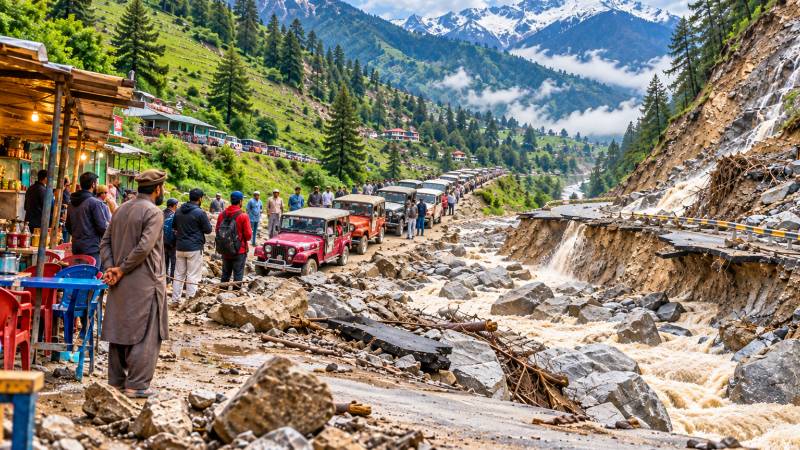
Climate change is turning some of Khyber Pakhtunkhwa’s most attractive tourist destinations into increasingly risky places to visit. One example is Bir Gali in Gadoon, District Swabi. The area was once a popular attraction for local people who could not afford expensive trips to Pakistan’s northern regions. It also provided a cool refuge for numerous families seeking relief from the scorching summer heat. However, the situation changed dramatically following the 2025 cloudburst. The road to Bir Gali in Gadoon no longer looks the same after the natural disaster.
Where visitors once came to enjoy the hills, greenery and tranquil landscape, intense rainfall can now transform the terrain in a matter of moments. Water rushes down slopes, roads become difficult to navigate, and the very landscape that attracts visitors becomes a reminder of how quickly weather conditions can change. For communities around Gadoon and Bir Gali, the recent cloudburst was not simply a weather event. It was a warning of how vulnerable mountainous and hilly tourist destinations can become when intense rainfall occurs within a short period.
“We always looked forward to summer because it was the only season in which our business would flourish. Tourists were our main source of livelihood, as we have few other options for earning a living and supporting our families in the mountains. After last year’s floods, the number of tourists fell by almost half, reducing our daily income and causing hardship for our families,” said Sabzali, a resident of Bir Gali who runs a roadside dhaba selling tea and snacks. Sabzali’s experience raises a broader question about Pakistan’s tourism sector: what happens when the natural beauty that attracts tourists also becomes increasingly exposed to climate-related hazards?
On 27 September, the world observes World Tourism Day. In Khyber Pakhtunkhwa, the occasion comes at a time when the tourism industry faces a difficult contradiction. The province continues to attract millions of visitors to its valleys and mountain resorts, but extreme weather is making travel increasingly unpredictable. In 2025, more than 12.4 million tourists visited KP, according to figures reported by the Khyber Pakhtunkhwa Culture and Tourism Authority. However, the authority also acknowledged that floods severely affected the hospitality sector and contributed to a decline in local tourist arrivals.
For residents of Gadoon and Bir Gali, the cloudburst provides a local example of the changing relationship between tourism, weather and livelihoods. A cloudburst can produce an extraordinary amount of rainfall within a short period. In hilly terrain, the consequences can be particularly severe because water moves rapidly downhill, carrying soil, stones and debris with it. Gadoon is not usually mentioned alongside Swat or Galiyat when Pakistan’s tourism industry is promoted. However, places such as Bir Gali illustrate an important reality: climate vulnerability is not limited to the country’s most famous tourist destinations.
Swat presents another side of the story. According to a Tourism Department report, the valley remains one of KP’s major tourist destinations. During Eid-ul-Adha in 2026, Swat received 416,794 visitors, the highest number recorded among the province’s tourist destinations during the holiday period. Across KP, more than 1.26 million tourists visited various destinations during the same period. For hotels, restaurants, transporters, guides and small businesses, these visitors represent an important source of income.
Tourism growth therefore needs to be measured not only by the number of hotels and visitors but also by whether destinations remain environmentally and physically safe.
However, Swat is also increasingly exposed to weather-related hazards. The National Disaster Management Authority (NDMA) has identified Swat and other mountainous districts as vulnerable to landslides and related hazards because of their steep slopes, fragile terrain, river-cut valleys and roadside embankments. In June 2025, the NDMA warned that intense rainfall and above-normal temperatures had increased the likelihood of glacial lake outburst floods (GLOFs) in northern KP, including Swat, raising the risk of flash floods, infrastructure damage and disruptions to public mobility.
Social activist Sadiya Umair, from Swat, highlighted the economic consequences of these disruptions. For a tourist, a blocked road may mean a cancelled trip. For a hotel owner, it may mean empty rooms. For a driver, it can mean days without income. For a family dependent on seasonal tourism, it can result in a significant loss of earnings. Climate change is not the only factor affecting these communities; it is part of a wider, interconnected set of challenges that particularly affects middle-class households in Pakistan, especially in KP.
Galiyat presents a slightly different picture. Its cool climate and forests make it an important retreat for people from the hotter plains of KP and Punjab. During a busy weekend in May 2026, thousands of tourists travelled to Nathia Gali, Ayubia, Thandiani and the surrounding areas, generating business for hotels, restaurants, guides, horse riders and roadside vendors. However, the same mountainous environment and rainfall patterns that make Galiyat attractive can also create significant risks.
Heavy rain can trigger landslides, mudslides and falling boulders, while flash floods can occur in local streams and nullahs. NDMA advisories have specifically warned of these risks in Galiyat and advised tourists to check weather conditions before travelling. In September 2026, the KP Tourism Authority intensified safety awareness efforts for tourists visiting Galiyat and other destinations during the monsoon season. Tourism Police and Rescue 1122 personnel were deployed to guide visitors and distribute safety information, while tourists were warned about rising water levels and dangerous streams. A handicrafts shopkeeper in Nathia Gali’s main bazaar explained the wider economic impact of tourism disruptions:
“Tourism creates an economic chain. A family travelling to Swat may hire a driver from Peshawar, stay in a hotel, eat at a local restaurant, buy handicrafts, hire a guide and purchase fuel. A tourist group visiting Galiyat may use a local photographer, horse rider or transport service. When visitor numbers decline, every link in that chain feels the impact. The consequences can be particularly serious for communities where tourism provides seasonal employment.”
KP’s own Climate Change Policy identifies floods, glacier melting, GLOFs, landslides, droughts and other hazards among the climate risks facing the province. It also notes that climate change can intensify natural hazards and that vulnerable terrain can turn these hazards into disasters in the absence of adequate risk reduction and adaptation measures.
The more Pakistan depends on its natural landscapes for tourism, the more urgently it needs to protect them and make tourism infrastructure resilient to climate change. A tourist may tolerate a long journey to reach a beautiful valley. However, a road repeatedly damaged by floods or landslides creates uncertainty that can discourage people from travelling altogether. For tourism-dependent communities, therefore, road resilience is also economic resilience. Tourism planning in Pakistan needs to be better integrated with the work of the Communication and Works Department, the Provincial Disaster Management Authority (PDMA), local governments, environmental authorities and district administrations.
KP’s 2026 monsoon contingency planning already involves multiple departments, including those responsible for disaster management, tourism, communication and works, local government, health and forests. The plan identifies mountainous districts, including Swat, Mansehra and Abbottabad, as vulnerable to GLOFs, landslides, cloudbursts and flash floods. The challenge is to ensure that this coordination continues beyond the immediate emergency period.
In May 2026, the KP government announced measures to address environmental degradation in key tourist destinations, including parts of Swat and Galiyat. Officials raised concerns about illegal construction, poor waste management and the need for stronger enforcement of environmental regulations and master plans. This issue is important because climate resilience cannot be separated from land-use planning. Building more hotels may increase accommodation capacity, but if buildings are located in vulnerable areas, development can also increase exposure to floods, landslides and other hazards. Tourism growth, therefore, needs to be measured not only by the number of hotels and visitors but also by whether destinations remain environmentally sustainable and physically safe.