

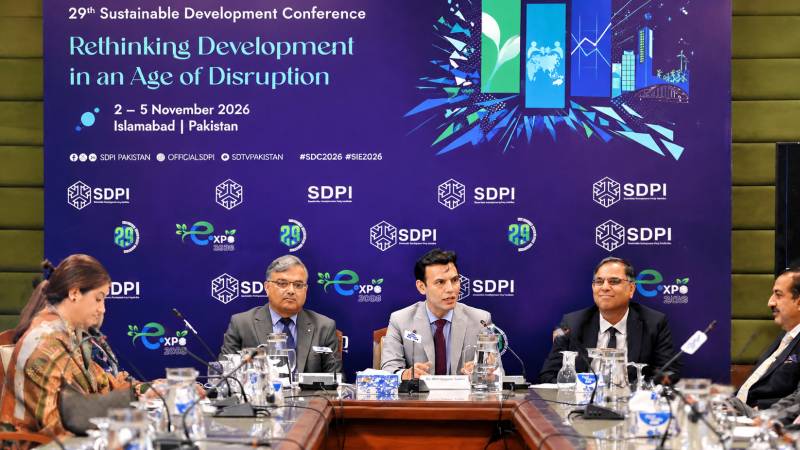
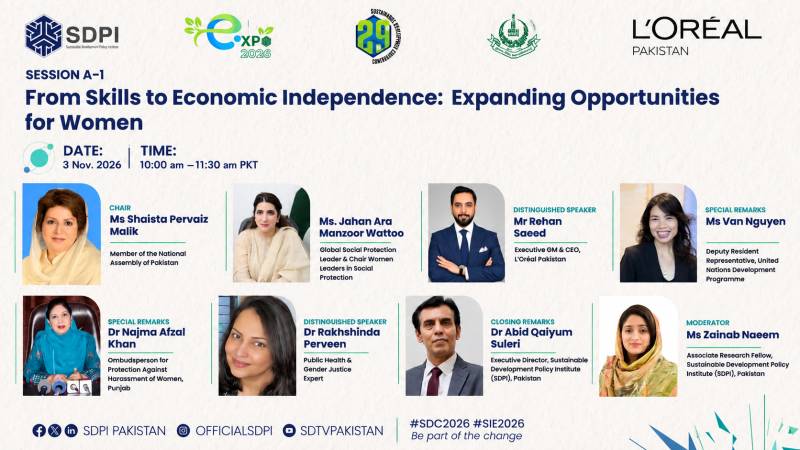
I was invited to speak at a session of the Sustainable Development Policy Institute's (SDPI) 29th Sustainable Development Conference in Islamabad, titled "From Skills to Economic Independence: Expanding Opportunities for Women". I felt genuinely humbled by the invitation. The session was chaired by MNA Shaista Pervaiz Malik, whom many of us, even those with different political ideologies, fondly know as Shaista Apa and appreciate for her polite charm.
Women's economic emancipation, skills development and structural inequalities are subjects I have written about and worked on for years. There was nothing particularly unfamiliar about the discussion. I left the room, as I usually do, with more ideas, questions and thoughts to carry into my writing, professional work and training workshops. But today I want to share something different.
The conference theme was "Rethinking Development in an Age of Disruption". It made me think about disruption in a rather personal way. Sometimes we use the word so frequently in conferences and policy documents that we forget what it actually looks like in everyday life. It can be a challenge to a conformist concept.I have been something of a hermit for quite some time. They gave me two small but meaningful reasons for hope.
A young business leader and a glass of water
The first was Rehan Saeed, the young CEO of L'Oréal Pakistan. An IBA Karachi graduate struck me as someone who combined business acumen with humility and good manners. I do not know him personally, and I have no professional association with him. Nor am I writing about L'Oréal as a brand. Those who know me may be aware that I am hardly someone who wears make-up! What caught my attention was the person I encountered at the podium. While we were seated together, Rehan poured water and politely asked whether I would like some. A small gesture? Of course. But it amused me because such basic courtesies are not always extended in professional settings, particularly when women are involved.
I have met quite a few people from the business community over the years, but this particular warmth and attentiveness were refreshing. Islamabad's business community could perhaps learn something from this younger generation. Professional confidence does not require an absence of courtesy, and good manners do not diminish authority. His contribution to the discussion was equally interesting. He spoke without reading from papers or relying on prepared notes. He demonstrated a good memory, a clear understanding of business realities and, importantly, a feminist lens on women's economic participation.
That combination impressed me. We need more Rehans in the business community: people who understand that connecting women to markets is not simply about teaching them to make or sell products. It is also about creating an environment in which women can sit across the table, negotiate, ask questions, build networks and feel comfortable engaging with business leaders. For women entering spaces traditionally dominated by men, professional etiquette and respect matter. They can make the difference between feeling like an outsider and being treated as an equal participant. I am not suggesting that one glass of water can change business culture. But sometimes a small gesture tells us something about the larger attitude of the person making it.
Four students and a photograph
The second moment came after the session. A group of four university students, two young women and two young men, approached me and asked if they could have a photograph. I was honoured by their request and happily obliged. As we chatted afterwards, I asked one of the young women where she was from. She told me she was from Chitral. Naturally, I asked what she and her friends thought of my remarks. Had I made sense? She replied:
"Abhi tou, Madam, sab ko chhor kar aap ke peechhay ghoom rahay hain. Aap ne tou dil ki baat ki." (You see, Madam, that is why everyone has left the others and is following you around. You spoke what was in our hearts.) I found her response rather touching. Dil Ki Baat. You spoke what was in our hearts.
Perhaps that is what we sometimes miss when we become too comfortable with the language of conferences, reports and policy documents. There is a place for research, data and international frameworks. I have spent much of my professional life working with them. But none of these should become a substitute for speaking about real lives, real experiences and the questions that people are often reluctant to ask.
I would rather discuss the woman who completes a skills-training programme but cannot access capital, the woman who works in a family business without ownership, or the woman whose unpaid labour sustains an entire household but remains uncounted. These are not abstract development challenges. They are people's lives. Perhaps the young woman was responding to that. Not to a perfectly constructed presentation, but to something she recognised from the world around her. It was a reminder that young people are listening. They may not always respond through formal questions or academic language, but they recognise when someone is speaking from experience rather than simply repeating familiar phrases.
We can organise conferences on women's economic independence, distribute skills certificates and celebrate entrepreneurship. Yet, if women continue to encounter these attitudes in professional spaces, we need to ask ourselves what exactly has changed.
Familiar old attitudes
I would be dishonest if I presented the conference as an entirely uplifting experience. There were two separate comments from older men that stayed with me, for very different reasons. The first was an unsolicited observation about my appearance: "You have gained weight." The second was more revealing of how women's professional contributions are sometimes viewed: "What is the point of doing all this work, Doctor sahiba? You would make much more money selling samosas." I am not naming either individual. Their identities are not the point. The attitudes are.
One comment reduced a professional woman to an assessment of her appearance. The other suggested that years of education, experience, research and advocacy were somehow less worthwhile than a supposedly more profitable commercial activity. I have a sense of humour and can take a joke. But we should not automatically dismiss every remark as harmless humour, particularly when the same attitudes repeatedly undermine women's professional authority.
We can organise conferences on women's economic independence, distribute skills certificates and celebrate entrepreneurship. Yet, if women continue to encounter these attitudes in professional spaces, we need to ask ourselves what exactly has changed.Economic emancipation is not just about preparing women to enter markets. It is also about changing the behaviour of those who already occupy them.
Do I dare?
To borrow T. S. Eliot's question, I do. The young woman's words reminded me why I continue to speak; the older attitudes reminded me why there is still so much to challenge. I, and many like me, without massive social media followings or elaborate PR machinery, are still here in Pakistan, questioning, writing and trying to disrupt business as usual. I hope the young will take that disruption further, challenging entrenched hierarchies and building a more equitable business system in which women's labour, talent and contribution are recognised rather than rendered invisible.