

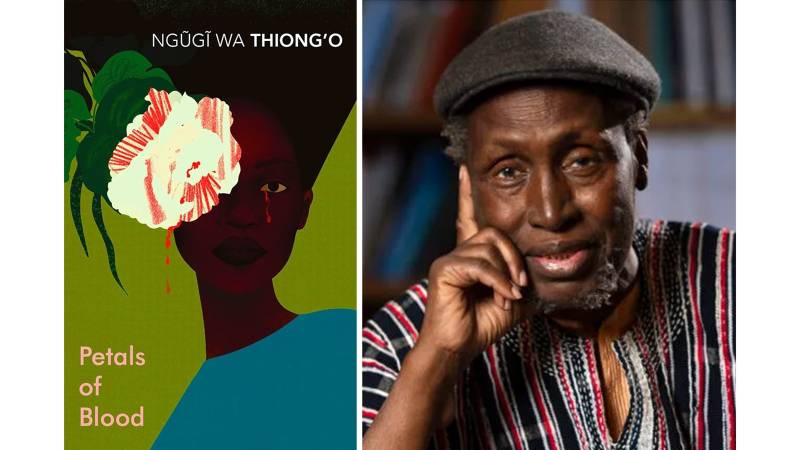
Petals of Blood is a political fiction novel by renowned Kenyan author Ngũgĩ wa Thiong'o that explores the painful transition, disillusionment, and exploitation of post-independence Kenya. This was the last novel Ngũgĩ wrote in English before he made a conscious shift to writing in his native Gikuyu (Kikuyu) to decolonise his work and connect directly with ordinary workers and peasants. The book’s heavy political critique led to his year-long imprisonment without trial by the Kenyan government. The origin of the title comes from a line in Derek Walcott’s poem, The Swamp.
The novel is a crime mystery, as it opens with a murder investigation. Three directors of a local, foreign-owned brewery in the upcountry town of Ilmorog have died in a dubious fire. Then, the lives of the four suspects unfold. These four main characters are arrested and interrogated: Munira (an idealistic school headmaster), Karega (a politically radical teacher), Abdulla (a wounded shopkeeper and former freedom fighter), and Wanja (a barmaid turned businesswoman). Through a set of flashbacks or recollections covering twelve years, the story moves backwards to explain how these four humans came to Ilmorog, how the remote farming village suffered a severe drought, and how it later transformed into a hyper-capitalist, industrialised modern town named New Ilmorog.
The story is set in Kenya just after independence, and follows the above-mentioned four characters whose lives are linked due to the Mau Mau rebellion. To escape city life, each of them goes to the small, rustic village of Ilmorog. As you read the novel, the characters deal with the backlash of the Mau Mau rebellion. Not only this, but they also have to deal with a new, speedily westernising Kenya.
Title: Petals of Blood
Author: Ngũgĩ wa Thiong'o
Publisher: Heinemann, 1977
There are three major themes running through the novel. Firstly, the theme of neocolonialism and exploitation. The novel strongly criticises how foreign capitalist interests and a greedy native elite have replaced British colonial rulers, leaving the working class and poor peasants just as exploited as before. Secondly, the writer discusses the betrayal of the Mau Mau. The novel reflects on the unfulfilled promises of the Mau Mau rebellion, arguing that the spirit of the freedom struggle was sold out by post-independence politicians. Lastly, the novel discusses urbanisation and moral decay. The transformation of rural Ilmorog into a modern commercial hub shows the loss of communal values, environmental destruction, and social alienation, all of which are detrimental in the view of Ngũgĩ wa Thiong'o.
This was the last novel Ngũgĩ wrote in English before he made a conscious shift to writing in his native Gikuyu, to connect directly with ordinary workers and peasants
As mentioned earlier, the title Petals of Blood is derived from a line from Derek Walcott’s poem, The Swamp. The poem suggests that there is a deadly power within nature that must be respected, despite attempts to suggest by humans that they live harmoniously with it.
Fearful, original sinuosities! Each mangrove sapling Serpent like, its roots obscene As a six-fingered hand, Conceals within its clutch the mossbacked toad, Toadstools, the potent ginger-lily, Petals of blood, The speckled vulva of the tiger-orchid; Outlandish phalloi Haunting the travellers of its one road. — Derek Walcott, The Swamp
The phrase "petals of blood" appears numerous times during the course of the novel, with varying meanings. At first, "petals of blood" is used by a pupil in Munira’s class to describe a flower. Munira quickly rebukes the boy, saying that “there is no colour called blood”. Later, the phrase is used to describe flames, as well as relating to virginity during one of Munira's sexual fantasies.
There are many passages in the book which I felt were pure genius, such as the following where the author is describing Munira’s state of mind:
“There past – present – future were one and his children were schooling to some national purpose, also felling trees, clearing virgin grounds, new horizons for the glory of man and his creative genius. Gradually, he heard a distant voice calling: tell me your dreams and wishes. He halted, in his flight, what did he wish for in life? What did he want? His parents had always played it safe and he Munira, had always stood at the shore and watched streams and brooks flow over pebbles and rocks. He was an outsider, and he had always been an outsider, a spectator of life, history.”
At another place in the novel, Ngũgĩ wa Thiong'o explains fear:
“Who told you I am afraid? I said, pretending anger. I walked on because of her challenge and because I did not want her to see my fear. Still I was scared. My heart gave one huge beat: my legs seemed to lose strength the knees. I was scared. I was scared. But the fear also fascinated me and thrilled me. It was strange: I was walking towards life and death my legs were really giving way and yet something between pain and joy coursed through my fear-warmed blood and this became intense.”
The book was a little rambling at several places. Also, there was no translation for the passages the author had written in his native Gikuyu, so I failed to understand those parts. Overall, it was a good read, and I would recommend it to anyone if they want to learn about Kenya and its history. There was a lot of knowledge and wisdom in the story, and Ngũgĩ wa Thiong'o seems to have poured his heart and soul into writing it.