

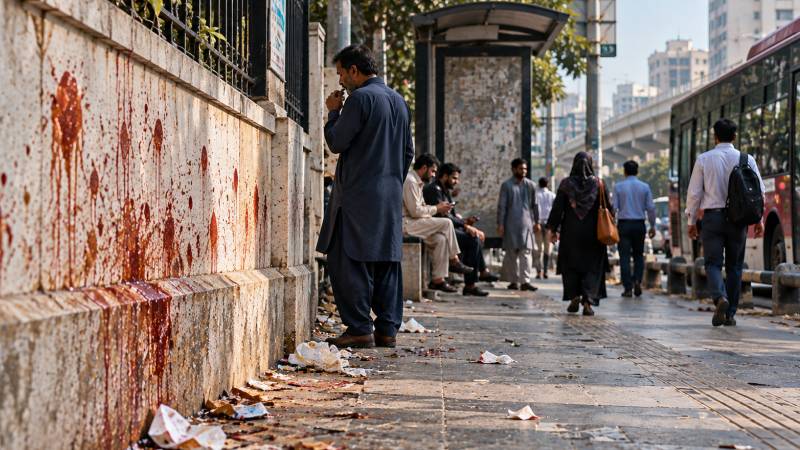
Not a day passes without it. You step out for a morning walk. You enter a commercial building. You climb a staircase, cross a market, visit a public office, wait at a bus stop, board a train, or simply walk through your neighbourhood. Everywhere along the way, you encounter the same revolting spectacle: fresh spit on pavements, phlegm on walkways, walls disfigured by paan and gutka stains, cigarette butts littering public spaces, and the unmistakable signs of a society that has become strangely comfortable with defacing its own surroundings. The locations change; the habit does not!
What makes the experience particularly disturbing is the magnitude of filth itself as well as the mindset behind it. People spit openly, frequently and defiantly, as though roads, footpaths, staircases, lifts, parks, buses, trains, government buildings and commercial centres were personal spittoons. There is rarely embarrassment, remorse, or awareness that these spaces belong to others. The act is performed openly, often within inches of others, with a confidence that suggests entitlement.
Paan, gutka and naswaar have left their unmistakably disgusting signature on countless walls, corners, staircases and public facilities, contributing substantially to the same blight. Yet these substances are only part of the story. The deeper problem is behavioural. Millions of Pakistanis have developed the habit of spitting in public whether necessity exists or not. It has become a reflex, a routine act performed without thought and tolerated without objection. People clear their throats and spit while walking, standing, conversing, riding motorcycles, waiting in queues, or stepping out of vehicles. The habit is so ingrained that many no longer recognise it as objectionable.
Some dismiss this issue as an elite concern, a cosmetic obsession, or a so-called “first-world problem”. The implication is that a country grappling with inflation, unemployment, governance failures, inadequate public services and economic uncertainty cannot afford such concerns, and that cleanliness and civic conduct are luxuries to be addressed after all other problems are solved. But how long must we wait? How many more years must our neighbourhoods become repositories of phlegm before we acknowledge that this is not a first-world problem at all? This is a third-world problem. More precisely, it is our problem. It confronts us every day, in every city.
You do not need wealth or academic qualifications to recoil from fresh spit on a staircase or a pavement covered in bodily excretion. Nor do you need to belong to an urban elite to understand that shared spaces are not dumping grounds for personal habits. Basic civic decency is not the preserve of privileged classes. It is one of the minimum requirements for civilised coexistence. The assumption that this problem belongs to poorer neighbourhoods is itself mistaken.
Public spitting is one of the few habits that appears genuinely democratic. It cuts across class, profession, income and education. One finds it in affluent housing societies, commercial districts, public institutions and ordinary neighbourhoods alike. Residents, security guards, gardeners, domestic workers, drivers, vendors and visitors - all without exemption - contribute to the cycle of civic defilement. No community remains insulated because the effects spill beyond property lines and social boundaries. Everyone inhabits the degraded civic landscape.
Public spitting has become so normalised that decent citizens often respond with resignation rather than objection, allowing a culture of civic defilement to flourish through collective silence.
This is not about aesthetics alone; it is also public health. Indiscriminate spitting in crowded public areas exposes countless people to avoidable health risks. In a country struggling with communicable diseases and an overburdened healthcare system, encouraging hygienic public behaviour should not be controversial. At its core, this is a question of civic culture. The easy explanation is lack of education. The more accurate explanation is the absence of civic responsibility. This behaviour exists among the educated and uneducated alike. Degrees do not automatically produce manners, nor does professional success create respect for shared spaces. The question is why society continues to tolerate it.
Healthy societies do not rely solely on laws to regulate behaviour. They also depend upon social disapproval. People refrain from objectionable conduct because they know it will invite embarrassment and criticism. Yet in Pakistan, public spitting has become so normalised that decent citizens often respond with resignation rather than objection. Rarely do we challenge it. Rarely do we condemn it openly. That silence has enabled a culture of civic defilement to flourish.
One is compelled to ask what has happened to the lessons once taught at home. Many of us grew up being told not to litter, not to dirty public places, and to respect the comfort of others. These were not sophisticated civic philosophies. They were elementary expressions of good upbringing. Children were expected to understand that civilisation begins with consideration for others, what we called manners. If these lessons are no longer being taught consistently at home, society must teach them. If society fails, the state must intervene.
Equally troubling is the near absence of public debate. Social media generates outrage over almost everything but pays no attention to everyday civility. We do not see legislators discussing it. Municipal authorities do not consider it a problem, let alone prioritise it. Civil society has not yet taken up this matter of public awareness. The issue remains where few treat it as worthy of collective action. This needs to change.
Firstly, we need a cultural shift. Public spitting, littering cigarette butts, and staining public spaces with paan, gutka and naswaar residue must become socially unacceptable. We should collectively stop tolerating such behaviour as a feature of Pakistani life. Habits survive because societies tolerate them. When tolerance ends, behaviour begins to change. So, if you find one gentle person objecting to such brazen acts of spitting and littering, stand with that objection. Do not seek pardon for the offender on the grounds of illiteracy or a lack of civic orientation. Join voices objecting to these habits and let us gather to say a loud “NO” to them. Offenders must learn civility.
Secondly, this problem needs to become a matter of legislative concern. Public spitting and similar acts of civic defilement should be explicitly prohibited and meaningfully penalised. Laws alone cannot transform culture, but they can establish clear boundaries and reinforce social norms. States routinely legislate against conduct that harms public welfare. Deliberately degrading shared spaces deserves serious legislative attention.
Thirdly, this problem must be prioritised for awareness-raising campaigns by influential platforms, organisations and governments. No one needs wealth to learn cleanliness. No one needs formal education to develop civic sense or attain prosperity first to respect a public place.
A civilised nation is measured not only by its highways, skyscrapers and economic indicators, but by the everyday habits of its people. And if Pakistan is serious about becoming a more liveable country, then perhaps it is time to acknowledge an uncomfortable truth: a society cannot aspire to progress while remaining indifferent to the degradation of the spaces its citizens share. For far too long, we have treated this as a minor annoyance. It is not. It is a daily assault on public decency, public health and civic life.