

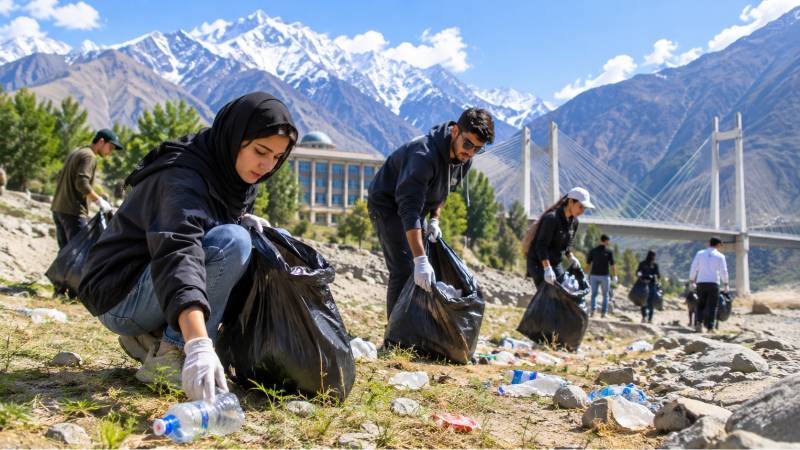
While scrolling through instagram, a reel of some young volunteers, mostly in their early twenties or teenagers, with gloves on hands and collecting trash from the scenic Chumik Pul area in Skardu popped up. Chumik Pul has increasingly attracted tourists, both domestic and international, over the past few years, owing to the iconic building of Baltistan University and construction of the spectacular bridge over the road to mesmerizing Shigar valley. Tourism is a double-edged sword: on one hand, it contributes to the local economy but on the other hand it’s the biggest contributor to pollution. Chumik Pul was caught in the same paradox. As tourist rush increased, so did the plastic bags and soft drink bottles littering the site.
A little digging over that reel revealed something more comforting. I learnt that it was not one group’s isolated work, rather multiple youth-led organizations and individual volunteers (mainly social media influencers) across Skardu and Gilgit have been independently running cleanup drives this summer. Some were visible on social media while some choose to do it quietly in their own corners. One of such organizations who pioneered the drive, Bright Path, whose founder also spoke with the author, has collected two to three tons of waste from each of five major tourism spots in Skardu. The pattern was echoed by other independent groups/initiatives across Gilgit Baltistan. What started as scattered, individual efforts, culminated into an unspoken movement over the course of a summer, exposing a bright side of the youth taking responsibility for keeping the streets clean.
Gilgit Baltistan experienced devastating climate disasters; floods, GLOFs and heavy rain in past years, displacing thousands across many districts in the region. The cost of these havocs was immense and unbearable. Current clean up drives in Skardu and Gilgit do not merely represent an aesthetic social experience, rather a deep seated initiative born out of that climate reckoning. Gilgit Baltistan’s environmental vulnerability has transformatively impacted youths’ perception of litter picking. It’s no longer just an act of beautifying the region, it’s something safeguarding human security in that largely ignored part of the world. The entire campaign represents a civic sense born out of vulnerability where the volunteers understand the impact of a single plastic bottle through a human experience.
What started as scattered, individual efforts culminated into an unspoken movement over the course of a summer, exposing a bright side of the youth taking responsibility for keeping the streets clean.
Civic campaigns, involving trash collection, are frequent in Pakistan but only few survive after initial photo shoots and even fewer manage to deliver impactfully. A stark line separates those who collapse from those that manage to sustain: in the former, volunteers driving the campaign are first mobilized and educated about the issue later. However, initiatives, such as this one, where volunteers already have an understanding of the underlying issue and are well exposed to its dire consequences, before they even join, continue to thrive. That ingrained understanding along with the very civic mindset of sharing responsibility for public space compels them to keep coming back.
Another crown jewel of this unspoken movement was its gender diversity. Female volunteers are sharing responsibility with their male counterparts to clean the city they collectively own. Girls, grossly underrepresented in the region’s political and social life, chose this inclusive platform to challenge that taboo. This open challenge to patriarchy also drew criticism from conservative sections of the society. Conservative voices condemned women’s presence in the public, insisting they belonged to the kitchen instead. The campaign providing equal opportunity to the female volunteers did not just break from traditional male-dominated campaigns, it opened up a door for all those girls who dreamt of taking a greater role in shaping the region’s political and social life, but could not muster up the courage to do it individually.
On June 3rd, the Gilgit Baltistan Election Commission announced elections for Local Government, the body responsible for waste management. This election is happening after a two-decade gap in the region and the movement’s emergence precisely at this moment lends it real political weight. Local body elections were previously seen more as an offshoot of local Assembly elections than a genuine system of trickling down of governance to local level. However, the drive can be a turning point in shifting people's opinion of this election and local accountability.
Over the last decade, tourism has surged exponentially in Gilgit Baltistan. For the region, the huge influx of tourists simply means more trash. However, the crisis is grossly neglected in the provincial government’s priorities. The government’s inactivity towards the crisis is evident from the fact that there are little to almost no facilities set up for trash collection at even some important spots. Public washrooms are almost non-existent. It rarely sets up dustbins in those areas, even where it does, they lack proper management. There’s not even a single waste management system installed on the two most important highways e.g. Karakoram Highway and Shahrah e Baltistan. Gilgit Baltistan is a region with majestic beauty but faces a political conundrum. It also holds very high geo-strategic importance in Pakistan. Consequently, the region is often discussed only in terms of tourism, hospitality and political status. Now, youth are taking a new step, quietly giving a new direction to this discussion. They are defining their own relationship to the land through a direct, yet emotional, action. The discussion which was often overlooked is now taking center stage in any future debate on the region.