

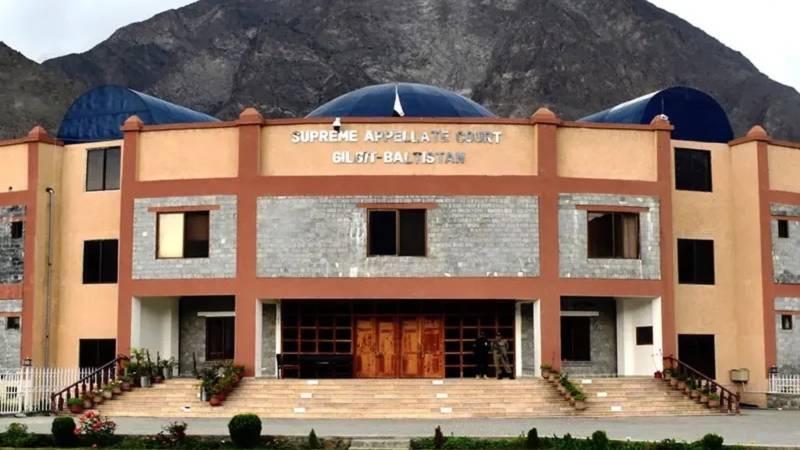
The Gilgit-Baltistan Supreme Appellate Court needs a three-judge bench. Lawyers have long said it has been operating with a single judge for many years. Since 2021, from Justice Wazir Shakeel to Justice Sardar Muhammad Shamim Khan, the Supreme Appellate Court has been operated by a single judge for nearly five consecutive years, and that has made the GB Bar Council body impatient. According to a report submitted by the Advocate General GB to the Supreme Court of Pakistan in April 2025, more than 8000 cases are pending before a single judge. Every file carries the hopes of a bail seeker, a government employee waiting for service regularization, a family awaiting a verdict on a property dispute, and so on.
The stats show the brutality of the system. Let’s assume one judge sees and disposes of 500 cases a year. It clearly shows that more than 8000 cases would take sixteen years if no new cases were filed. However, the results are opposite; new cases come every day. That is not an accumulation or overflow of cases, but a failure of the structure: not new but decade-old.
There is no single cause for the delay. Appointments have been caught up in a gridlock of disputes over the power struggle, raising questions about who is credible to hold the authority to make them happen. In early 2023, then Chief Minister of Gilgit-Baltistan, Muhammad Khalid Khurshid Khan, filed a petition against the federal government for failing to consult him on the appointments. The Supreme Court of Pakistan, while considering his lawsuit, forbade the Prime Minister from appointing new judges, and the outcome was in his favor. In April 2025, the stay was lifted after an agreement between the Attorney General for Pakistan and the Advocate General of Gilgit-Baltistan to follow the appointment process according to the Gilgit-Baltistan Order 2018. Even so, the bar association expressed concerns that the vacancies weren’t filled despite directions from the Apex Court.
In Gilgit-Baltistan, “justice delayed is justice denied” is not merely an old legal maxim—it has become a lived reality for litigants waiting years for courts capable of hearing their cases.
Furthermore, the Chief Court faces the same issue. In 2022, judges were appointed to one-year contract terms, even though the positions had been vacant for years. Temporary appointments of judges undermine the judicial system because an appointed judge knows he has an insecure 12-month term, so pleasing the government could get them a service extension.
Now comes the important question. Social media and some online media channels report that the Prime Minister has approved the two-judge summary of the Supreme Appellate Court Gilgit-Baltistan after signing it on September 30. It seems to be a report only rather than an official confirmation because there has been no public issuance of a formal notification. If the PM has already approved, why has no notification been issued yet? If not, who told the public it has, and why?
On October 3, the Gilgit-Baltistan High Court Bar Association called for a general body meeting and a total strike on October 10 in all courts. Its agenda includes inducting judges to both the Supreme Appellate Court and the Chief Court. If all doors close, lawyers will not shut down the courts; they will be deprived of their livelihood. Lawyers have already boycotted the proceedings in 2025, so they have already done this before. The public deserves an explanation from the person who caused the silence. A summary that is approved but not notified leaves the court as empty as ever. The wait from decision to notification is the injustice itself.
The Government of Gilgit-Baltistan Order, 2018 is in place in lieu of the Constitution of Pakistan. Articles 75 and 84 of the Order address the two courts. They do not specify a set time for filling a vacancy. The problem lies in that gap. If there is no appointment deadline, it relies on goodwill, and goodwill is over.
If the summary is already approved, the appointees should be publicly notified immediately, and the judges should take the oath. Moreover, appoint judges on merit, as lawyers have long demanded, and remove the opportunity for judges to hear appeals against their previous rulings. Third, replace one-year stopgaps with proper tenure. Fourth, impose a statutory time limit on filling vacancies and on notifying approved appointments, so that no further vacancy will be allowed to drag on for years.
Rumours about changes to the region's constitutional status, including talk of a federal bench sitting in Gilgit, should not be an excuse for further delay. "Justice delayed is justice denied" is an old legal maxim. In Gilgit-Baltistan, it has been a reality for over a decade. If a notification exists, it should be issued immediately; if not, the government should state its intention explicitly.