

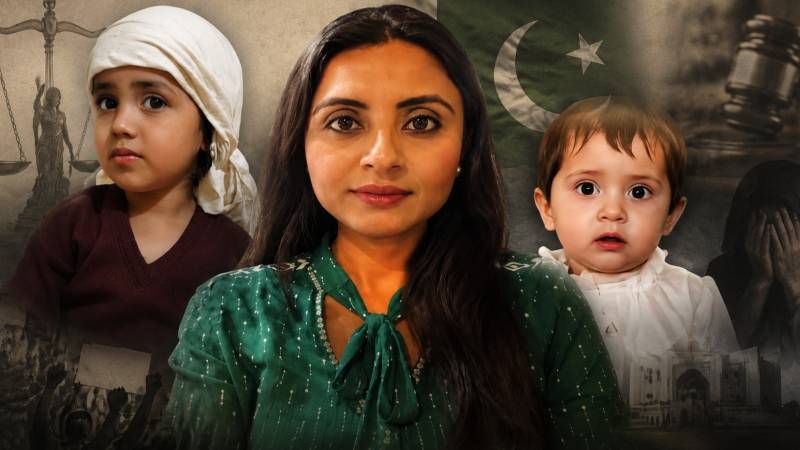
The recent cases of 18-month-old Aizal in Karachi, five-year-old Ayat Noor in Haripur, and Hina Javed in Rawalpindi are different in circumstanceS, age and nature, but they expose the same disturbing question: How effectively does Pakistan protect women and girls when the greatest threat comes from people around them and how seriously does the State fulfil its obligations under domestic and international law? The answer cannot simply be another condemnation on social media. Pakistan already has laws. Pakistan has constitutional guarantees. Pakistan has ratified major international human-rights treaties.
The real crisis is implementation, prevention, institutional response and accountability. The death of 18-month-old Aizal in Karachi after alleged sexual assault has shocked the country. Police reports indicate that a teenage relative allegedly took the child from the house, after which she was returned in critical condition and later died. Police said medical findings were consistent with sexual assault. The suspect was subsequently placed in judicial custody. Because the suspect is a minor, the case also raises important questions concerning the Juvenile Justice System, rehabilitation, criminal responsibility and, above all, the protection of the victim's family and the integrity of the investigation. But there is a more fundamental point: An 18-month-old child cannot protect herself. The State therefore carries a especially high duty of protection.
The case of five-year-old Ayat Noor, reported missing from Haripur on August 10, 2026, illustrates another dimension of the same problem. Three children reportedly disappeared from different parts of Haripur within one week, and police had yet to establish their whereabouts at the time of reporting. Authorities said CCTV, geofencing and other investigative measures were being used. Ayat's case must not be described as a confirmed crime until the facts establish what happened to her. But the disappearance of a five-year-old itself triggers an urgent child-protection responsibility. Every missing child should be treated as a potential protection emergency not as an ordinary missing-person report.
The alleged murder of Hina Javed in Rawalpindi brings the issue into the private sphere of marriage. According to the FIR and police reporting, Hina was found dead in the bathroom of her apartment with her hands allegedly tied, her mouth gagged and a wire around her neck. Her brother alleged that she had previously complained of severe physical and psychological abuse by her husband to the family. Here question arise what was the responsibility of the family. The FIR was registered under Sections 302 and 34 of the Pakistan Penal Code. A Rawalpindi court has now remanded her husband and a domestic worker in police custody for further investigation. These remain allegations under investigation, and every accused person is entitled to due process and the presumption of innocence. But Hina's case nevertheless raises a critical legal question: What happens when domestic abuse is reported before it becomes murder? That is where prevention must begin. International human-rights law does not regard violence inside a home as merely a "family matter."
Pakistan's international obligations are clear; Pakistan is a State Party to the Convention on the Elimination of All Forms of Discrimination against Women (CEDAW), having acceded to it in 1996. Pakistan is also party to the Convention on the Rights of the Child (CRC) and, since 2010, to the International Covenant on Civil and Political Rights (ICCPR) and the Convention against Torture (CAT). These treaties matter because violence against women and girls is not simply a matter of morality or social policy. It is a human-rights and State-responsibility issue.
CEDAW requires States to eliminate discrimination against women and to take appropriate legislative measures to protect women's rights. States must take measures to prevent, investigate, prosecute, punish and provide reparation for gender-based violence, including violence committed by private individuals. It specifically recognises that gender-based violence can occur in the family, community, workplace and other private or public settings. This principle is directly relevant to cases such as Hina Javed. The State cannot say: "It happened inside a home; therefore it was a private matter." International law says otherwise.
Aizal's case brings the CRC into sharp focus. Article 19 requires States to protect children from physical or mental violence, abuse, neglect, maltreatment and exploitation, including sexual abuse. Article 34 specifically requires States to protect children from sexual exploitation and sexual abuse. Therefore, child protection cannot begin after a child has been assaulted. It must begin with prevention, risk identification, reporting mechanisms, investigation and institutional safeguards.
The ICCPR protects fundamental rights including life, security of person and freedom from cruel, inhuman or degrading treatment. Pakistan ratified the ICCPR in 2010. When a woman is killed, tortured or subjected to severe violence, the issue is therefore not merely whether a criminal prosecution eventually takes place. The State also has an obligation to maintain institutions capable of protecting life, investigating serious violations and providing effective remedies.
Pakistan ratified CAT (Convention against Torture) in 2010. While not every case of domestic violence automatically constitutes torture in the treaty sense, severe physical or psychological abuse raises important questions concerning protection from cruel, inhuman or degrading treatment and the State's responsibility to prevent and investigate serious abuse. Pakistan already has domestic legal mechanisms.
The Anti-Rape (Investigation and Trial) Act, 2021 was enacted specifically to provide special investigation mechanisms, anti-rape crisis cells, special courts and procedures intended to ensure more effective and expeditious handling of rape and sexual-abuse cases involving women and children. Pakistan's constitutional framework also guarantees equality before law and prohibits discrimination on the basis of sex, while permitting special protection for women and children. The problem, therefore, is increasingly difficult to describe as simply a legislative vacuum. It is an implementation vacuum.
The UN Human Rights Committee has itself expressed concern about Pakistan regarding violence against women, domestic violence, low reporting, inadequate investigation, low prosecution and conviction rates, and insufficient assistance for victims. It specifically called for prompt and thorough investigation, effective prosecution, victim support and gender-sensitive training for judges, prosecutors and law-enforcement officials. That assessment should concern every lawyer, judge, police officer, policymaker and human-rights institution in Pakistan. We need to move from reaction after tragedy to prevention before tragedy.
Five immediate priorities:
Treat domestic-violence complaints as risk indicators. A woman's repeated complaint of threats, assault, stalking or coercive control should trigger a structured risk assessment rather than being dismissed as a marital dispute. A woman should not have to wait until she is severely injured—or dead—for the criminal justice system to recognise the danger. Cases involving sexual violence, child abuse and domestic violence require trained investigators, forensic capacity and survivor-sensitive procedures. Schools, neighbourhoods, hospitals, police and child-protection institutions must have functioning reporting and referral mechanisms. The State should publish meaningful data on complaints, investigations, protection orders, prosecutions, convictions, acquittals, case duration and survivor support.
Aizal cannot tell us what happened to her. And Hina Javed, tragically, can no longer tell her own story. That makes the responsibility of the State and of society even greater. The question is not whether Pakistan has signed international treaties.
The question is not whether Pakistan has enacted laws. The question is whether those treaties and laws are actually protecting women and girls before violence becomes irreversible.
CEDAW's principle of due diligence gives us the legal framework. The Constitution gives us fundamental rights. The Anti-Rape Act gives us specialised mechanisms. The CRC gives children a right to protection. The ICCPR protects life and security.
What remains is political will, institutional capacity and accountability. Justice must not begin at the graveyard. It must begin when the first warning is given.