

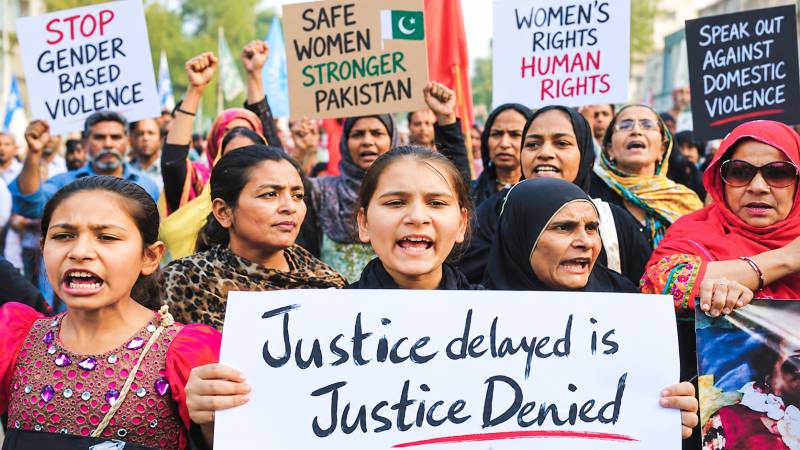
Gender-based violence is not a new phenomenon in Pakistan. However, the recent killing of Hina Javed in Rawalpindi, allegedly at the hands of her husband, has once again triggered debate on this pressing issue. What is particularly distressing is that such violence continues to permeate even those sections of society considered educated and socially enlightened. The alleged killer of Hina Javed reportedly teaches at a university. The vicious cycle of violence against women continues unabated. At times, it is committed in the name of honour; at others, on the pretext of vulgarity or other perceived transgressions. The nature of the offence remains the same, while its justification and means continue to change.
This is happening despite numerous pro-women laws, laws addressing rape, domestic violence, sexual harassment, forced marriage, deprivation of inheritance, and other forms of discrimination enacted at both federal and provincial levels. The establishment of Gender-Based Violence courts was intended to serve two primary purposes: ensuring higher conviction rates and expediting the disposal of such cases. The legal response, however, does not end here; efforts have also been made at the international level to protect and promote women's rights.
Pakistan is a signatory to several international treaties concerning women's rights, including the Convention on the Elimination of All Forms of Discrimination against Women (CEDAW) and the Convention against Torture (CAT). Despite these legal and international commitments, Pakistan's position regarding women's safety and gender-based violence remains deeply unsatisfactory. According to the Women, Peace and Security (WPS) Index 2023/24, Pakistan ranked 158th out of 177 countries. The 2025/26 ranking is even more alarming: Pakistan stands at 169th out of 181 countries.
Several factors contribute to the persistence of violence despite the abundance of pro-women legislation. These include poor implementation of laws, low conviction rates, uncertainty of punishment, limited access to justice, inadequate gender-sensitive training of judges and prosecutors, defective investigations, insufficient women police stations, and limited awareness of women's rights. Some reforms are therefore urgently required.
This is not about favouring women; it is about ensuring that gender stereotypes and social prejudices do not distort justice.
First, gender-based violence should be declared a cognizable offence, allowing police to register cases and initiate proceedings without requiring prior permission from a magistrate. This would enable female victims to immediately report incidents of violence and empower the police to promptly set the law in motion against the alleged offender. The existing legal framework of pro-women rights laws requires prior approval from a magistrate for filing a complaint, making the process time-consuming and cumbersome. Gender-sensitive training of judges and prosecutors should also be made compulsory. This is not about favouring women; it is about ensuring that gender stereotypes and social prejudices do not distort justice. Laws cannot protect women if those responsible for enforcing them fail to understand the realities of gender-based violence.
Premarital psychological assessment should also be considered for both men and women. It should not be a test of one's “fitness” to marry, but a confidential assessment aimed at identifying serious behavioural risks and providing counselling where necessary. A District Premarital Psychological Assessment Centre should be established under the Health Department in every district, where both prospective spouses undergo a confidential assessment by qualified psychologists, with counselling provided where necessary. A certificate of assessment could be made a prerequisite for marriage solemnization.
Similarly, women's rights under Islamic and Pakistani law should be made a compulsory part of the university curriculum. This would challenge notions of patriarchy and female subservience while educating both men and women about their respective rights and corresponding duties. At present, students from disciplines other than law often have little knowledge of women's legal rights. Women police stations should be established in each district. Women often feel reluctant, particularly in rural areas, to report acts of violence to male police officials. Similarly, GBV courts should be presided over by female judges, and female victims should have the right to be represented by female lawyers in court. Such changes, if introduced, would provide a friendly environment in which women can report and describe acts of violence freely, safely, and without fear.
The persistence of gender-based violence shows that legislation alone cannot solve the problem. Pakistan has laws, specialised courts, and international commitments, yet violence against women continues. The real challenge lies in implementation, institutional capacity, public awareness, and changing social attitudes. Only then can legal protection become a meaningful reality for Pakistani women.