


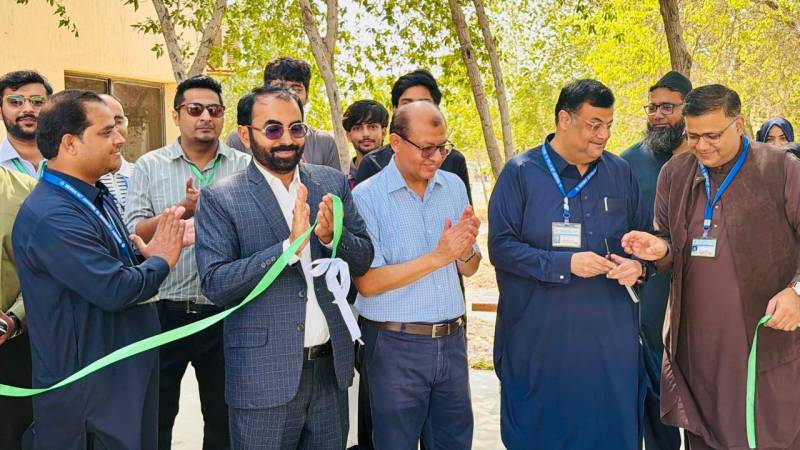
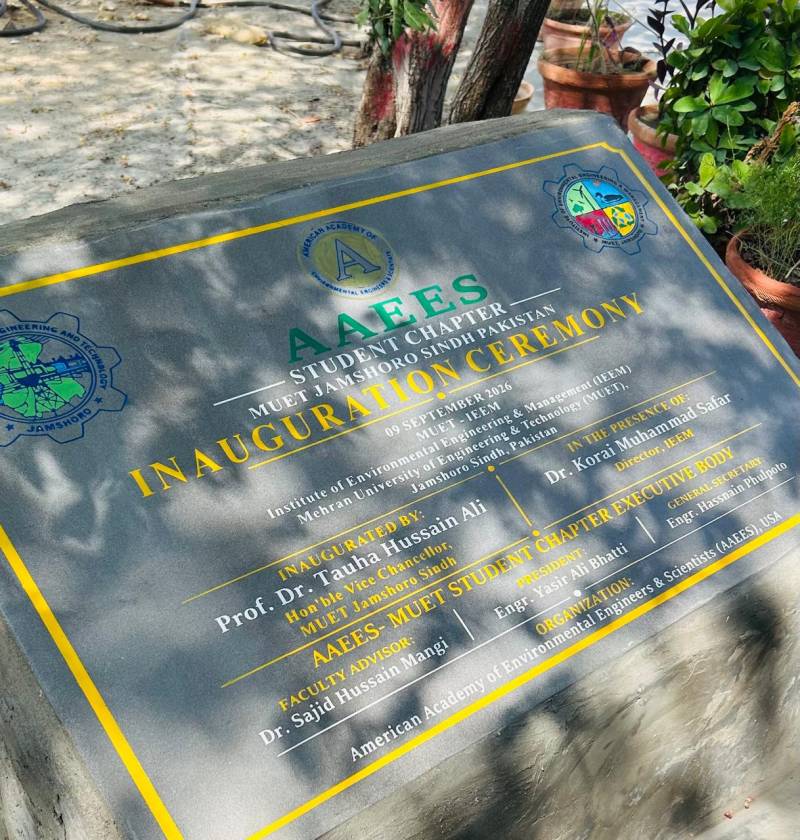
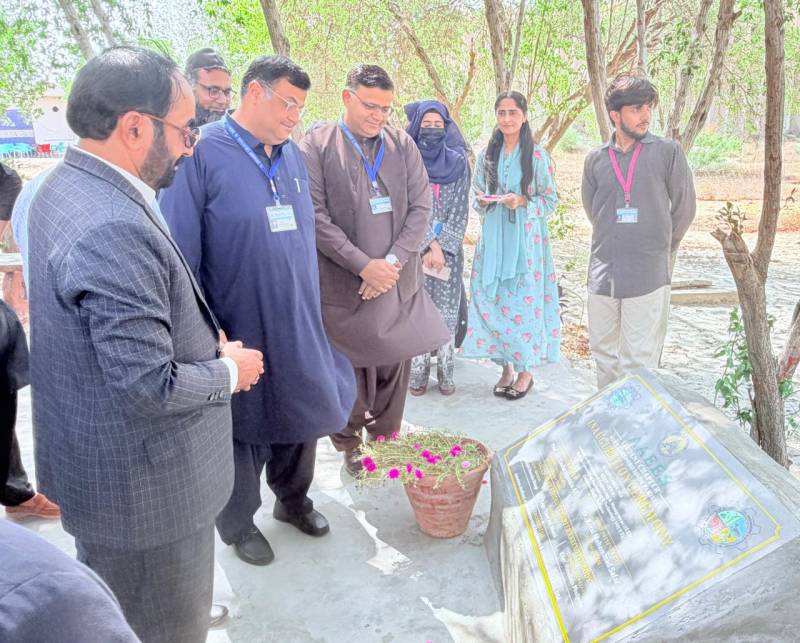
On the 9th of September 2026, an event greater than just an academic ceremony happened at the Mehran University of Engineering & Technology (MUET) in Jamshoro. The university inaugurated the first chapter of the American Academy of Environmental Engineers and Scientists (AAEES) in Pakistan. So far, there has been no connection between Pakistan's environmental engineers and an American professional body.
Due to the emergence of multiple challenges in terms of water security and pollution, the timing of this initiative becomes crucial. Pakistan does not only need environmental policies but also professionals who can apply engineering techniques to solve problems concerning the environment and sustainability. The newly opened AAEES student chapter from the Institute of Environmental Engineering & Management (IEEM) can meet that need.
AAEES is a professional organisation from the US which focuses on environmental engineering and environmental sciences. AAEES promotes the improvement of education and practice in the field of environmental engineering and environmental sciences. With the network of student chapters, AAEES connects universities with professionals in the field of engineering and environmental sciences, thus allowing students to find employment in the industry.
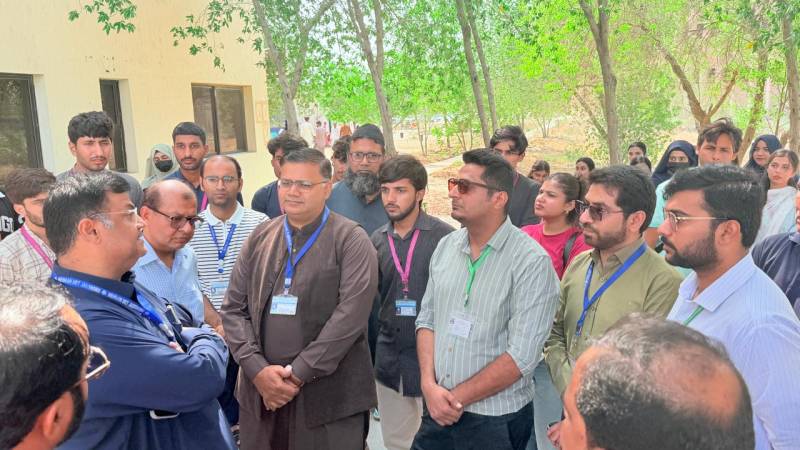
The significance of the initiative is more than just its name. AAEES provides its student chapters with a platform to connect profession-wise through webinars, mentoring, career advice, technical presentations, and interaction with environmental engineers and scientists. Moreover, the student members can also take advantage of AAEES webinars and resources, which shall prove beneficial for the students of IEEM in connecting their learning at Jamshoro with the larger international environmental engineering fraternity. The inauguration should not merely be seen in the context of another university initiative but should also be considered as the beginning of a link between professionals and universities.
A Historic Beginning in Jamshoro
The importance of this chapter is revealed when we look at Pakistan's environmental challenges. Water scarcity, water pollution, industrial emissions, waste disposal, extremely hot weather, floods, and climate-related threats are quite close. They are getting closer to the economy of Pakistan, its public health, agriculture, cities, and infrastructure. The case of Sindh is particularly striking. This province is linked to the Indus basin and is also under serious threat in its coastal areas. Water management, flooding, agriculture, urban development, and coastal management must be investigated and designed.
All this makes it possible to use MUET's knowledge.
With coastal threats and Indus basin challenges directly impacting public health and agriculture, the province stands to benefit immensely from localized, research-driven engineering solutions
The university can make use of the AAEES connection to inspire students and faculty to think about real environmental problems and their solutions, which would be applicable to this place. Instead of treating environmental engineering as just an academic discipline, the chapter can create a culture of thinking about how engineering knowledge can help in solving issues faced by people.
The change is crucial.
A student studying wastewater treatment could think of ways to make wastewater treatment affordable for communities. A student focused on air pollution can visualise how monitoring tools can be helpful to a city. A student who is considering climate change can look at the means of developing the necessary infrastructure able to bear extreme weather effects. A student studying energy can think of the necessity to combine renewable energy and energy efficiency to reduce environmental pollution.
AAEES promotes professional excellence as well as innovations, sustainability, environmental awareness, and the sharing of knowledge. These principles will serve as a good foundation for the student chapter if it wants to be active and not just a name. The international relation also plays an important role in professional development. Many young engineers in Pakistan are well trained technically but have an insufficient link to international networks. An organisation like AAEES can play a role in bridging the gap by allowing students to participate in international discussions. Thus, there is a two-way opportunity for both the MUET students and international professionals to make mutual use of each other. The students will be able to learn from international experts, and vice versa.
Why Pakistan Needs This Global Connection
Pakistan has entered an era where investments related to the environment and climate are gaining prominence and importance. Various significant development projects will be initiated in the fields of water resources, agriculture, climate resilience, clean energy, flood management, and environmental sustainability. This development will create not only implementation-related requirements but also a huge demand for research, monitoring, evaluation, and engineering solutions. A good example of this is the World Bank’s Country Partnership Framework for Pakistan for the years 2026–2035, which provides a framework for collaboration for the next 10 years and specifies such priority areas in the development process as clean water and sanitation, climate resilience, water/agriculture connection issues, sustainable energy, and the improvement of air quality.
Among successful projects, we can mention the Sindh Coastal Resilience Sector Project (called the Sindh Coastal Project) with an overall value of around 180.5 million US dollars. This project, supported by the Asian Development Bank and the Green Climate Fund, aims at providing solutions in the areas of integrated water resources management and flood risk management, as well as enhancing institutional and community capacity. A positive impact is expected to be experienced by a population of around 3.8 million in Sujawal, Thatta, and Badin.
For a university located within Sindh, large projects like this create strong opportunities for research. The environmental engineers can take the chance to investigate coastal ecosystems, flood risk, water management, climate adaptation, nature-based solutions, and the evaluation of resilience. Universities can work to establish the evidence needed to determine what is effective and what needs improvement.
Another important project is Recharge Pakistan, which is a $77.8 million climate programme for ecosystem-based adaptation, green infrastructure, and flood risk management. The approach shows the growing importance of nature-based solutions in dealing with climate risks. The Transforming the Indus Basin with Climate Resilient Agriculture and Water Management project, worth about $47.7 million, also demonstrates the link between water, agriculture, and climate change. Its focus on climate-resilient agriculture and water management is directly relevant to environmental and engineering-related challenges in Sindh and other parts of the country. Energy is another great opportunity. In July 2026, the World Bank authorised $375.9 million for the first phase of the Boosting Energy Security through Transmission in Pakistan programme. In the programme, the main focus is electricity transmission network improvement.
The significance of these statistics lies in the illustration of the magnitude of the environmental and sustainability transition occurring across Pakistan. Nevertheless, it is not simply about acquiring funding for initiatives for MUET. The university should not be regarded merely as an implementer of the funds. Its true function would be to act as a partner in terms of research, knowledge, testing, training, and innovation. The AAEES chapter becomes relevant in this regard.
The chapter enables students to engage in international environmental engineering practice, while MUET provides an academic environment for developing local research. By bringing the two entities together, they can motivate students to investigate matters connected with major national issues.
How can water be reused in a more efficient way? How can flooding risks be decreased? How can cities control their air pollution? How can industrial emissions be regulated? How can waste become a resource? How can alternative energy be implemented more effectively? How can transport minimise emissions? How can infrastructure withstand scorching weather and flooding?
These are not only environmental questions but also engineering ones.
A Research Opportunity for MUET
The AAEES chapter is, in fact, the single greatest opportunity in the long run, possibly in terms of research. The chapter could be transformed into an active platform for dealing with real-world environmental issues involving students, professors, engineers, and outside institutions. Programmes for research could be gradually initiated at the university about such issues as water and wastewater problems, air pollution, the solid waste issue, the circular economy, climate impact, clean energy, sustainable transport, and environmental monitoring, among others.
Artificial intelligence and digital technologies could also have their place in this realm. Environmental engineering is changing rapidly, and future engineers will increasingly start working with sensors, remote sensing, geographic information systems, environmental modelling, etc. The above-mentioned technologies will facilitate the prediction of pollution, monitoring of environmental conditions, etc.
A future research project of MUET can try to establish the air quality in cities with the help of inexpensive monitoring instruments. Another project can study water quality and wastewater recycling. In addition, climate threats to infrastructure can be researched by a group of scientists from the university. Another research group can look at how misconception influences the quality of environmental monitoring. Students from different engineering specialties can work together.
Pupils could assess energy consumption, water usage, waste creation, and efficiency levels. Then, they could come up with suggestions on how to use energy more efficiently, improve waste management practices, use less water, and utilise renewable energy. This practice promises to give students something more than academic knowledge—an opportunity to tackle real-world problems.
However, it is important to note the significance of the MUET Office of Research, Innovation, and Commercialization (ORIC), stating that research becomes valuable when it turns into a prototype, pilot project, or product. Thus, involving the AAEES chapter, IEEM, and ORIC in the students’ activities could provide them with an understanding of how to transform research ideas into projects and innovations that can be realised in practice.
One should strive to develop a research pathway from a problem to its resolution and implement it into practice. Initially, a community should face the problem. Students and professors could collect information, formulate a research question, test a technical solution, and conduct their experiment. This plan can offer the AAEES USA-MUET Student Chapter an aim which is much bigger than just student activity, as it can contribute to the establishment of a stronger culture of environmental research, innovation, and professional development at MUET.
Heartfelt gratitude to Prof Dr Tauha Hussain Ali, the Vice-Chancellor of Mehran University of Engineering and Technology (MUET), and Dr Korai Muhammad Safar, the Director of the Institute of Environmental Engineering and Management (IEEM), for taking the responsibility of creating the environment to pursue the students’ professional and research opportunities. The contribution of Dr Sheeraz Memon, Director of the Office of Research, Innovation and Commercialization (ORIC) MUET, in linking the chapter’s vision with research, innovation, and university collaboration has a great importance.
The success of this chapter represents the work of the AAEES-MUET Core Team, which has become a great cooperation of people who contributed a lot to establishing the chapter for students to be professionals, do research, and communicate with experts from the environmental domain. The scene in the future of the chapter will depend on them.
From a Student Chapter to a National Environmental Vision
The establishment of the AAEES USA-MUET Student Chapter on the 9th of September 2026 should be understood as the beginning of a new era rather than as the end of anything. The very first purpose of the chapter is to create a community of active and involved students; however, the broader goals can be much more substantial. With time, MUET can turn this student chapter into a platform for international lectures, professional mentoring, technical excursions, students' research, environmental campaigns, competitions for innovations, and collaboration with industries and the government.
The chapter, little by little, might start supporting initiatives such as the MUET clean-air research programme, the Sindh water innovations project, the climate-resilient infrastructure research centre, the circular economy lab, and the sustainable mobility research project. These initiatives do not have to be developed overnight but can evolve along with the capabilities of the university as well as its professors and students. The important thing is to have a clear vision and provide students with the possibility to turn environmental issues into practical solutions.
The country of Pakistan has a need for environmental engineers who are aware of international standards plus have knowledge of local conditions. In particular, it would be good to find people willing to research water systems, urban settlements, agriculture, industries, and the sea coasts of Sindh. Industries are in need of engineers capable of making their work environmentally friendly, while governments need reliable technical expertise. Finally, communities look for inexpensive and practical solutions to their environmental problems. The AAEES-MUET collaboration can serve this purpose.
The goal is more than just stating that Pakistan now has the first AAEES student chapter. Its objective should be to prove what that first chapter can accomplish. Given that Pakistan pays considerable attention to climate resilience, water security, clean energy, sustainable infrastructure, and environmental protection, MUET at this point has a good opportunity to take advantage of this situation. Students at MUET can become researchers, laboratories can become innovative centres, faculty can strengthen their collaboration with national projects, and the university's international relations can help to exchange information.
The AAEES chapter gives an international professional link, IEEM provides the academic basis for environmental engineering, while ORIC can help improve the bigger ecosystem of research and innovations, and the students bring enthusiasm, ideas, and motivation. In this way, all of these components can give rise to the opportunity to create something bigger than a student organisation.
The real issue will arise in the future when the chapter will stop having just inauguration photos and will start fulfilling its mission: producing research, partnerships, expertise, and practical ideas. That will be when the importance of the 9th of September 2026 will become evident. The student chapter came into being in Jamshoro, but its aims can go far beyond the university.
The chapter can also become a door to the global world of environmental engineering for Pakistani students, a spot for cooperation, and a tool to gain professional knowledge in Pakistan, and share Pakistani ideas and experience with the world. Most importantly, it can contribute to preparing young engineers who do not view environmental issues as problems, but as challenges wanting to be studied and solved.
The very first AAEES Student Chapter in Pakistan has been started at Mehran University of Engineering & Technology. The next chapter belongs to the students, researchers, faculty, and professionals who will tell us what is next. The journey in environmental engineering will begin from Jamshoro to Pakistan, and from Pakistan to the world.